

Quick Answer: What Are Mooncakes?
Mooncakes (月饼, yuèbǐng) are filled pastries associated especially with Mid-Autumn and often shared or given as gifts. Read their descriptions on three overlapping levels:
- Regional style: Cantonese, Suzhou, Beijing and other local traditions describe families of pastries.
- Crust (饼皮, bǐngpí): Syrup crust (糖浆皮, tángjiāngpí), flaky pastry (酥皮, sūpí) and chilled snow skin (冰皮, bīngpí) describe the outside.
- Filling (馅料, xiànliào): Sweet pastes, nuts, fresh meat and cured ham offer different tastes and textures.
These descriptions overlap. A regional name, crust type and filling can all describe the same mooncake; no single combination defines the whole category. Not every mooncake is sweet, round or baked.
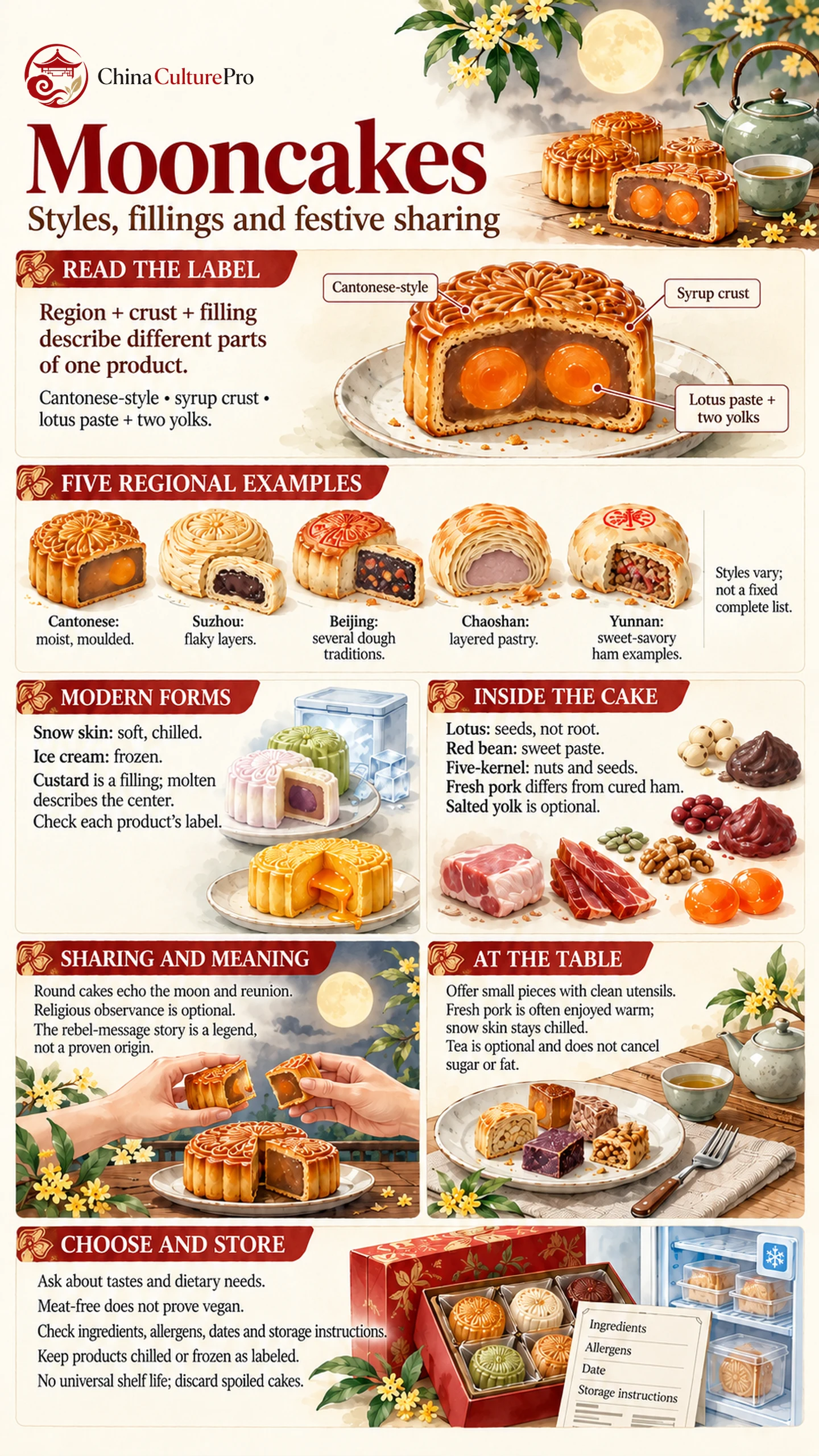
Two boxes of mooncakes (月饼, yuèbǐng) can contain very different pastries: glossy and dense, delicately flaky, or soft and chilled. This guide explains their styles, fillings and labels, alongside the sharing customs associated with the Mid-Autumn Festival (中秋节, Zhōngqiū Jié), so you can choose and serve them confidently.
How to Read Mooncake Types: Region, Crust and Filling
Start with the crust and filling, then place them within a regional tradition. Crust describes the outer layer; filling describes what is enclosed. Neither alone establishes the cake’s regional identity.[1]
For example, “Cantonese-style (广式, Guǎngshì) double-yolk lotus seed paste (莲蓉, liánróng)” identifies a style, a seed-based filling and two yolks. The common baked version has syrup crust, but check the product rather than assuming the name states every ingredient.[2]
A filling can appear in several styles. Equally, a regional bakery can make both sweet and savory mooncakes. Read the complete description instead of treating the first familiar word as the whole answer. The style name is not a substitute for the ingredient label.
Traditional Regional Mooncake Styles at a Glance
These five examples show useful differences, rather than an official, exhaustive division. Crust thickness, shape and sweetness vary within each tradition, and contemporary products may combine features.
| Regional style | Typical crust or appearance | Representative fillings | Identification limit |
|---|---|---|---|
| Cantonese-style, associated with Guangdong | A thin, moist baked exterior, often glossy and moulded with patterns | Lotus seed or bean paste; optional salted yolks | A yolk is not compulsory, and not every product uses the same skin-to-filling ratio.[2] |
| Suzhou-style (苏式, Sūshì), in Jiangsu and neighboring areas | Flaky pastry with visible, crumbly layers | Fresh pork (鲜肉, xiānròu), bean paste and mixed sweet fillings | Meat-filled cakes are one branch, not the whole style.[3] |
| Beijing-style (京式, Jīngshì), in the Beijing area | Several dough traditions; some use sesame oil | Nuts, candied ingredients and sweet pastes | Zilaihong (自来红, zìláihóng) and zilaibai (自来白, zìláibái) are distinct named forms, not interchangeable labels for every Beijing mooncake.[4] |
| Chaoshan-style (潮式, Cháoshì), in eastern Guangdong | Layered pastry; some versions show a spiral | Taro or bean pastes | A colorful taro spiral is an example, not the definition of every Chaoshan cake.[1] |
| Yunnan-style (滇式, Diānshì), in Yunnan | Often a substantial baked pastry enclosing a sweet-savory filling | Cured ham with sugar or honey | Xuanwei ham is a documented example; the regional label alone does not guarantee that provenance.[5] |
Use the table to narrow a preference: moist, flaky, or more substantial. Then check the actual filling. Regional style is a useful starting point, rather than a complete ingredient list or a guarantee of one particular texture. A layered exterior does not by itself prove Suzhou origin: flaky pastry appears in more than one regional tradition. Likewise, decorative moulding cannot tell you which paste is inside.
Snow Skin, Custard and Other Modern Mooncakes
Snow skin is a soft, chewy exterior commonly served chilled. The finished cake is not baked like a conventional golden pastry; this does not mean every component is raw. It also is not the same as an ice-cream mooncake, which needs frozen storage.[6]
Custard (奶黄, nǎihuáng) names a filling. Molten (流心, liúxīn), sometimes called “lava,” describes a flowing center. Neither word identifies one universal crust or storage condition. Follow the package for the particular product, rather than refrigerating every molten cake by assumption.
Modern ranges also include chocolate, tea-flavored and ice-cream variations. These expand the category rather than replacing regional traditions.[1] In Singapore, durian and other locally familiar flavors are among the available choices.[7] A pale or pastel exterior tells you little about sweetness, ingredients or dietary suitability. Rice-based appearance is not proof of a gluten-free product either: check all ingredients and relevant allergen labeling.
Common Mooncake Fillings and What They Taste Like
Choose the filling after deciding which exterior you enjoy. The descriptions below are tasting guides: sweetness, texture and the proportion of each ingredient vary by product. Lotus paste comes from lotus seeds, not lotus root.[2]
| Filling | What to expect | What to check |
|---|---|---|
| Lotus seed paste | Smooth, dense and sweet; often paired with yolk | White and darker versions vary; neither automatically contains egg.[2] |
| Red bean paste (豆沙, dòushā) | A sweet bean flavor, smooth or slightly textured | Other ingredients can change its richness and consistency.[1] |
| Five-kernel (五仁, wǔrén) | A chewy mixture of nuts and seeds, sometimes with candied ingredients | Read the named ingredients, especially for allergies; the label has more specific meanings in some standards.[8] |
| Salted egg yolk (咸蛋黄, xián dànhuáng) | Usually duck yolk, giving a rich, savory contrast | Often a center or addition to paste, rather than the entire filling.[2] |
| Fresh pork | Savory meat enclosed in pastry | Different from cured-ham filling; commonly enjoyed warm in Suzhou-style cakes.[3] |
| Yunnan ham (云腿, yúntuǐ) | Cured-meat flavor balanced with sweetness | Sugar or honey can be part of the filling; “ham” does not mean purely salty.[5] |
| Jujube paste (枣泥, zǎoní) | A dense, sweet filling made from Chinese dates | Distinct from bean or lotus paste.[1] |
| Taro paste (芋泥, yùní) | A smooth, starchy root-based filling | Color alone does not identify its ingredients.[7] |
The mainland Chinese standard gives the specific name “Cantonese five-kernel” a defined ingredient combination. That should not be confused with every mixed-nut mooncake sold internationally. For an individual purchase, the package’s ingredient list is more useful than a generic English flavor name. A mixed box may contain several recipes, so check the individual wrappers as well as the outer carton.[8]
Why Are Mooncakes Shared at Mid-Autumn?
Mid-Autumn falls on the fifteenth day of the eighth lunar month. Its association with reunion helps explain the appeal of sharing a whole pastry among relatives or friends. Round mooncakes echo the full-moon imagery, although the category includes other shapes.[7]
Sharing can be an ordinary social gesture: opening a box, comparing fillings and offering small pieces around the table. A gift box can carry greetings between households even when people cannot gather. The meaning comes from the relationship and occasion; eating a particular cake does not guarantee good fortune or family harmony.
Religious observance and casual sharing are separate choices. Historical accounts of Chinese Singaporean celebrations describe mooncakes among offerings to the moon, while contemporary gatherings often center on family and friends.[7] Serving mooncakes does not require taking part in a ritual.
The story about rebels hiding messages inside mooncakes near the end of the Yuan dynasty is a popular legend.[7] It should not be presented as a proven invention story, or as evidence that every present-day style began at one moment. There is no need to settle that legend to appreciate the modern custom.
How to Eat and Serve Mooncakes
For a tasting, offer small pieces so guests can compare more than one filling. There is no required number of slices, and sharing does not mean someone eating a cake alone has broken a rule.
Baked paste-filled mooncakes are often served at room temperature when their label permits it. Fresh-pork pastries are commonly enjoyed warm, while snow-skin products should stay chilled until serving. Ice-cream versions belong in the freezer until needed; do not treat them as ordinary baked cakes.[3][6]
Use clean utensils and bring out only what you expect to serve, especially with chilled products. Keep different varieties identifiable if guests need to avoid particular ingredients.[10]
Keep the wrappers nearby and introduce flavors before cutting. Guests can choose what interests them; there is no auspicious serving order to follow.
Tea is an optional accompaniment: its less-sweet taste can contrast with a rich filling. It does not cancel out sugar or fat, and water or another preferred drink is equally acceptable.
Choosing Mooncakes for Yourself or as a Gift
Begin with the recipient’s preferences rather than the most elaborate box. A small assortment can suit people who enjoy comparing flavors; a familiar filling may be better for someone with a clear favorite. Ask whether they enjoy yolk, meat or intensely sweet pastes.
- Ingredients: Read the complete list. A meat-free filling does not establish that the pastry is vegetarian or vegan: lard, egg or milk may appear elsewhere. Check wheat, eggs, milk, nuts and other relevant allergens, including the manufacturer’s cross-contact information.[11]
- Labels: Look for the producer, date marking, storage instructions and intact packaging. “Low sugar” wording does not replace ingredient and nutrition information.[9]
- Delivery: Choose a product you can transport under its stated conditions. Confirm that the recipient can refrigerate or freeze it if required.
A gift should arrive usable, not simply impressive. For a long journey without reliable chilling, choose only a product whose own label allows the conditions you can maintain.
How to Store Mooncakes Safely
Use the package’s storage instructions and date marking. A filling name cannot establish shelf life, and different products may require different treatment even when they look similar.[6]
- Ambient-storage products: Keep them under the stated conditions, protected from heat, damp and contamination. “Baked” alone does not guarantee room-temperature storage.
- Snow-skin products: Refrigerate promptly and maintain the cold chain. Take out only what you intend to serve.
- Ice-cream mooncakes: Keep frozen as directed. Do not refreeze a thawed product.
- Fresh-meat, custard or molten products: Follow the producer’s specific instructions. Neither a universal three-day rule nor one temperature covers every product.[6]
After opening, observe any separate consumption instructions. Discard a cake showing mould, an abnormal smell or other spoilage.[11] Refrigeration does not extend a printed use-by limit indefinitely. If instructions are missing or unclear, ask the seller before storing the cakes for later.
FAQs About Mooncakes
Are All Mooncakes Sweet?
No. Fresh-pork versions are savory, while cured-ham cakes can combine salty and sweet flavors. The filling name is usually a better clue than the cake’s shape or regional label alone.
Why Do Some Mooncakes Have an Egg Yolk Inside?
Salted duck yolk adds richness and a savory contrast to sweet paste. Its round shape can also recall the moon. It is an optional ingredient, not a requirement for every mooncake.
Are Mooncakes Vegetarian or Vegan?
Some may be, but a bean or lotus filling is not enough evidence. Check the crust, glaze and filling for animal ingredients, and look for labeling appropriate to your dietary requirements.
Do All Mooncakes Need Refrigeration?
No. Follow each product’s instructions: some permit ambient storage, snow skin needs chilling, and ice-cream versions need freezing. A “molten” label describes texture and does not settle the storage question.
Can You Eat Mooncakes Outside Mid-Autumn Festival?
Yes. Mid-Autumn is their principal festive setting, rather than a restriction on eating them. Availability varies by location and producer; there is no need to wait for the festival to enjoy one.
Sources
[1] Agriculture & Livestock Industries Corporation. Chinese fillings and mooncakes
[2] China Intangible Cultural Heritage. Cantonese mooncake-making techniques
[3] Suzhou Municipal Government. Local mooncake varieties and fresh-pork pastries
[4] Beijing Municipal Government. Beijing-style mooncake craft
[5] Yunnan Intangible Cultural Heritage. Xuanwei ham mooncake-making
[6] Singapore Food Agency. Safety of Mooncakes
[7] Singapore Chinese Cultural Centre, Culturepaedia. Mid-Autumn Festival
[8] Beijing Administration for Market Regulation. Five-kernel mooncakes and the national standard
[9] Beijing Administration for Market Regulation. Mooncake labels and consumer guidance
[10] Hong Kong Centre for Food Safety. Mooncakes and Food Safety
[11] Yongren County Government. Yunnan mooncake purchasing guidance