

Quick Answer: What Are Popular Chinese New Year Songs?
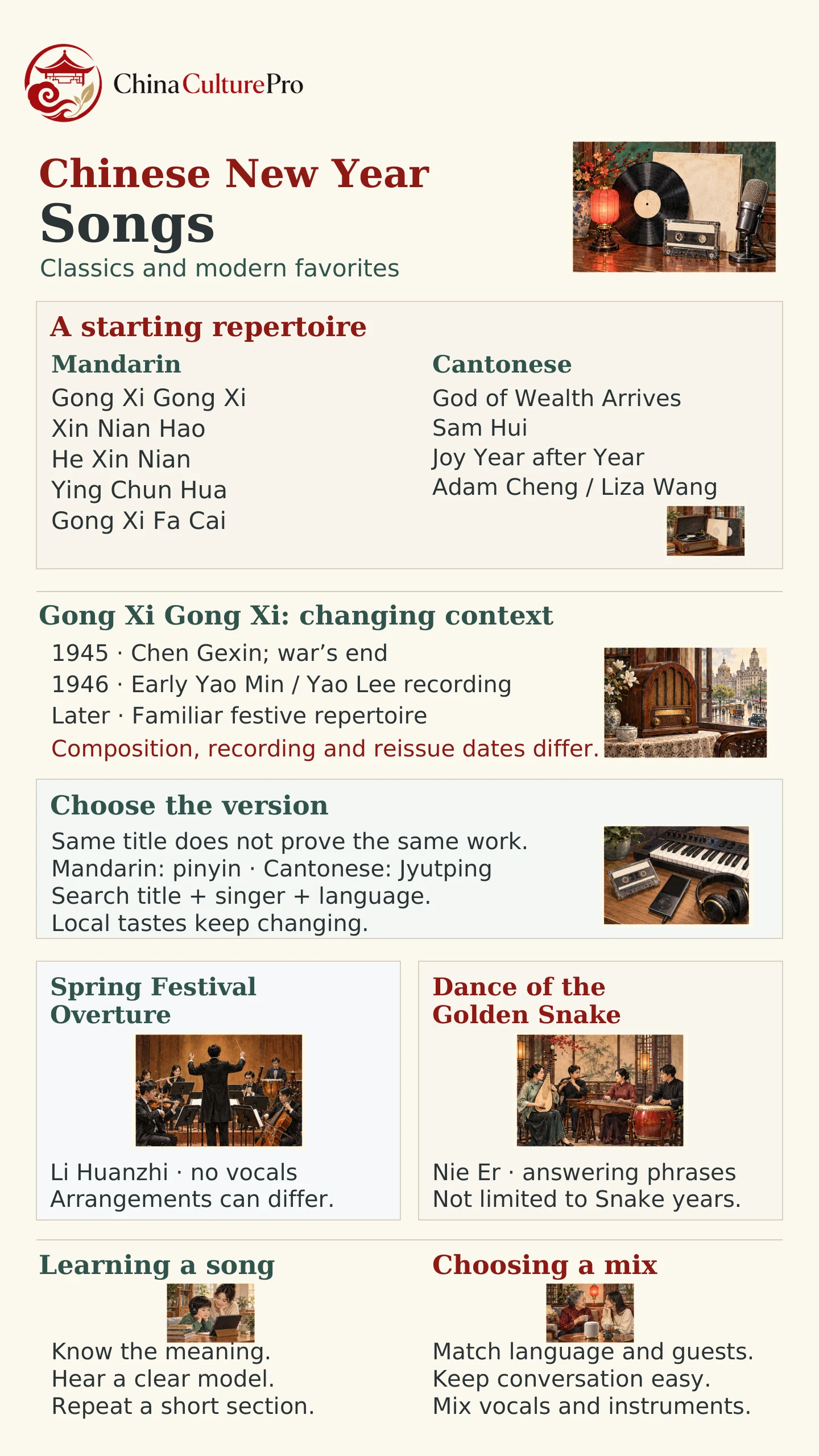
Chinese New Year music includes classic songs, pop recordings and instrumental works. Start with three groups:
- Mandarin classics: Gong Xi Gong Xi (恭喜恭喜, Gōngxǐ Gōngxǐ), meaning “Congratulations,” and He Xin Nian (贺新年, Hè Xīnnián), meaning “New Year’s Greetings.”
- Pop and language versions: Andy Lau’s Gong Xi Fa Cai (恭喜发财, Gōngxǐ Fācái), “Wishing You Prosperity,” and Sam Hui’s Here Comes the God of Wealth (财神到, Mandarin title: Cáishén Dào; Cantonese Jyutping: coi4 san4 dou3).[3][4]
- Instrumental music: Spring Festival Overture (春节序曲, Chūnjié Xùqǔ) offers a familiar festive orchestral sound.[6]
These are starting points, not an official popularity ranking or a compulsory playlist.
A festive melody heard in a Singapore shopping centre or at a family gathering may be instantly familiar without its title being clear. This guide helps you identify songs, understand their themes and choose recordings within the wider Chinese New Year season.
Chinese New Year Songs at a Glance
Use the title, language and performer together to identify a recording. The Mandarin pinyin below helps readers recognize written titles. The separately marked Jyutping gives Cantonese pronunciation; it is not interchangeable with pinyin.
The English descriptions explain titles and themes rather than translating complete lyrics. A named recording provides a useful search target without implying that every performance sounds the same.
| Song and title pronunciation | Language | Recording to identify | English meaning and theme |
|---|---|---|---|
| Gong Xi Gong Xi | Mandarin | Early Yao Min and Yao Lee recording | “Congratulations”; distinguish the recording performers from the composer.[1][2] |
| Xin Nian Hao (新年好, Xīnnián Hǎo) | Mandarin | A children’s recording, such as the Xinshidai Xiaoxingxing ensemble version | “Happy New Year”; a short greeting song. Identify the actual recording rather than assuming a unique original singer.[5] |
| He Xin Nian | Mandarin | Zhang Fan’s early recording | “New Year’s Greetings”; a seasonal greeting and celebration song.[1] |
| Ying Chun Hua (迎春花, Yíngchūnhuā) | Mandarin | Chang Loo, also known as Zhang Lu | “Spring Flowers”; specify the performer to distinguish it from Cantonese material with the same Chinese title.[1] |
| Gong Xi Fa Cai | Mandarin | Andy Lau’s 2005 Spring Festival Gala performance | “Wishing You Prosperity”; an energetic pop celebration built around New Year wishes.[3] |
| Here Comes the God of Wealth | Cantonese; Jyutping: coi4 san4 dou3 | Sam Hui; the recording catalogue dates the song to 1978 | A festive welcome to the God of Wealth. The title expresses a cultural wish, not a promise of financial results.[4] |
| Joy Year after Year (欢乐年年, Mandarin title: Huānlè Niánnián) | Cantonese; Jyutping: fun1 lok6 nin4 nin4 | Adam Cheng and Liza Wang duet | A wish for recurring happiness.[1] |
A compilation’s publication date can be much later than the music it contains. Check the recording credit and edition before treating an album date as evidence of a song’s beginning.
Why Was Gong Xi Gong Xi Not Originally a New Year Song?
Gong Xi Gong Xi was composed by Chen Gexin (陈歌辛, Chén Gēxīn) in the context of the end of the Second Sino-Japanese War in 1945. Its original setting was the relief and hope associated with the war’s end, rather than an ancient New Year ceremony. References to winter giving way to spring could express renewal after hardship.[2]
That imagery, together with its repeated congratulations, also suited New Year celebrations. Over time, the song became closely associated with the festive season.[2] The early recording by Yao Min and Yao Lee is dated 1946 in a cultural history of the repertoire.[1]
Keep composition, recording and reissue dates separate. A recent streaming upload does not establish when the work was written or first recorded.
Knowing this background changes how the song is understood: a familiar holiday standard can carry memories beyond the occasion on which it is now heard. That does not mean every New Year song shares the same origin.
Mandarin, Cantonese and Local Versions: What Changes?
Chang Loo’s Mandarin Ying Chun Hua and the Cantonese recordings by Adam Cheng and Liza Wang share a Chinese title. Check performer and language before identifying the work.[1]
Likewise, a translated title, a cover, a new arrangement and a reissue describe different things. A cover gives another performance of a work; an arrangement changes its musical treatment. A reissue makes an existing recording available again. A language adaptation may also change the words, so it needs more checking than a matching title alone.
Hong Kong, Singapore and Malaysia have developed their own festive listening preferences. In Singapore and Malaysia, recordings circulated through records and cassettes, while later releases brought electronic arrangements, rap and local expressions into the seasonal repertoire.[1]
For a practical search, combine the Chinese title with the performer and “Mandarin” or “Cantonese.” Compare the result with the recording you remember before saving it. A singer from Hong Kong may record in either language, and traditional Chinese characters alone do not identify Cantonese. When singing, follow the language of the chosen recording rather than reading a Cantonese title through Mandarin pinyin.
Instrumental Chinese New Year Music: Two Familiar Pieces
These works offer a different listening experience from vocal greeting songs. Choose the piece and the performing version separately: an orchestra’s arrangement can change the instrumental colours without changing the work’s identity.
Spring Festival Overture
Spring Festival Overture is an orchestral work by Li Huanzhi (李焕之, Lǐ Huànzhī), drawing on northern Shaanxi yangge musical material. It is the opening movement of his Spring Festival Suite and is frequently performed on its own.[6]
It has no sung text to learn. Listen for the contrast between passages and the changing instrumental colours rather than looking for a chorus. A Chinese-orchestra performance and a symphony-orchestra performance need not use the same instruments. For example, a Singapore Chinese Orchestra programme credits Li Huanzhi as composer and Sim Boon Yew as adaptor.[7]
Dance of the Golden Snake
Dance of the Golden Snake (金蛇狂舞, Jīnshé Kuángwǔ) is associated with Nie Er (聂耳, Niè Ěr), who reworked folk instrumental material. Its musical construction includes exchanges between contrasting phrases and increasingly compressed rhythmic patterns.[8]
Listen for the answering phrases and growing momentum. Those features offer an accessible way to follow the piece without understanding Chinese. The title does not restrict it to a Snake-year playlist, and its use of folk material does not make every modern orchestral version an unchanged ancient performance.
Which Chinese New Year Songs Are Easy for Children to Learn?
Xin Nian Hao and an educational performance of Gong Xi Gong Xi are useful starting choices. Choose a recording with clear vocals and a manageable pace; those qualities depend on the performance, not simply the title.
A specific children’s recording of Xin Nian Hao provides one identifiable example. For guided learning, Qian Yi’s Gong Xi Gong Xi lesson includes demonstration and audio.[5][2]
Begin with the title’s meaning, listen to a short section, then repeat it with the recording. Children can participate by listening or following the rhythm before singing every word. Keep one version throughout a short learning session so changes in arrangement do not become another obstacle.
How to Choose Music for Your Celebration
Choose for the people and setting rather than trying to assemble a universal “correct” selection:
- Family gathering: Ask which language and recordings guests enjoy. Keep the volume comfortable for conversation; a familiar voice may matter more to the household than the age of the song.
- Children or language learning: Preview a clear educational performance. Avoid choosing a fast remix merely because the title matches a classroom suggestion.
- Background listening: Alternate vocal tracks with instrumental works if that suits the occasion. An instrumental performance can still be loud or energetic, so preview the actual recording.
For example, pair Gong Xi Gong Xi with Spring Festival Overture for a Mandarin-focused introduction, or Joy Year after Year with Dance of the Golden Snake for a Cantonese-focused gathering. These are editorial combinations, not customary requirements. Use the linked educational resources, broadcaster archives and official recording pages to identify versions before building your own mix.
FAQs About Chinese New Year Songs
What Is the Most Famous Chinese New Year Song?
There is no single ranking established here. Gong Xi Gong Xi and Andy Lau’s Gong Xi Fa Cai are familiar examples; Cantonese listeners may also recognize Sam Hui’s Here Comes the God of Wealth.
Are Gong Xi Gong Xi and Gong Xi Fa Cai the Same Song?
No. They are separate songs with different musical identities. Their similar congratulatory wording can make them easy to confuse when searching by English translations alone; use the title and performer together.[2][3]
Are Chinese New Year Songs Ancient Folk Music?
Some festive music draws on folk material, but many familiar songs have named modern composers or identifiable commercial recordings. A long-standing seasonal association does not establish an ancient, anonymous origin.
Do All Chinese Communities Listen to the Same New Year Songs?
No. Language, regional circulation, generation and household memories influence the selection. A recording familiar at one family gathering may be unfamiliar at another; there is no required repertoire shared by everyone.
Can You Learn a Chinese New Year Song Without Speaking Chinese?
Yes. Start with its meaning and a clear recording, then imitate short passages. Use pronunciation guidance for that recording’s language; Mandarin pinyin cannot stand in for Cantonese singing pronunciation.
Sources
[1] Singapore Chinese Cultural Centre, Culturepaedia. Chinese New Year songs
[2] Carnegie Hall. Lesson 2: Learning “Gong Xi, Gong Xi”
[3] CCTV. 2005年春晚_歌曲《恭喜发财》表演:刘德华
[4] Apple Music. 財神到 — Sam Hui
[5] Apple Music. 新年好 — 新时代小星星组合
[6] National Centre for the Performing Arts. 国乐情怀——民族管弦乐新春音乐会(上)
[7] Singapore Chinese Orchestra. Rhapsodies of Spring 2026
[8] ChinaCulture.org. Contemporary Composer: Nie Er