

Quick Answer: What Are the 24 Solar Terms?
The 24 Solar Terms (二十四节气, èrshísì jiéqì) are seasonal markers based on the Sun’s apparent annual motion. They supply the solar framework within China’s traditional lunisolar calendar.
- Astronomy: Each marker corresponds to another 15° of solar longitude, producing 24 points around the year.
- Calendar: Their timing follows the Sun rather than lunar phases, so Gregorian dates remain relatively stable.
- Culture: Their names preserve agricultural and seasonal observations, while associated customs differ between communities.
They are not 24 compulsory festivals or a forecast of local weather. Astronomical timing, seasonal descriptions and celebrations are related but distinct.[1]
Why does a Chinese calendar mark autumn while Shanghai still feels like summer, or announce snow where none falls? This guide separates astronomical dates from seasonal names and local customs, alongside the wider Chinese lunar calendar.
How Do the 24 Solar Terms Work?
Imagine the Sun’s apparent yearly path through the sky as a circle, called the ecliptic. Longitude measures position around that circle. Modern calculations place successive terms 15° apart: the March equinox is 0°, the June solstice 90°, the September equinox 180° and the December solstice 270°. These are angular positions, not geographic longitudes on Earth.[1]
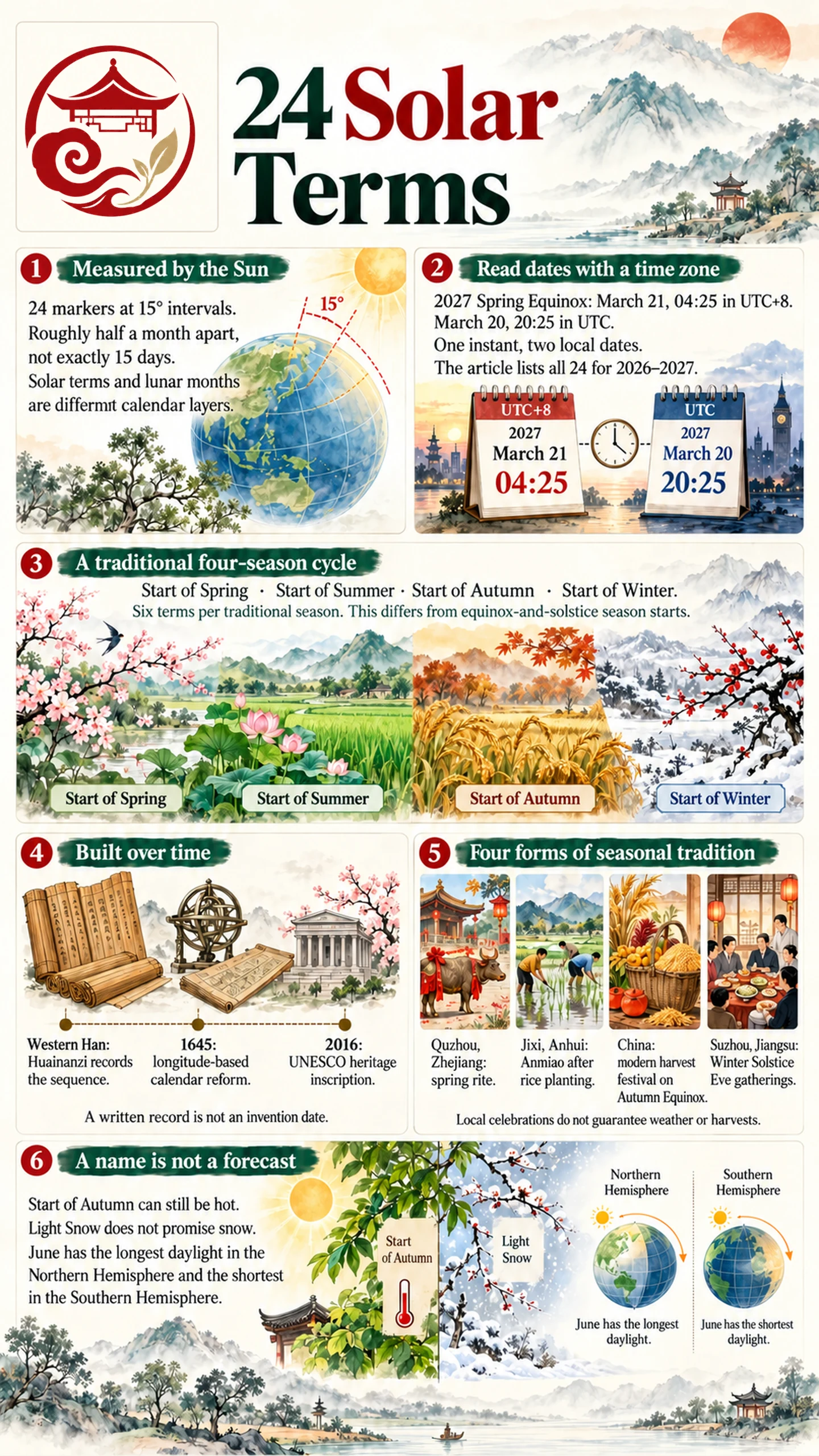
A term begins at a specific instant. Everyday speech also uses its name for the interval until the next term. Because Earth’s orbital speed varies, those intervals are roughly half a month, not exactly 15 days. The calendar describes equal angles rather than equal stretches of time.[6]
Gregorian dates remain close because that calendar also tracks the solar year. Lunar months track a different cycle, so a term can move between lunar dates without losing its place in the seasonal year.
The set alternates between 12 jie (节, jié), often called minor terms, and 12 zhongqi (中气, zhōngqì), or principal terms. “Minor” does not mean culturally unimportant. Principal terms help keep lunar months aligned with seasons; solar markers do not themselves begin each lunar month.[1]
Time zones explain some apparently conflicting dates. In 2027, Spring Equinox (春分, chūnfēn) occurs at 04:25 on March 21 in UTC+8, equivalent to 20:25 on March 20 in UTC. That is one astronomical event, not two different equinoxes. Always check the year and time zone before comparing calendars.[4]
The 24 Solar Terms: Names, Longitudes and Dates for 2026–2027
All dates below are Gregorian dates in Hong Kong Time, UTC+8. The longitudes identify the same 24 astronomical positions each year; the dates do not form a permanent calendar. English names have alternative translations, so Chinese characters and pinyin help identify the term.[1][2][3]
| Term, Chinese, pinyin and solar longitude | 2026, UTC+8 | 2027, UTC+8 | Traditional seasonal association |
|---|---|---|---|
| Minor Cold — 小寒, xiǎohán — 285° | Jan 5 | Jan 5 | Deepening winter cold |
| Major Cold — 大寒, dàhán — 300° | Jan 20 | Jan 20 | Severe winter cold |
| Start of Spring — 立春, lìchūn — 315° | Feb 4 | Feb 4 | Traditional spring begins |
| Rain Water — 雨水, yǔshuǐ — 330° | Feb 18 | Feb 19 | Increasing spring precipitation |
| Awakening of Insects — 惊蛰, jīngzhé — 345° | Mar 5 | Mar 6 | Stirring life and spring thunder |
| Spring Equinox — 春分, chūnfēn — 0° | Mar 20 | Mar 21 | Day and night approximately equal |
| Clear and Bright — 清明, qīngmíng — 15° | Apr 5 | Apr 5 | Brightening spring landscapes |
| Grain Rain — 谷雨, gǔyǔ — 30° | Apr 20 | Apr 20 | Rain supporting crop growth |
| Start of Summer — 立夏, lìxià — 45° | May 5 | May 6 | Traditional summer begins |
| Grain Buds — 小满, xiǎomǎn — 60° | May 21 | May 21 | Grain filling before full ripeness |
| Grain in Ear — 芒种, mángzhòng — 75° | Jun 5 | Jun 6 | Awned crops and busy fieldwork |
| Summer Solstice — 夏至, xiàzhì — 90° | Jun 21 | Jun 21 | Northern Hemisphere’s longest daylight |
| Minor Heat — 小暑, xiǎoshǔ — 105° | Jul 7 | Jul 7 | Developing summer heat |
| Major Heat — 大暑, dàshǔ — 120° | Jul 23 | Jul 23 | Intense midsummer heat |
| Start of Autumn — 立秋, lìqiū — 135° | Aug 7 | Aug 8 | Traditional autumn begins |
| End of Heat — 处暑, chǔshǔ — 150° | Aug 23 | Aug 23 | Heat’s traditional seasonal retreat |
| White Dew — 白露, báilù — 165° | Sep 7 | Sep 8 | Dew and cooling nights |
| Autumn Equinox — 秋分, qiūfēn — 180° | Sep 23 | Sep 23 | Day and night approximately equal |
| Cold Dew — 寒露, hánlù — 195° | Oct 8 | Oct 8 | Colder autumn conditions |
| Frost’s Descent — 霜降, shuāngjiàng — 210° | Oct 23 | Oct 23 | Increasing likelihood of frost |
| Start of Winter — 立冬, lìdōng — 225° | Nov 7 | Nov 7 | Traditional winter begins |
| Light Snow — 小雪, xiǎoxuě — 240° | Nov 22 | Nov 22 | Early-winter snow associations |
| Heavy Snow — 大雪, dàxuě — 255° | Dec 7 | Dec 7 | Deepening winter snow associations |
| Winter Solstice — 冬至, dōngzhì — 270° | Dec 22 | Dec 22 | Northern Hemisphere’s shortest daylight |
In Grain in Ear, “ear” means a crop’s seed-bearing head, not a body part. Grain Buds refers to grain filling before maturity. English translations using “Lesser” instead of “Minor,” or “Greater” instead of “Major,” do not identify additional terms.[7]
This table follows January–December so every date belongs to its column’s year. The traditional cycle commonly starts with Start of Spring and ends with Major Cold. Read from February through December, then return to January, to follow that order.
The traditional four seasons each contain six terms, beginning with Start of Spring, Start of Summer, Start of Autumn and Start of Winter. That convention differs from starting astronomical seasons at equinoxes and solstices. Neither convention guarantees a change in local weather on its opening day.[6]
How Did the 24 Solar Terms Develop?
The system grew through generations of observing sunlight, seasonal change and farming conditions. Many names reflect agricultural experience in the middle and lower Yellow River basin. This historical setting explains their imagery without limiting the astronomical markers to that region.[7]
The Western Han text Huainanzi (淮南子, Huáinánzǐ), compiled in the second century BCE, records the full sequence in its Tianwen Xun (天文训, Tiānwén Xùn), or astronomy chapter. This is evidence of an established system, not proof of one inventor or a single day of invention.[5]
Calculation methods also changed. Earlier calendars used pingqi (平气, píngqì), dividing the solar year into equal time intervals. The calendar reform introduced in 1645 adopted dingqi (定气, dìngqì), using the Sun’s actual position. Today’s equal-angle explanation should therefore not be projected unchanged onto every ancient period.[6]
In 2016, the knowledge and associated practices entered UNESCO’s Representative List of the Intangible Cultural Heritage of Humanity. The inscription recognizes a living tradition; it is not the date the system began.[8]
Seasonal Traditions: Four Examples
Four examples distinguish community rites, farming celebrations, modern observances and family traditions. They do not form a nationwide schedule.
- Jiuhua, Quzhou, Zhejiang — welcoming spring: The local Start of Spring rite includes ceremonies associated with the spring deity and a symbolic spring ox. Its agricultural wishes concern favorable weather and abundant crops. The rite belongs to Jiuhua in Quzhou’s Kecheng District and is a documented local heritage practice.[9]
- Jixi, Anhui — Anmiao: Anmiao (安苗, ānmiáo) celebrates the establishment of rice seedlings after planting. Local descriptions connect it with the period after Grain in Ear, once village planting is complete. Its date follows local arrangements and agricultural progress rather than necessarily matching the astronomical instant.[10]
- China — a modern harvest observance: The Chinese Farmers’ Harvest Festival (中国农民丰收节, Zhōngguó Nóngmín Fēngshōu Jié) was established in 2018 and falls on Autumn Equinox. Its nationwide designation is modern; it should not be presented as an unchanged ancient festival.[11]
- Suzhou, Jiangsu — Winter Solstice Eve: Some families gather on the evening before Winter Solstice. A 2024 community gathering brought together cross-strait families on that preceding evening, illustrating a continuing local tradition. This timing does not bind every household; the wider Dongzhi Festival includes other regional practices.[12]
Ritual wishes express cultural hopes. They do not control rainfall or guarantee a harvest.
Do Solar Term Names Match the Weather Everywhere?
No. Astronomy fixes the markers, while weather depends on location, elevation and the particular year. Historical seasonal observations can help explain a name without predicting conditions everywhere. Their Yellow River background is a reference point, not a border beyond which the system becomes meaningless.[7]
Shanghai and other parts of the lower Yangtze region can remain very hot after Start of Autumn. End of Heat is likewise not a promise of immediate cooling. In Guangdong’s lowlands, Light Snow may arrive without snow at all; higher elevations and other regional conditions complicate any simple north–south division. Frost’s Descent does not require every location’s air temperature to reach freezing that day.
The solstice descriptions also need a hemisphere. June brings the longest daylight in the Northern Hemisphere but the shortest in the Southern Hemisphere; December reverses that relationship. The astronomical event is shared globally, while the seasonal experience differs. Consult local forecasts for actual conditions rather than treating a traditional name as a weather bulletin.[1]
FAQs About the 24 Solar Terms
Are the 24 Solar Terms Based on the Moon?
No. They follow the Sun’s position, independently of lunar phases. The traditional Chinese calendar combines these solar markers with lunar months, which is why “lunisolar” describes it more accurately than “lunar” alone.
Do Solar Terms Fall on the Same Dates Every Year?
Their Gregorian dates stay close, but are not permanently fixed. Check the relevant year and time zone: even one astronomical instant can appear on different calendar dates in different places.
Is Lichun the Same as Chinese New Year?
No. Lichun is Start of Spring, a solar marker. Chinese New Year, or Spring Festival (春节, Chūnjié), begins on the first day of the first lunar month within the lunisolar calendar. The two dates need not coincide: in 2027, Start of Spring falls on February 4, while Chinese New Year falls on February 6.[3]
Are All 24 Solar Terms Festivals?
No. Some, including Qingming and Winter Solstice, also have substantial festival traditions. Others have localized observances or little special celebration in a particular household. There is no universal 24-festival program.
Sources
[1] Hong Kong Observatory. The 24 Solar Terms
[2] Hong Kong Observatory. Gregorian–Lunar Calendar Conversion Table of 2026
[3] Hong Kong Observatory. Gregorian–Lunar Calendar Conversion Table of 2027
[4] Hong Kong Observatory. 24 Solar Terms in 2027
[5] Institute for the History of Natural Sciences, Chinese Academy of Sciences. The Completion and Standardization of the Twenty-Four Solar Terms
[6] China Weather. Division and Calculation of the Twenty-Four Solar Terms
[7] China Agricultural Museum. Introduction to the Twenty-Four Solar Terms
[9] China Intangible Cultural Heritage Network. Twenty-Four Solar Terms: Jiuhua Start of Spring Rite
[10] Xuancheng Municipal Government. Anmiao Festival
[11] State Council. Approval for Establishing the Chinese Farmers’ Harvest Festival
[12] Suzhou Municipal Government. Taiwan Compatriots and Their Families Celebrate Winter Solstice