

Quick Answer: What Is the Chinese Farmers’ Harvest Festival?
The Chinese Farmers’ Harvest Festival (中国农民丰收节, Zhōngguó Nóngmín Fēngshōu Jié) was established in 2018 as China’s first national festival specifically for farmers, celebrating their work and agricultural harvests.[1][2]
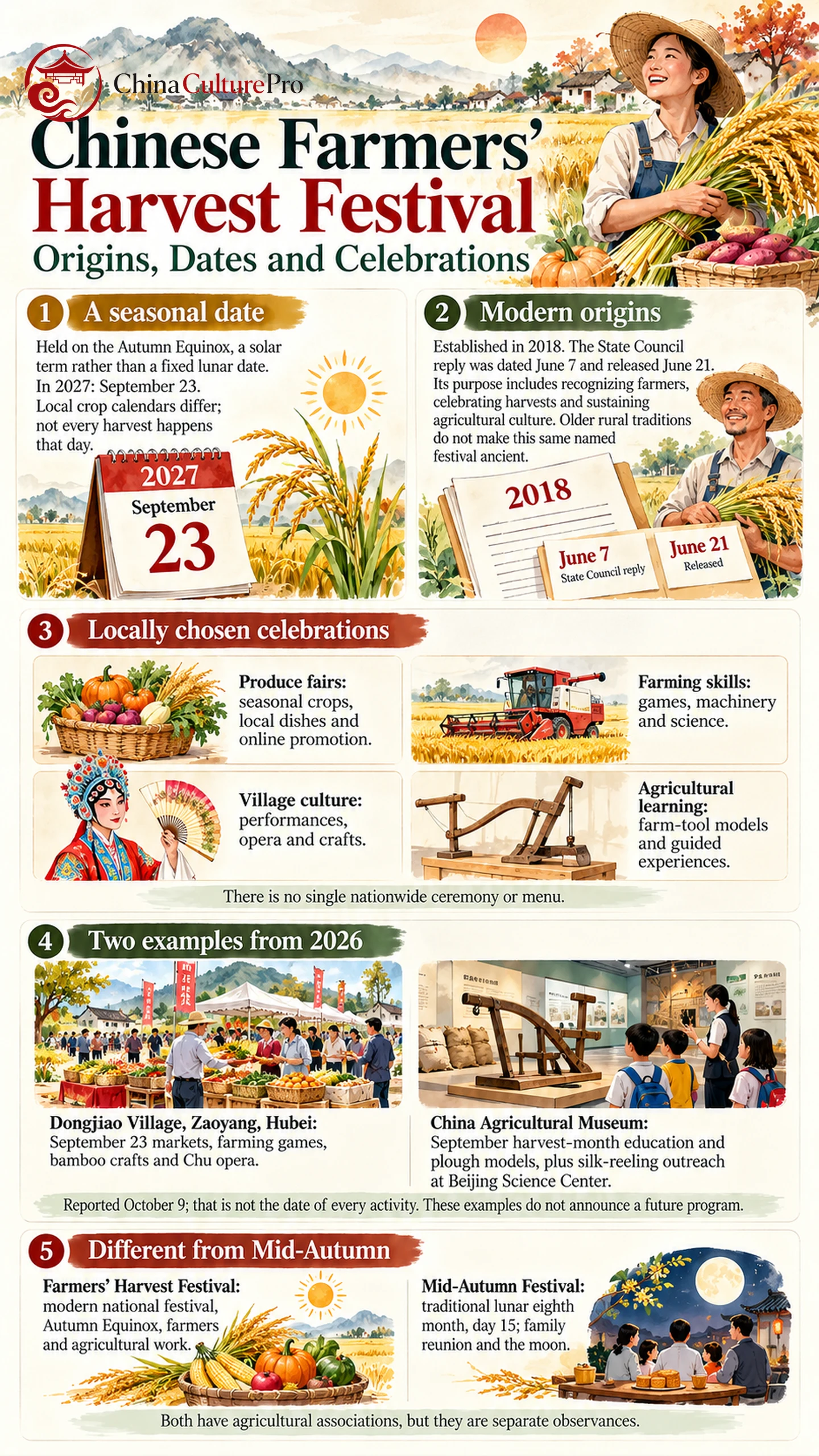
- Date: It falls on the Autumn Equinox (秋分, Qiūfēn), a solar term rather than a fixed lunar-calendar day.
- Purpose: It celebrates agricultural work and harvests, highlights rural culture, and places farmers at the center.
- Activities: Local programs can feature produce fairs, farming games, technology displays, performances and educational experiences.
There is no nationwide required ceremony or festival menu. Official recognition also does not make it a nationwide statutory day off.[7]
Produce markets, farm machinery demonstrations and village performances give the Chinese Farmers’ Harvest Festival (中国农民丰收节, Zhōngguó Nóngmín Fēngshōu Jié) an agricultural character. Yet this named national celebration began in 2018. Its place among Chinese festivals and holidays shows how longstanding rural culture can inform a modern festival.
When Is the Festival, and Why the Autumn Equinox?
The festival takes place on the Autumn Equinox each year. In 2027, it falls on September 23 in the Chinese calendar. That Gregorian date can vary between years, so September 23 should not be treated as permanently fixed.[3]
The equinox is one of the 24 solar terms, determined by the Sun’s position. The traditional Chinese calendar combines lunar months with solar terms; this festival follows the solar term rather than a numbered day of a lunar month.
Autumn offered a shared seasonal reference point across different farming regions. The original explanation for choosing the equinox emphasized autumn harvests, the variety of production calendars across northern and southern China, and opportunities to show agricultural achievements. It did not require every crop to ripen together.[2]
A festival date and a local program’s timetable are separate matters. Associated exhibitions or markets may run around the equinox rather than only on that day.
Origins: A Modern Festival with Agricultural Roots
The formal starting point is a State Council reply dated June 7, 2018 and publicly released on June 21. It approved establishing the Chinese Farmers’ Harvest Festival from 2018 onward, with the Ministry of Agriculture and Rural Affairs coordinating implementation with other departments. The first observance fell on September 23, 2018.[1][2]
The stated purpose was to recognize farmers, celebrate agricultural achievements, sustain agricultural culture and support rural development. Farmer participation and locally distinctive activities were part of the organizing principles. This is why the festival can include both traditional crafts and modern farming equipment: its subject includes farmers’ working lives as well as cultural heritage.[4]
China’s agricultural traditions long predate that decision. Seasonal celebrations and local harvest customs provide a cultural background, but they do not establish an ancient nationwide festival with this exact name, date and organization. The modern designation and older heritage should be understood together without collapsing their different histories.
Rural development was a stated goal. The designation itself does not demonstrate that a particular fair increased farmers’ incomes.
How Is the Chinese Farmers’ Harvest Festival Celebrated?
Celebrations are locally organized rather than governed by one inherited ritual sequence. A farming community, a produce market and a museum can interpret the same occasion differently. Farmers may present their products, skills and cultural activities, while other participants learn about the work behind the harvest.[4]
| Activity type | What it can include | How to understand it |
|---|---|---|
| Produce fairs and local food | Seasonal produce displays, sales, regional dishes and online promotion | The products reflect local farming and food culture, not a national festival menu. |
| Farming skills and technology | Grain-carrying contests, machinery demonstrations and agricultural science | Selected activities can connect agricultural work with recreation or public education. |
| Village arts and crafts | Community performances, local opera and traditional craft displays | The forms vary with the host community and region. |
| Agricultural learning | Farm-tool models, seasonal-calendar education and guided experiences | Participation takes place at designated venues; a festival does not make every field open to visitors. |
Produce promotion is a contemporary part of the occasion. For example, the 2026 autumn consumption campaign launched in Shanghai linked produce markets with cultural experiences and agricultural product promotion. This extends the celebration beyond a single village or stage performance.[8]
Recognizing these different formats helps explain what appears in festival coverage. A grain-carrying competition at one venue is a local program choice, not an ancient obligation that households across China must follow.
Contemporary Celebrations: Two Examples from 2026
At Dongjiao Village in Zaoyang, Hubei, the national main event took place on September 23, 2026. The program brought together a harvest market, local-food tastings, village performances and agricultural science activities. Grain-carrying contests and tug-of-war in rice paddies appeared alongside bamboo crafts and Chu opera.[5]
These activities joined work, recreation and local culture in one setting. Their connection to the harvest was expressed through produce, skills and rural life. They illustrate that year’s program rather than a permanent nationwide ceremony.
A different setting was the China Agricultural Museum’s harvest-month program in September 2026. Activities included seasonal-calendar education and making models of a curved-beam plough. Museum outreach at the Beijing Science Center also included silk-reeling experiences and demonstrations of water filtering through soil. The report appeared on October 9; that publication date should not be mistaken for the date of every activity.[6]
The museum example shows how urban audiences can encounter agricultural culture through education. Together, the two cases demonstrate different settings for participation, not an exhaustive division of all celebrations into just two types. Neither report announces the following year’s host or timetable.
Farmers’ Harvest Festival vs Mid-Autumn Festival
The Farmers’ Harvest Festival and Mid-Autumn Festival (中秋节, Zhōngqiū Jié) are separate observances. Both have associations with the agricultural year, but their calendar rules and main emphases differ.
| Festival | Date and historical identity | Main emphasis |
|---|---|---|
| Chinese Farmers’ Harvest Festival | Established nationally in 2018; held on the Autumn Equinox | Farmers, agricultural work, harvests and rural culture |
| Mid-Autumn Festival | A traditional festival on the fifteenth day of the eighth lunar month | Family reunion, the moon and associated local customs |
The two can occur close together without falling on the same date. The Mid-Autumn Festival guide explains its moon-viewing and family traditions; those customs should not be used as a checklist for the modern farmers’ festival.
FAQs About the Chinese Farmers’ Harvest Festival
Is the Chinese Farmers’ Harvest Festival a public holiday?
No. It is not included among mainland China’s nationwide statutory holidays under the current holiday regulations. Establishing a national festival and granting a nationwide day off are separate decisions; the festival itself does not create an additional holiday.[7]
Can people who are not farmers take part?
Yes, where events are open to the public. Produce fairs, performances and educational activities may welcome wider audiences, while farmers remain central. Check the organizer’s conditions; an advertised celebration does not grant unrestricted access to working farmland.
Is there a traditional food everyone eats?
No nationwide dish is required. Local produce and regional cooking vary between events. Mooncakes are especially associated with Mid-Autumn; they are not a required food for the Farmers’ Harvest Festival, although an event could still offer them.
Are all celebrations held on the equinox itself?
No. The designated festival day is the equinox, but related markets, exhibitions and educational programs can extend before or after it. A previous year’s program does not establish a future schedule; consult the current organizer’s announcement.
Sources
[1] State Council. 国务院关于同意设立“中国农民丰收节”的批复
[2] Ministry of Agriculture and Rural Affairs. 农业农村部部长为“中国农民丰收节”打广告
[3] Hong Kong Observatory. 2027 Gregorian–Lunar Calendar Conversion Table
[4] Ministry of Agriculture and Rural Affairs. 国务院批准设立“中国农民丰收节”
[5] Chinese Farmers’ Harvest Festival official website. 2026年中国农民丰收节主场活动在湖北枣阳举办
[6] Chinese Farmers’ Harvest Festival official website. 中国农业博物馆举办“丰年笑语话农耕” 丰收节主题活动
[7] State Council. 国务院关于修改《全国年节及纪念日放假办法》的决定
[8] Chinese Farmers’ Harvest Festival official website. “丰收开新局 实干促振兴”2026年中国农民丰收节金秋消费季在沪启动