
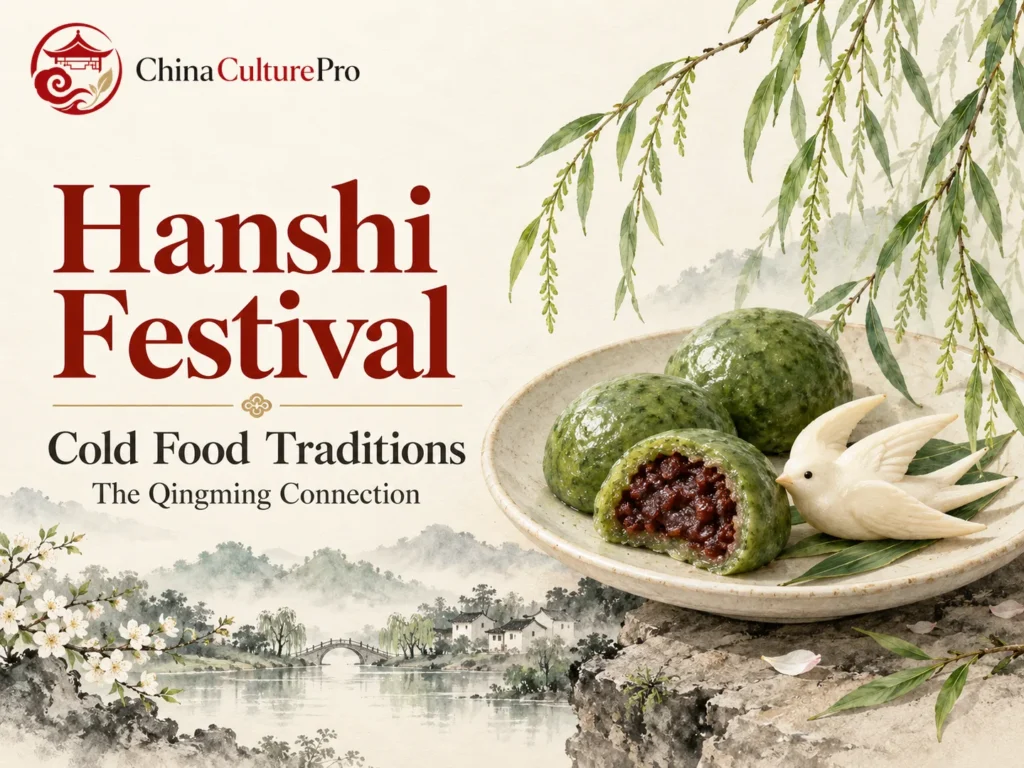

Quick Answer: What Is the Hanshi Festival?
The Hanshi Festival (寒食节, Hánshí Jié), or Cold Food Festival, is a traditional Chinese observance associated with avoiding cooking fires shortly before the Qingming Festival (清明节, Qīngmíng Jié).
- Cold food: Households observing a fire restriction prepared cooked food beforehand and ate it without lighting a fire to reheat it.
- Commemoration: Later tradition linked the observance with Jie Zitui (介子推, Jiè Zǐtuī), remembered for integrity and withdrawal from public life.
- Qingming connection: Neighboring dates and overlapping customs gradually drew the two observances together.
Cold food did not mean raw food. Historical fire restrictions are not a nationwide requirement for present-day households.
Green rice balls and shaped wheat foods appear around Qingming, often alongside stories about a loyal official. Hanshi explains part of that connection: a seasonal custom of eating previously prepared food became intertwined with remembrance. Understanding it also helps separate the history of a festival from the legends later attached to it.
When Is the Hanshi Festival?
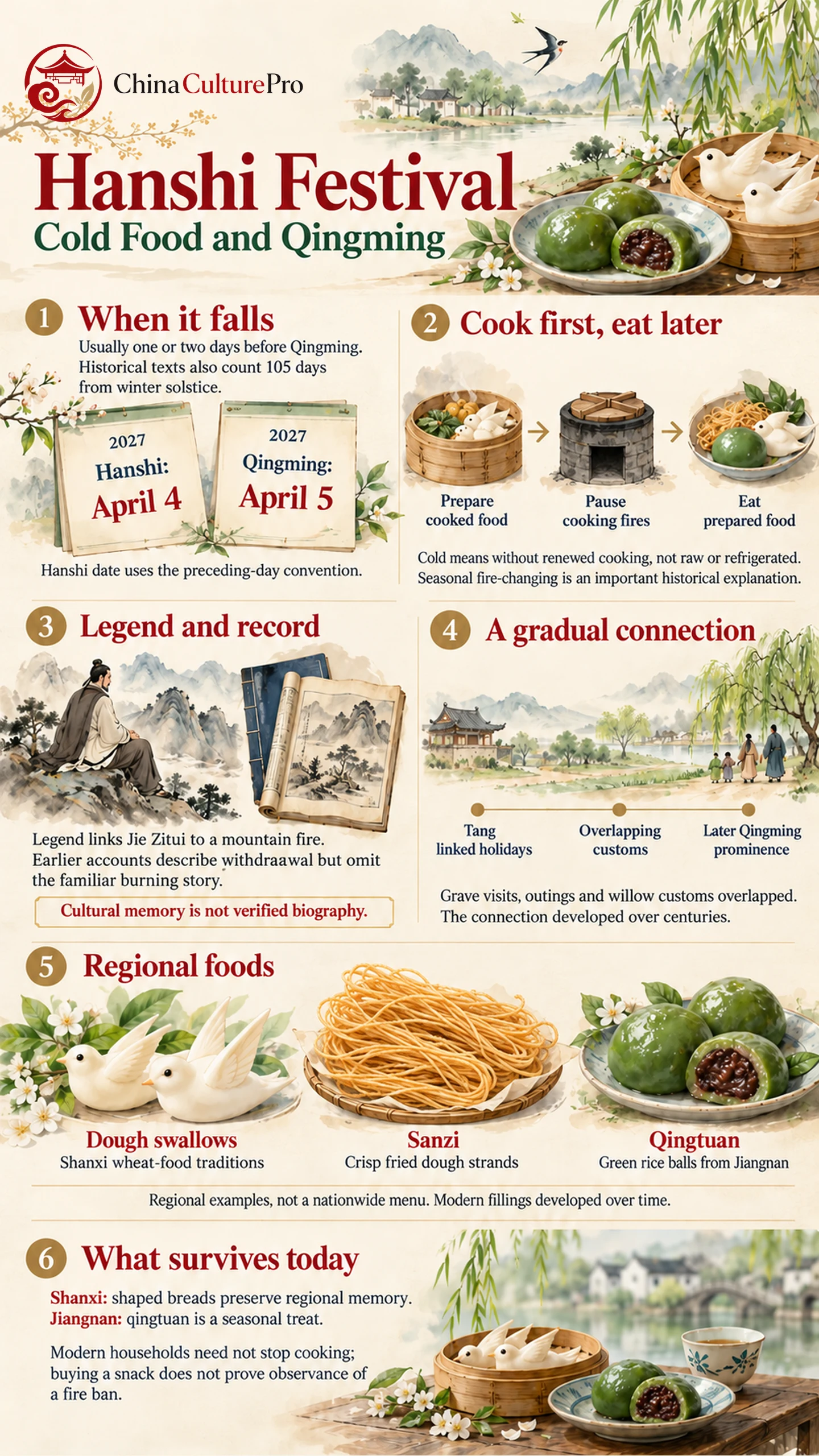
Hanshi is commonly described as falling one or two days before Qingming. Historical texts also use a count of 105 days from the winter solstice, reflected in the name Baiwu Festival (百五节, Bǎiwǔ Jié), or “105th-day festival.” These descriptions belong to different historical and calendrical contexts; they should not be treated as interchangeable calculations.[1]
For 2027, Qingming falls on April 5. Under the convention that places Hanshi on the preceding day, Hanshi therefore falls on April 4, 2027. The April 4 date is a conversion using that convention, rather than a separately designated Hanshi date in the astronomical calendar.[2]
Hanshi has no single fixed lunar month-and-day date that works across these traditions. Its customary date also does not establish the schedule of a local commemoration or cultural event.
Why Did People Avoid Fire and Eat Cold Food?
The food custom followed from the hearth restriction: if a household was not to light a cooking fire, meals had to be prepared beforehand. Rice, porridge, wheat foods and other cooked dishes could then be eaten without fresh cooking. “Cold” described their condition when eaten, rather than an instruction to eat uncooked ingredients or use refrigeration.
An important historical explanation connects Hanshi with seasonal fire restrictions and changing fire (改火, gǎihuǒ): putting aside an old fire and obtaining a new one. Early ritual texts discuss spring fire precautions, while later descriptions connect the interruption of household fires with cold meals. This gives the custom a seasonal setting beyond the familiar memorial legend; it does not establish one uncontested origin for every regional observance.[1][6]
The sixth-century Jingchu Suishiji, a record of seasonal customs, mentions a three-day restriction and barley porridge. This is one historical description, not a timetable followed by every family across all periods.[1]
Jie Zitui: The Legend and the Historical Record
The later legend says that Jie Zitui withdrew to the mountains with his mother, and that a ruler’s attempt to summon him by setting a mountain fire ended in their deaths. A prohibition on fire then became a way to commemorate him. The story supplies a memorable moral explanation for a smoke-free festival.[3]
The earlier record is more restrained. The Zuozhuan describes Jie declining to seek rewards after his lord’s return to power and choosing seclusion with his mother. The familiar flesh-cutting and mountain-burning episodes are absent from its account and from the related Shiji narrative. They should not be presented as though the earliest accounts document the complete popular story.[3]
Jie became an example of integrity, filial commitment and refusal to trade service for status. Those values help explain the story’s appeal without proving that one ruler founded every later Hanshi custom.
Traditional Hanshi Foods and Regional Differences
There is no nationwide Hanshi menu. The examples below belong to regional cold-food and Qingming traditions, rather than a compulsory set of dishes for every household.[4][6]
| Food | Regional setting | What makes it relevant |
|---|---|---|
| Zitui yan (子推燕, zǐtuī yàn), or dough swallows | Parts of Shanxi and northern wheat-food traditions | Shaped, steamed dough birds associated with remembrance; some local customs display them on willow twigs. |
| Fried dough strands, or sanzi (馓子, sǎnzi) | Regional Hanshi and Qingming food traditions | A cooked, crisp wheat snack that can be prepared before the observance and eaten without reheating. |
| Green glutinous rice balls, or qingtuan (青团, qīngtuán) | Jiangnan, including Shanghai and southern Jiangsu | Green rice-flour wrappers with fillings; now especially familiar as seasonal Qingming snacks. |
These foods explain the practical meaning of “cold food”: a steamed dough swallow or fried snack is already cooked. Their different forms reflect local food traditions, not one ancient recipe.[4][6]
Modern filled qingtuan also should not be described as unchanged food from two thousand years ago. Earlier herb-colored rice preparations and today’s filled rice balls belong to a developing food tradition; contemporary savory fillings are later variations.[5]
How Hanshi Became Connected with Qingming
Hanshi and Qingming started with different emphases. Hanshi was associated with restrictions on fire and cold meals; Qingming was a seasonal marker in the solar-term calendar. Their closeness made shared observances possible, but their connection developed over time.[6]
By the Tang dynasty, grave visits during Hanshi had become prominent enough to receive official recognition. Tang leave arrangements also treated Hanshi and Qingming as a connected holiday period. These arrangements show their growing relationship, rather than a single decree that instantly erased one festival.[3][7]
Tomb visits, willow customs, outings, swings and ball games became part of the same spring festival season. Through later centuries, Qingming became the more familiar name while absorbing practices associated with Hanshi and other nearby observances.[6]
The distinction helps explain why today’s festival combines remembrance, outdoor recreation and seasonal food. Our Qingming Festival guide covers those broader customs and contemporary observances, which go beyond Hanshi’s cold-food focus.
How Is Hanshi Observed Today?
Hanshi is less prominent as a separate observance than Qingming, but its cultural memory survives unevenly. In parts of Shanxi, shaped festival breads and dough swallows remain recognizable elements of spring remembrance. Their forms and uses belong to particular communities, rather than a rule followed throughout the province.[4]
In Shanghai and neighboring Jiangnan communities, the connection is often encountered through food. Qingtuan appears in shops before Qingming and is enjoyed as a seasonal treat. Buying it does not necessarily mean a household observes an ancient prohibition on cooking, and modern products may be eaten or reheated according to their instructions.[5]
Local commemorations and food customs should therefore be distinguished from a surviving national fire ban. Within the broader Chinese festivals and holidays calendar, Hanshi offers an example of a once-distinct observance surviving through another festival’s customs.
FAQs About the Hanshi Festival
Is the Hanshi Festival the same as Qingming?
Historically, they were distinct. Hanshi emphasized fire restrictions and cold food; Qingming began as a solar term. Their customs gradually overlapped, and Qingming became the better-known festival name.[6]
Does cold food mean raw food?
No. It includes food cooked beforehand and eaten without renewed cooking. The historical distinction concerns the use of fire, not a requirement to eat raw ingredients or chilled dishes.
Do people still avoid fire during Hanshi?
Some regional traditions retain memories or forms of the restriction, but there is no nationwide expectation that households stop cooking. Seasonal foods can be enjoyed without reproducing the historical taboo.[3][5]
Is the Hanshi Festival a public holiday in China?
Hanshi is not a separate nationwide public holiday in mainland China. Qingming is included in the statutory holiday system. Annual days-off arrangements should be checked separately from a customary Hanshi date.[8]
Sources
[1] Zhang Xin, Peking University. Hanshi and Qingming
[2] Hong Kong Observatory. 2027 Gregorian–Lunar Calendar Conversion Table
[3] 国家人文历史. How Did Qingming Become Associated with Tomb Sweeping?
[4] Yuan Li, China Intangible Cultural Heritage Network. The Cultural Inheritance of Qingming
[5] Shanghai Municipal Government. Qingtuan: A Taste of Spring in Every Bite
[6] Xiao Fang, China Intangible Cultural Heritage Network. Chinese Cultural Time: Reading a Millennium of Qingming
[7] Institute of Literature, Chinese Academy of Social Sciences. A New Study of the Dunhuang Manuscript Hanshi Pian
[8] Shanghai Municipal Human Resources and Social Security Bureau. Which Festivals Are Public Holidays for All Citizens?