

Quick Answer: What Are the Main Dragon Boat Festival Customs?
Household customs for the Dragon Boat Festival (端午节, Duānwǔ Jié) center on three groups of objects associated with wishes for protection and well-being:
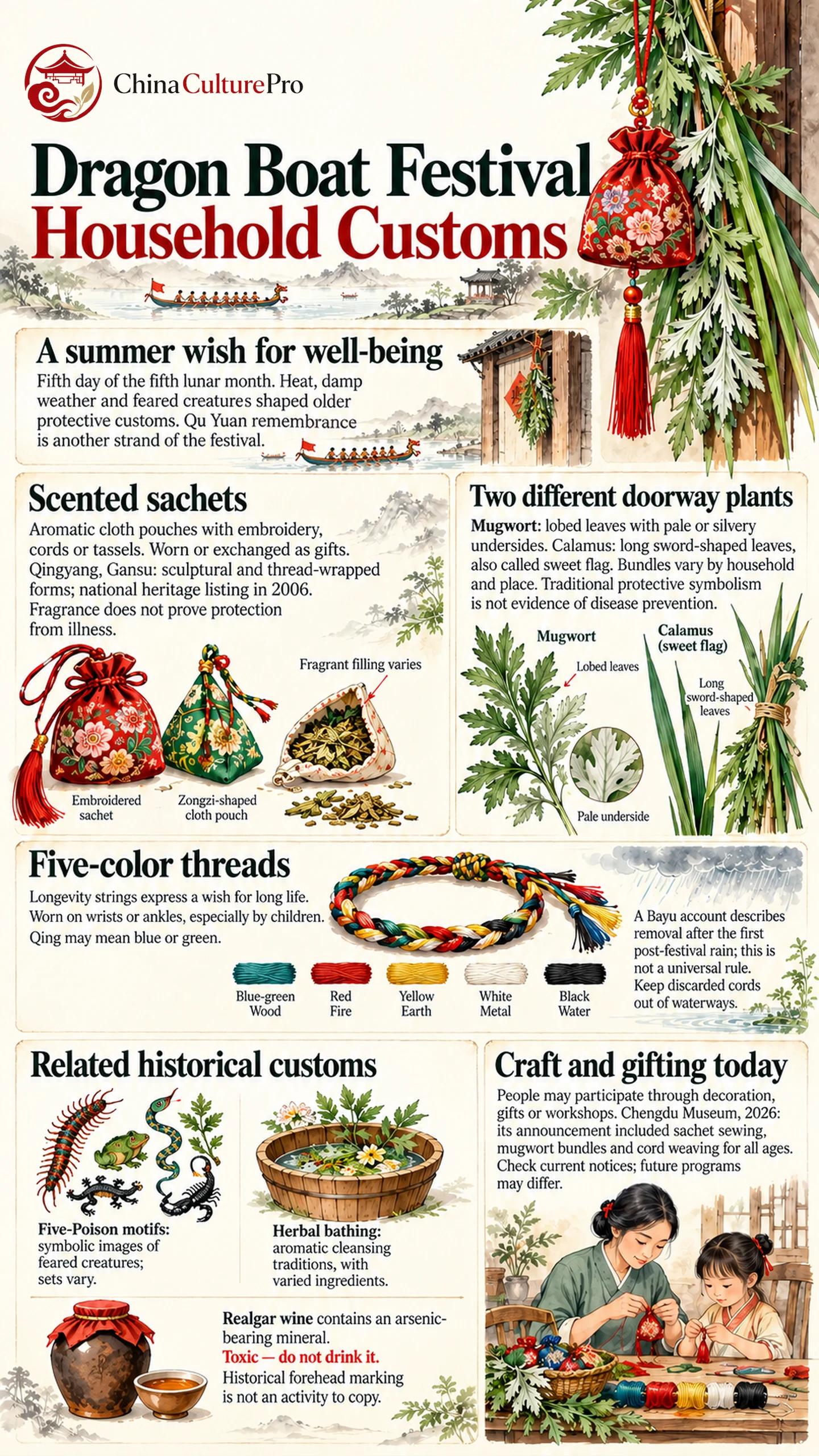
- Scented sachets: Small fabric pouches called scented sachets (香囊, xiāngnáng) are worn or exchanged as gifts.
- Doorway greenery: Mugwort (艾草, àicǎo) and calamus (菖蒲, chāngpú) are hung near entrances as traditional protective decorations.
- Five-color threads: Five-color threads (五色线, wǔsè xiàn) are twisted or braided into cords worn around wrists or ankles, especially by children.
Families choose different combinations. These are cultural expressions of care, with no nationwide checklist and no guarantee of protection from illness.
A fragrant pouch on a jacket, greenery above a doorway and a colored cord around a wrist can all mark the same festival. These household traditions reveal a quieter side of the Dragon Boat Festival (端午节, Duānwǔ Jié), alongside its public races and seasonal food.
Why Protection and Well-Being Matter at Duanwu
Duanwu falls on the fifth day of the fifth lunar month. Older traditions associated this part of the year with heat, damp weather, troublesome creatures and illness. References to an “evil” or “poisonous” month express a historical understanding of seasonal danger, rather than a modern description of the calendar. Protective ornaments and household customs offered ways to seek a safer summer.[1]
Early written evidence helps distinguish that seasonal setting from later explanations. The sixth-century Jingchu Suishiji (荆楚岁时记, Jīngchǔ Suìshí Jì), a record of customs in the Jingchu region, describes mugwort fashioned into human forms and suspended above doorways to ward off harmful influences.[2]
Seasonal protection and remembrance of Qu Yuan are different strands within the festival’s development. One story cannot explain every object or local practice. Recognizing those overlapping strands also avoids treating a family decoration as a religious obligation. The historical purpose of an object does not establish that it prevents disease today.
Scented Sachets: Fragrance, Embroidery and Family Wishes
A sachet is a small cloth container for aromatic material, often decorated with embroidery, cords or tassels. It may hang from clothing rather than sit inside a pocket. Possible fillings include dried mugwort, cloves and fragrant angelica root; these are examples, not a standard ingredient list. A Beijing festival workshop advertised all three among its materials in 2024.[3]
The cloth and stitching matter as much as the filling. Color, shape and the work of making or choosing a pouch turn it into a personal gift. An elder giving one to a child can express a wish for a peaceful summer; friends can exchange them as seasonal keepsakes. Fragrance explains their sensory appeal without proving that wearing one repels insects.
Qingyang in Gansu offers a specific regional example. Its sachet-making tradition was listed as national intangible cultural heritage in 2006. It combines three-dimensional forms with embroidery; one thread-wrapped type resembles a small zongzi. Pieces may be worn, displayed or given away. The variety within this one regional craft shows why there is no single national sachet design.[4]
A zongzi-shaped pouch borrows the outline of the festival food while serving as a wearable or hanging craft object.
Mugwort and Calamus: Doorway Greenery for the Festival
Mugwort and calamus are different plants, even when tied into the same bundle. Their contrasting leaves help explain both their appearance at the entrance and their traditional imagery. The comparison below is for recognizing festival decorations, not identifying wild plants for collection or use.
| Plant | Recognizable appearance | Traditional decorative role |
|---|---|---|
| Mugwort | Lobed leaves, commonly darker above and pale or silvery beneath | Aromatic leafy branches hung near the doorway |
| Calamus | Long, narrow, sword-shaped leaves | Blades associated with a symbolic protective sword |
Mugwort belongs to a different botanical group from calamus. English sources sometimes use “wormwood” loosely for the festival greenery, but that name should not be taken to mean that every Artemisia species is interchangeable. Calamus is also known as sweet flag; it should not be confused with cattail.[5]
In the traditional explanation, the doorway marks where harmful influences are kept outside. A mugwort bundle or a symbolic “sword” of calamus makes that wish visible. Plants may be paired or combined with other seasonal greenery; additions vary by place.[6]
Plant combinations, placement and timing follow local and household preferences; the paired bundle is a familiar arrangement rather than a requirement. Hanging branches is a seasonal decoration and cultural practice, not a substitute for sanitation or reliable insect protection.
Five-Color Threads: Longevity Strings on Wrists and Ankles
These cords are also called longevity strings (长命缕, chángmìng lǚ). Historical writing connects colored silk tied around the arm with wishes for long life and freedom from harm. The Han-period Fengsu Tongyi (风俗通义, Fēngsú Tōngyì) is cited in later scholarship for this practice; the name describes a blessing, not an extension of the wearer’s lifespan.[7]
The conventional palette is blue-green, red, yellow, white and black. It is associated with Wuxing (五行, wǔxíng), the traditional Five Phases:
- Blue-green: Wood.
- Red: Fire.
- Yellow: Earth.
- White: Metal.
- Black: Water.
The Chinese color word qing can be rendered as blue or green in this context. That translation difference does not necessarily indicate a different custom. Contemporary cord designs can vary, while the traditional five-color explanation remains a recognizable reference.[8]
Wrists and ankles are established places for the cords, particularly in children’s celebrations. Their meaning comes from the gift, color and family custom, with no universal left-or-right rule for everyone.[8]
Removal traditions also differ. A historical account of Bayu customs describes removal after the first rain following Duanwu, with misfortune symbolically washed away with the discarded cord. This is a particular folk narrative, not a compulsory date for everyone. The symbolism can be understood while keeping discarded threads out of rivers and drains.[9]
Other Protective Customs: Five-Poison Motifs, Herbal Baths and Realgar
Related customs extend the same seasonal concern into images, bathing and historical substances:
- Five-Poison motifs: The Five Poisons (五毒, wǔdú) are a folk grouping of feared creatures, often snakes, scorpions, centipedes, geckos and toads. Sets vary across historical representations. Their images appear as symbolic ways to confront harm; the category is cultural, not a scientific list of equally venomous animals.[6]
- Herbal bathing: Scented bathing belongs to the festival’s historical repertoire. Accounts describe aromatic plants associated with cleansing and well-being. The ingredients vary; “orchid bathing” should not automatically be understood as a bath made with modern ornamental orchids. This is cultural context, not a bath recipe or treatment recommendation.[6]
- Realgar wine: Realgar wine (雄黄酒, xiónghuáng jiǔ) historically combined alcohol with an arsenic-containing mineral. Drinking it and marking children’s foreheads were protective folk practices.[10] Realgar is toxic: do not drink realgar wine or treat the old custom as health advice. Understanding its history does not require reenacting it.[11]
These practices need not accompany the three main household ornaments, and a modern celebration can omit them entirely.
How These Customs Are Practiced Today
People can take part through decoration, gifts and craft activities while holding different views about the older beliefs. A pouch given to a friend, a cord exchanged within a family or a seasonal bundle at home can each be a complete way to participate.
Chengdu Museum’s 2026 Dragon Boat Festival announcement provides a dated example. Its public program advertised sachet sewing, mugwort-bundle making and five-color cord weaving among six activities, with participation open to all ages. The announcement documents that year’s planned program, not a permanent annual schedule or proof that the same workshops will return.[12]
For a current visit, check the organizer’s latest notice. Visitors can choose an activity that interests them, learn what the object means locally and leave other parts of the program for another occasion.
FAQs About Dragon Boat Festival Customs
Can adults wear Dragon Boat Festival sachets and threads?
Yes. Although many descriptions focus on children, the ornaments are not reserved for them. Adults can wear sachets or cords and exchange them as seasonal gifts; local preferences and personal comfort guide the choice.
When should five-color threads be removed?
There is no nationwide removal date. Some traditions refer to the first rain after the festival, while other families follow different timing. The rain story is symbolic and does not require throwing a cord into water.
Are mugwort and calamus the same plant?
No. Mugwort has lobed leaves with a pale underside; calamus has long, sword-shaped leaves. They are distinct plants often combined in festival doorway decorations.
Do all Dragon Boat Festival customs come from Qu Yuan?
No. The festival brings together seasonal protective practices, local traditions and stories of remembrance. Qu Yuan is central to a famous commemorative narrative, but that does not explain every sachet, plant bundle or colored cord.
Sources
[1] Lin Jifu and Zhou Man. 端午节的文明特性与中华民族共同体建设
[2] Chinese Academy of Sciences, Institute for the History of Natural Sciences. 《荆楚岁时记》与岁时文化
[3] Beijing Municipal Government. 党群阵地@你端午安康做香囊活动
[4] China Intangible Cultural Heritage Network. 庆阳香包绣制
[5] Chinese Academy of Sciences, Wuhan Botanical Garden. 第542期:端午佳景——菖蒲切玉,百草祛疫
[6] Chinese Academy of Sciences, Wuhan Botanical Garden. 第595期:手执艾旗招百福,门悬蒲剑斩千邪
[7] Chinese Text Project. 风俗通义校注:佚文
[8] China Intangible Cultural Heritage Network. 赛龙舟、佩香包、挂五彩——端午节,带着技艺走上荧屏的非遗“破圈”人
[9] Chongqing Local Chronicles Office. 端午佳节巴渝老祖宗都如何过?
[10] Xinhua. 端午节习俗之饮雄黄酒
[11] Ministry of Health and Welfare, Taiwan. 端午節不喝雄黃酒
[12] Chengdu Museum. 端午预告丨粽香逢雅事,赴一场成博端午文化之约!