
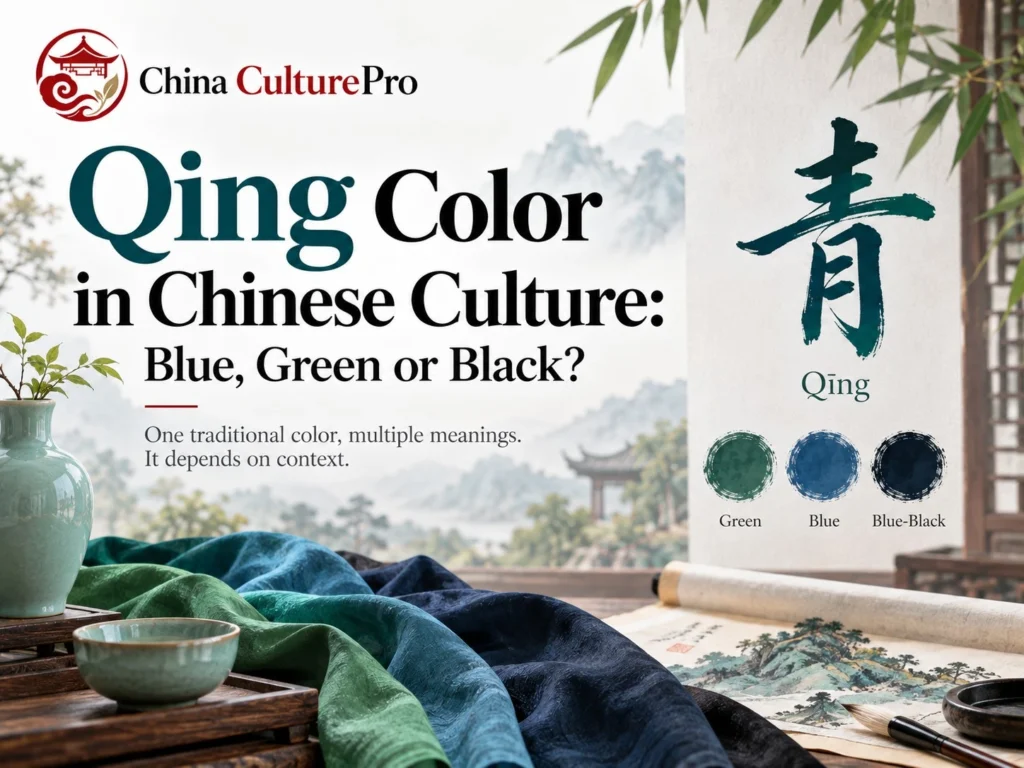

Quick Answer: What Does Qing Mean in Chinese Culture?
Qing (青, qīng) is a historical Chinese color category, not one fixed hue. Depending on the object and period, it can indicate green vegetation, a blue sky or glaze, or dark hair approaching black. Linguists therefore describe qing as a broad category spanning a green-blue continuum and extending into dark tones. [1]
- Historical color field: Qing groups colors that modern English and Mandarin usually divide among green, blue, blue-green, gray-green and blue-black.
- Contextual translation: Translate it from the noun it describes: qingshan are verdant mountains, qingtian is a blue or clear sky, and qingsi is black hair.
- Ritual correspondence: In the Five Colors (五色, wǔsè) and Wuxing (五行, wǔxíng) traditions, qing is associated with Wood, the east and spring.
- Seasonal and literary meaning: Because it often evokes new vegetation, qing can suggest growth, youth and spring in appropriate texts.
- Material and artistic naming: In ceramics and painting, qing may identify a glaze family, cobalt-blue decoration, or mineral blue used with green.
Qing is not simply “cyan,” and it is neither a universal lucky color nor a source of health, wealth or spiritual power. Its meaning comes from language, material, period and setting.
Chinese color words rarely work as timeless one-to-one labels. Qing is the clearest example: a single character can lead an English translator toward green, blue, black, a named ceramic category or a non-color word such as youth. That flexibility does not mean earlier Chinese speakers could not perceive color differences. It means their language grouped and named those differences differently.
This guide treats qing as a linguistic and cultural category rather than a paint swatch. It also separates ritual correspondence from literary imagery and separates both from the materials of ceramics and painting. For the wider system, see our guide to Chinese color meanings and symbolism.
Qing Is a Historical Color Category, Not One Fixed Hue
Qing in Classical Chinese and Modern Mandarin
In classical texts, qing could occupy a broad region that crosses boundaries now assigned to green, blue and dark or blackish shades. Victoria Bogushevskaya describes it as a composite category covering the green-blue continuum and extending into a “macro-black” area. The Taiwan Ministry of Education dictionary likewise records green, blue and black senses, with examples ranging from vegetation and sky to dark cloth and hair. [1][2]
Modern Standard Mandarin has more sharply differentiated basic terms for blue, green and black, so qing is no longer the ordinary all-purpose label it once was. It remains highly visible, however, in compounds, literary language, historical terminology and specialist color names. In some modern contexts it can also indicate a narrower blue-green or cyan-like range. That newer use is one part of the word’s history, not a definition that can be projected onto every older text.
Scholars continue to debate which hue was earliest or most central to qing. Some evidence emphasizes growing plants; other evidence highlights dark blue or blackish applications. The secure conclusion is broader: qing was polysemous, and its precise reference must be recovered from context rather than imposed from a modern color wheel. [1]
Qing vs Lan, Lü, Bi and Cang
The neighboring words are not interchangeable. Lan (蓝, lán) originally named dye-yielding plants and today is the standard word for blue. Lü (绿, lǜ) has a long history as a green color word and is now the everyday basic term for green. Bi (碧, bì) often evokes bright, clear blue-green qualities associated with water, sky or jade. Cang (苍, cāng) is strongly contextual and can suggest gray-blue, dark green, hoary gray or a vast, weathered atmosphere.
| Term | Broad modern guide | Typical contexts | Translation caution |
|---|---|---|---|
| Qing | Green, blue, blue-green or dark | Classical texts, ritual categories, fixed compounds, art terms | Translate from the object and period |
| Lan | Blue | Modern color naming; historically, indigo plants and dye | Do not read every ancient lan as the color blue |
| Lü | Green | Vegetation and modern everyday color naming | Not the canonical Five-Color term for Wood |
| Bi | Clear or lustrous blue-green | Water, sky and jade imagery | Often carries material or poetic texture |
| Cang | Gray-blue, dark green, gray or deep | Sky, mountains, pines, age and vastness | Usually needs a literary translation, not a swatch |
For focused comparisons, see blue meaning in Chinese culture and green meaning in Chinese culture.
How Context Changes the English Translation of Qing
The most reliable method is “object first, dictionary second.” A translator should identify what qing modifies, establish the historical register, and then choose the English word that makes the image intelligible without erasing its Chinese category.
| Chinese expression | Object or idea | Best English treatment | Why |
|---|---|---|---|
| 青山 qīngshān | Vegetated mountains | Verdant or green mountains | The reference is living vegetation |
| 青天 qīngtiān | Clear sky | Blue sky or clear heavens | The reference is the open sky |
| 青丝 qīngsī | Dark hair | Black hair, often poetically | Qing reaches into the dark range |
| 青瓷 qīngcí | Iron-glazed ceramics | Celadon (青瓷, qīngcí) | This is an established art-historical category |
| 青花瓷 qīnghuācí | Cobalt decoration under glaze | Blue-and-white porcelain (青花瓷, qīnghuācí) | The fired decoration is blue |
| 青龙 Qīnglóng | Eastern celestial emblem | Azure Dragon (青龙, Qīnglóng) | This is the conventional contextual rendering |
| 青春 qīngchūn | Life stage | Youth | The compound is no longer a literal color phrase |
These translations are functional, not mathematical. “Azure Dragon” preserves a conventional cosmological name; it does not prove that every historical image used the same blue. “Celadon” identifies a ceramic family whose glazes range from gray-green and olive to bluish green. A translator may explain the qing component, but should not force all examples into one English hue.
What “Qing Comes from Lan” Originally Means
The famous line from the Xunzi reads, “Qing is taken from lan, yet is qing-er than lan.” In this passage, lan refers to an indigo-producing plant, while qing refers to the stronger color obtained through processing and dyeing. The material comparison supports the larger argument that learning can transform a person beyond the starting material. [3]
The later idiom qing chu yu lan is used for a student or successor who surpasses a teacher or predecessor. That metaphor does not make qing a traditional symbol of intelligence, progress or personal success. It is the meaning of a complete saying, not an inherent power attached to the color.
Qing in the Five Traditional Colors and Wuxing
Qing belongs to the Five Colors (五色, wǔsè), the canonical set commonly given as qing, red, yellow, white and black. In developed correlative systems, it aligns with the Wuxing (五行, wǔxíng) phase Wood, the east and spring. It is also associated with the Azure Dragon (青龙, Qīnglóng), the eastern emblem in the Four Symbols. These correspondences formed across related ritual, calendrical and cosmological traditions; they should not be treated as one immutable chart delivered by a single text. [4]
The system organized relationships among direction, season, ritual and political order. Its purpose was not to tell individuals which color would improve luck. Modern blue does not replace qing in this framework, and Water corresponds with black rather than blue in the standard Five-Color scheme.
This is also why “Green Dragon” can be misleading in this context. The established English name Azure Dragon signals a traditional cosmological category whose qing cannot be reduced to the modern word green.
Why Qing Suggests Spring, Growth and Youth
Qing’s association with Wood, the east and spring reinforced a cluster of images centered on emergence: new plants, clear weather and the return of visible life. Traditional word explanations also connect qing with the color of things when they grow. That background helps explain compounds such as qingmiao for young crops and qingcong for fresh, luxuriant greenness.
Qingchun, literally “qing spring,” came to mean youth. In poetry, qingshan can keep mountains alive and verdant, while qingsi can contrast black hair in youth with white hair in old age. The same word therefore connects seasonal renewal, landscape and the passage of human life without assigning all three the same literal hue. [2]
These are literary and temporal associations, not a universal promise of renewal. Qing does not automatically signify health, longevity, wealth or good fortune. A spring poem may activate growth imagery; a ceramic glaze or dark robe may not.
Qing in Chinese Art and Material Culture
In art, qing often functions less like a symbolic label than a material or technical category. Three famous ceramic and painting terms contain the same character but refer to different substances, processes and visual ranges.
Celadon: Why Qingci Is Not Simply “Green Porcelain”
Celadon (青瓷, qīngcí) is the preferred art-historical term for a broad family of high-fired wares with iron-bearing glazes. Depending on clay, glaze chemistry, kiln atmosphere and firing, the surface may appear gray-green, olive, jade-like, bluish green or nearly gray. Calling the whole category “green porcelain” is therefore too narrow, although “greenware” appears in some scholarship.
The Metropolitan Museum of Art describes a thirteenth-century Southern Song Longquan tea bowl as having a refined, pale bluish-green celadon glaze. That object alone shows why qingci is a ceramic technology and aesthetic category rather than a single green swatch. [5]
Its value comes from the ware, kiln, glaze, form and history of use. The qing color does not independently make a celadon object lucky, protective or morally pure.
Qing in Blue-and-White Porcelain
Blue-and-white porcelain (青花瓷, qīnghuācí) uses cobalt pigment beneath a clear glaze. Here qing refers to the blue fired decoration, not the gray-green glaze associated with celadon. The Victoria and Albert Museum likewise identifies cobalt as the pigment responsible for the blue decoration. [6]
Any symbolic reading must come from the full object: motif, inscription, shape, function, patronage and historical setting. A dragon, lotus, narrative scene or auspicious inscription can carry meaning; cobalt blue is the medium that renders it. Some decoration is primarily aesthetic or commercial, so not every blue-and-white design encodes a blessing.
Qing in Blue-Green Landscape Painting
Blue-green landscape (青绿山水, qīnglǜ shānshuǐ) is a classical painting mode that combines mineral blues and greens, often with strong outlines and decorative color fields. In this name, qing and lü stand together: the category is not a monochrome “qing painting” and cannot be reduced to modern blue.
The Metropolitan Museum of Art’s 1633 Scholar-recluse in blue-green landscape by Chen Hongshou uses flat planes of color, patterned foliage and boldly contoured forms to allude to an antique blue-and-green style. The museum interprets its archaizing method and psychologically charged scene, not the pigments as a generic promise of calm or healing. [7]
That example captures the general rule: materials create visual possibilities, while composition, subject and historical context shape meaning.
How to Interpret Qing Correctly in Texts, Art and Design
Use this five-step check before translating or assigning symbolism:
- Identify the grammatical role: Is qing a free color word, part of a fixed compound, an art-historical term or a metaphor?
- Date the context: Classical prose, imperial ritual, modern Mandarin and contemporary design do not use the category identically.
- Name the object: Vegetation, sky, hair, glaze and pigment point toward different English renderings.
- Check the material and technique: Indigo dye, iron glaze, cobalt decoration and mineral pigment are not one “qing material.”
- Separate description from symbolism: A color may describe appearance without encoding luck, rank or virtue.
If evidence is limited, keep the translation broad or explain the ambiguity. “Qing, a historical blue-green-dark color category,” is more accurate than choosing a precise modern hue without support.
Common Misreadings of Qing
- Misreading: Qing is exactly cyan: Cyan is a narrower modern blue-green category, and specific digital systems may assign it exact values. Qing is a historically variable word and cannot be given one universal RGB or HEX code.
- Misreading: Ancient Chinese people could not distinguish blue from green: A shared lexical category describes how a language organizes color; it does not demonstrate a visual limitation.
- Misreading: Qing, lan and lü are interchangeable: Their histories overlap, but modern lan and lü are ordinary blue and green terms, while qing retains broader and more specialized uses.
- Misreading: Qing belongs to Water because it can look blue: In the canonical Five-Color correspondence, qing aligns with Wood and black aligns with Water.
- Misreading: Every qing object symbolizes spring or luck: Growth imagery is activated by particular seasonal and literary contexts. A glaze, pigment or dark textile does not inherit it automatically.
- Misreading: Qingci and qinghuaci share one color and meaning: Celadon depends on an iron-bearing glaze; blue-and-white porcelain depends on cobalt decoration. Their histories and techniques differ.
- Misreading: The Azure Dragon must be literally green or blue: Its English name is a conventional translation of a cosmological title, not a color-matching instruction.
- Misreading: Qing the color and Qing the dynasty are related: 青 and 清 are different characters with different histories and meanings, although both are pronounced qīng in modern Mandarin.
FAQs About Qing Color in Chinese Culture
Is qing blue or green?
It can be either, and sometimes neither. Qing can describe green vegetation, blue sky or glaze, and dark hair or cloth. The noun, period and genre determine the best translation.
Is qing the same as cyan?
No. Cyan is a narrower modern color category, while qing is a historical Chinese category with a much wider range. A cyan-like translation may fit a particular modern swatch, but it cannot define qing across classical texts and traditional objects.
What is the difference between qing, lan and lü?
Qing is the older broad category and remains common in compounds, literary expressions and traditional art terms. Lan is the ordinary modern word for blue, and lü is the ordinary modern word for green. Both lan and lü have older histories, so the distinction is an evolution of usage rather than a sudden modern invention.
Is qing one of the Five Traditional Chinese Colors?
Yes. Qing is one of the canonical five and is associated with Wood, the east and spring in developed correlative systems. Modern blue and green are not direct substitutes for it in that ritual framework.
Is qing considered lucky or unlucky in China?
Neither by default. Qing has positive spring and youth associations in some contexts, but there is no broadly recognized general taboo or universal lucky meaning. An artwork or object must be read through its material, motif, inscription and use.
Sources
[1] Victoria Bogushevskaya. Chinese GRUE: on the original meaning and evolution of qīng 青
[2] Ministry of Education, Taiwan. 青: Revised Mandarin Chinese Dictionary
[3] Chinese Text Project. Xunzi: Encouragement of Learning
[4] Smithsonian Libraries and Archives. Color in Ancient and Medieval East Asia
[5] The Metropolitan Museum of Art. Tea Bowl, Southern Song Dynasty
[6] Victoria and Albert Museum. Chinese Blue-and-White Ceramics
[7] The Metropolitan Museum of Art. Scholar-Recluse in Blue-Green Landscape