

Quick Answer: What Do Colors Mean in Chinese Culture?
Colors in Chinese culture do not carry one permanent meaning. Their significance depends on the period, setting, material, object, accompanying motifs, and written context. Broadly, color performs five cultural jobs:
- Celebration and blessing: Colors can express joy, renewal, and good wishes in weddings and seasonal festivals.
- Ritual and cosmic order: Traditional systems connect colors with directions, seasons, and the Five Phases.
- Mourning and solemnity: Plain or restrained colors help define funerary, ancestral, and ceremonial settings.
- Rank and authority: Regulated colors in court dress and imperial objects could identify status and occasion.
- Artistic expression: Pigments, dyes, glazes, and ink create seasonal, natural, religious, or literary associations.
No color automatically brings luck, wealth, health, or protection. A culturally accurate reading must identify where, when, and how the color is being used.
A red wedding garment, a white mourning robe, a black ink landscape, and a yellow court robe do not belong to one simple code of “lucky” and “unlucky” colors. Chinese color meanings developed through ritual systems, materials, social rules, literature, religion, and everyday custom. This guide explains the major colors and shows how to read them without turning a complex tradition into a fortune chart. It also provides a foundation for the wider Chinese symbols and meanings system.
Why Chinese Colors Do Not Have One Fixed Meaning
In early Chinese thought, color was often understood through the colored substance or surface of an object rather than as an abstract band of light. Mineral pigments, plant dyes, metals, glazes, textiles, and naturally colored bodies therefore mattered to interpretation. A color word might describe a material, a social category, a ritual relationship, or a visible hue—and these functions did not always coincide.[1][2]
Before assigning a meaning, check six variables: historical period, region, exact shade or material, type of object, social occasion, and surrounding motifs or inscriptions. The same broad color category can change meaning when any of these variables changes.
- Red: It is strongly associated with celebration in weddings and Lunar New Year settings, yet writing a living person’s name in red ink can feel ominous or disrespectful in many Chinese contexts.
- White: Undyed or plain white has an important role in mourning dress, but white can also suggest simplicity, clarity, or deliberate restraint in ceramics and painting.
- Black: It may signal water and the north in a cosmological table, dense ink in painting, official sobriety in clothing, or a negative idea in a particular modern expression.
This is why “red means luck” or “white means death” can be a useful first clue but never a complete interpretation. Color symbolism is a relationship between a color and its setting, not an unchanging property of the color itself.
The Five Traditional Colors and the Wuxing System
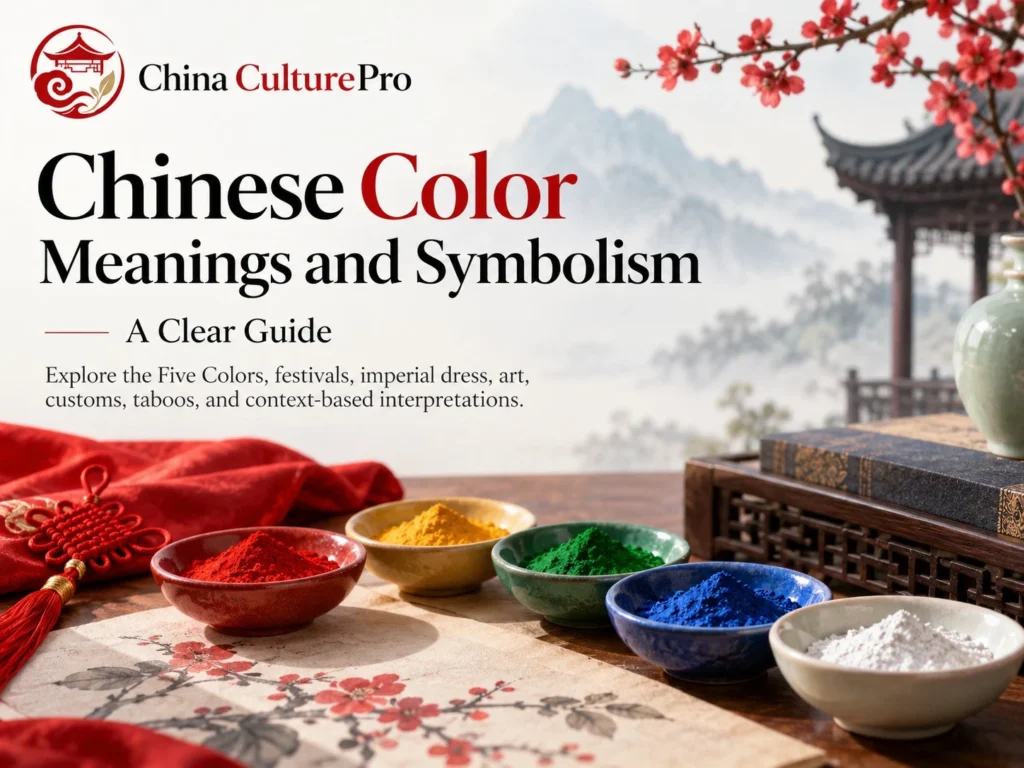
The Five Colors (五色, wǔsè) are qing (青, qīng), red or chi (赤, chì), yellow (黄, huáng), white (白, bái), and black (黑, hēi). They became part of a larger correspondence system associated with Wuxing (五行, wǔxíng), better translated here as the Five Phases than as five physical “elements.” Classical and technical texts developed relationships among color, direction, season, material processes, and ritual order over time; they should not be treated as one unchanged chart created at a single moment.[1][2][3]
| Traditional color | Five Phase | Direction | Seasonal position | Typical systemic association |
|---|---|---|---|---|
| Qing (青, qīng) | Wood | East | Spring | Growth and emergence |
| Chi (赤, chì) | Fire | South | Summer | Heat, expansion, and brilliance |
| Huang (黄, huáng) | Earth | Center | Seasonal center or transitions in some schemes | Centrality and stability |
| Bai (白, bái) | Metal | West | Autumn | Contraction and clarity |
| Hei (黑, hēi) | Water | North | Winter | Depth, storage, and stillness |
These are relational categories, not precise swatches. Chi is more specific than the broad modern category “red,” while qing spans a range that modern English often divides among blue, green, and darker tones. Exact correspondences also vary with the text and historical use, so the table gives the best-known framework rather than a universal key.
What the Five-Color Correspondences Actually Mean
The Five Colors helped organize relationships among the human, natural, and political worlds. They could guide ritual distinctions, directional schemes, calendrical associations, and the visual language of official objects. In some artistic systems, the directional colors also appear through figures such as the Azure Dragon of the east, the Vermilion Bird of the south, the White Tiger of the west, and the Black Tortoise of the north.
This system is descriptive and historical. It does not mean that wearing a color linked with Wood, Fire, Earth, Metal, or Water will alter a person’s fate. Modern “lucky color” calculations may borrow the vocabulary of Wuxing, but they are not the same task as interpreting a historical robe, mural, vessel, or text.
Chinese Color Meanings at a Glance
The table below gives a safe starting point for nine frequently searched color categories. Each association is conditional; the last column prevents the shorthand from becoming a universal claim.[1][2]
| Color and Chinese term | Common associations | Typical contexts | Do not automatically assume |
|---|---|---|---|
| Red (红, hóng; also 赤, chì, in older systems) | Celebration, vitality, ritual emphasis, auspicious wishes | Lunar New Year, traditional weddings, seals, festive decoration | Every red mark is lucky, romantic, or appropriate |
| Yellow (黄, huáng) | Earth, centrality, authority, selected imperial privileges | Five-Color schemes, court dress, architecture, Buddhist objects | Every yellow object was reserved for an emperor |
| Gold (金, jīn) | Precious material, splendor, radiance, sacred or courtly display | Gilded sculpture, metalwork, embroidery, architectural details | Gold and yellow are culturally or materially identical |
| White (白, bái) | Mourning, plainness, clarity, restraint | Funerary dress, uncolored cloth, monochrome wares, painting | White always means death or misfortune |
| Black (黑, hēi) | Water and north, depth, gravity, concentrated ink | Five-Color schemes, painting, clothing, ritual objects | Black always means evil |
| Green (绿, lǜ) | Vegetation, freshness, growth; one famous social taboo | Landscape, textiles, ceramics, modern dress | All green is unlucky because of the “green hat” idiom |
| Blue (蓝, lán) | Dye color, ceramic decoration, cool visual contrast | Indigo textiles, blue-and-white porcelain, folk decoration | The Western marketing meanings of trust and professionalism |
| Purple (紫, zǐ) | Celestial and courtly associations, rarity, Daoist imagery | Purple Enclosure astronomy, clothing, religious and palace settings | A universal wealth or luxury meaning |
| Qing (青, qīng) | A historical range spanning blue, green, blue-green, gray, and dark tones | Classical texts, Five Colors, ceramics, clothing, landscape terms | One modern English color or fixed digital value |
The modern word hong is a broad everyday term for red, while chi, zhu (朱, zhū), and dan (丹, dān) may point to different historical categories, pigments, or literary registers. In the same way, a gilded surface is not simply “yellow,” and indigo-dyed blue is not interchangeable with a qing glaze. Materials and words are part of the evidence.
Why Qing Is Not Simply Blue or Green
Qing is one of the clearest examples of why historical color words resist one-to-one translation. Its range has changed across time and can cross boundaries that modern English treats as separate basic colors. Depending on the object and phrase, qing may be rendered as blue, green, blue-green, gray-green, or even a dark tone.[1][7]
| Chinese expression | Usual object | Context-sensitive English |
|---|---|---|
| 青天 (qīngtiān) | Sky | Blue or clear sky |
| 青草 (qīngcǎo) | Grass | Green grass |
| 青瓷 (qīngcí) | Glazed ceramic | Celadon or qing-glazed ware |
| 青衣 (qīngyī) | Garment or theatrical role name | Dark, blue, blue-green, or a conventional role label, depending on context |
The object supplies part of the meaning. Translating qing in a poem about vegetation is not the same as identifying a ceramic glaze, a textile, or a direction in the Five Colors. There is therefore no historically valid “qing hex code.” A museum label, recipe, material analysis, or surrounding phrase is more useful than a modern color picker.
How Chinese Color Symbolism Developed Over Time
Chinese color culture accumulated rather than moving through one neat, uniform sequence. Ritual classification, technical production, court regulation, local custom, and modern media often overlapped. A short historical framework is still useful as long as it does not imply that every community adopted the same rule at the same time.
Early Ritual and Cosmological Systems
Late Shang evidence already shows that differently colored sacrificial animals could be selected for different ritual purposes, but this was not yet the fully standardized popular chart often presented online. Texts compiled and transmitted through the late Zhou and Han worlds developed increasingly elaborate correspondences among colors, directions, seasons, and the Five Phases. The Kaogong ji, or Artificers’ Record, is especially important for understanding how technical practice, materials, and ordered design were described in early China.[1][2][3]
The safest historical conclusion is gradual formation: early ritual distinctions provided important foundations, while later thinkers and institutions organized them into broader systems. It is misleading to assign the complete later Five-Color chart unchanged to the earliest Chinese history.
Imperial and Material Cultures
As dyeing, weaving, glazing, painting, and metalworking changed, color possibilities changed with them. Historical dye manuals show that craftspeople combined different dyestuffs, mordants, sequences, and quantities to extend the textile palette. A named color could therefore represent a recipe and material result, not merely a symbolic idea.[4]
Court dress also used color to mark status and occasion, but regulations varied by dynasty and garment type. In the Qing court, bright yellow had especially restricted imperial uses, while apricot yellow, golden yellow, blue, blue-black, red, and other grounds helped differentiate wearers and ceremonies. Surviving robes and the illustrated court regulations commissioned under the Qianlong emperor show that color worked together with fabric, dragon claws, symbols, and garment form.[5]
Modern National, Commercial, and Global Meanings
After the imperial system ended, court color regulations no longer governed ordinary public life. Red gained new national and political associations while remaining central to many festive settings. Global fashion, white wedding dresses, corporate branding, digital screens, and international color psychology added further layers.
These modern meanings are real parts of contemporary culture, but they are not evidence for an ancient object. A modern purple luxury brand cannot prove that every historical purple textile symbolized wealth, just as a white contemporary wedding dress cannot redefine the role of plain white in older mourning customs.
How Setting Changes a Color’s Meaning
The fastest way to avoid a false reading is to identify the social or artistic system before interpreting the color.
| Setting | How color works | Interpretive limit |
|---|---|---|
| Lunar New Year and weddings | Red and gold often support celebration, visibility, and auspicious wishes | Customs vary, and neither color guarantees luck |
| Funerals and ancestral rites | White, undyed cloth, hemp, and subdued tones may express mourning and ritual restraint | Guest dress and family mourning grades vary by community and period |
| Imperial and official dress | Color joins textile, motif, garment type, rank, and occasion in a regulated code | A color alone cannot identify an emperor or official |
| Buddhist and Daoist art | Gold, mineral colors, directional colors, and robes serve iconographic and ritual purposes | Religious meanings do not transfer automatically to secular objects |
| Chinese opera | Makeup and costume colors help distinguish role, temperament, status, and dramatic identity | The full facial pattern and character matter; stage codes are not daily color meanings |
| Painting, ceramics, and textiles | Color may identify a material, technique, season, genre, or visual mood | Decoration is not automatically symbolic |
| Modern public and commercial design | Traditional references mix with branding, politics, global fashion, and digital convention | Modern design choices cannot be projected backward onto antiquity |
Opera provides a particularly useful warning. A red-painted face may suggest loyalty in a specific Jingju character, while a white-painted face may help characterize cunning. These are theatrical conventions shaped by the complete facial design, role, and story—not a claim that red people are loyal or that white objects are treacherous.[6]
Lucky, Unlucky, and Taboo Colors in Real Situations
In everyday use, “lucky” usually means culturally suitable for a celebratory setting. “Unlucky” often means inappropriate, emotionally discordant, or linked to a taboo in one specific context. These are social conventions, not supernatural effects.
- Celebrations: Red remains a safe, recognizable choice for many Lunar New Year and traditional wedding decorations. Gold can add brilliance, but it should not be translated automatically as money or wealth.
- Funerals: Avoid treating a Chinese funeral like a red festive event. Plain white, subdued colors, or dark modern formalwear may be appropriate, but actual expectations depend on the family, region, religion, and the mourner’s relationship to the deceased.
- Names in red ink: Writing a living person’s name entirely in red is widely regarded as uncomfortable or disrespectful. Explanations of the taboo differ, so it is safer to follow the living convention than to claim one proven origin.
- The “green hat” taboo: The expression “to wear a green hat” (戴绿帽子, dài lǜ màozi) refers to a man whose wife or partner is unfaithful. The taboo concerns green headwear in this idiomatic setting, not green clothing, plants, jade, or landscape painting in general.
- Black and white: These colors can look solemn, elegant, modern, or deliberately restrained. Do not turn them into a simple Western-style good-versus-evil pair.
For invitations, gifts, clothing, and event design, the safest question is not “Is this color lucky?” but “Is it appropriate for this event, audience, and relationship?”
Chinese and Western Color Meanings: Key Differences
Neither “China” nor “the West” has one internally uniform color code. The comparison below identifies recurring contrasts, not rules shared by every person or historical period. Historical semantics also show why modern color categories cannot simply be projected onto earlier languages.[1][7]
| Color | Common Chinese contexts | Common Euro-American contexts | What changes the reading |
|---|---|---|---|
| Red | Celebration, weddings, New Year, ritual emphasis | Love, passion, danger, warning | Event, written use, motif, and shade |
| White | Mourning, plainness, clarity, restraint | Weddings, purity, innocence, sterility | Dress, ritual role, material, and modern influence |
| Black | Water and north, ink, depth, authority, solemnity | Mourning, elegance, rebellion, evil in some narratives | Cosmology, art medium, clothing, and genre |
| Blue | Indigo, ceramics, decoration, or part of the historical qing range | Calm, trust, sadness, corporate professionalism | Dye, glaze, language, and modern branding |
| Yellow | Earth and center, selected court privileges, religion | Sunshine, caution, cowardice, visibility | Dynasty, garment, shade, institution, and material |
| Purple | Astronomy, Daoist imagery, high status in selected periods | Royalty, luxury, spirituality, creativity | Textual reference, religious setting, and historical availability |
A cross-cultural comparison is useful only when it sends the reader back to the object. If a porcelain vessel is blue, ask which pigment and decorative tradition produced it. If a robe is yellow, ask who wore it, in which dynasty, for what ceremony, and with which motifs.
How to Interpret Color in Chinese Art, Clothing, or Design
- Identify the exact term and material. Distinguish broad modern labels from words such as chi, zhu, dan, and qing. Note whether the color comes from dye, pigment, glaze, metal, stone, or natural material.
- Date and locate the object. A late Shang ritual use, Tang garment, Qing court robe, regional opera costume, and modern poster do not share one color code.
- Establish the medium and function. Decide whether the object is ritual, official, funerary, festive, theatrical, religious, commercial, or primarily decorative.
- Read combinations rather than isolated hues. Check adjacent colors, animals, plants, characters, rank badges, garment forms, and other motifs.
- Use the text around the object. Titles, inscriptions, recipes, historical regulations, catalog records, and museum notes can narrow an otherwise open interpretation.
- Choose the narrowest supported meaning. If the evidence proves only a material or decorative choice, do not upgrade it into an auspicious, moral, religious, or imperial symbol.
This method also works for contemporary design. A modern creator may deliberately give a color a new personal meaning, but that decision should be labeled as modern interpretation rather than presented as an ancient Chinese rule.
Common Misreadings of Chinese Color Symbolism
- One fixed meaning: Chinese color meanings change with period, material, object, event, and accompanying imagery.
- Red is always lucky: Red is strongly festive in the right setting but can be inappropriate in particular writing, mourning, or institutional contexts.
- Yellow was only imperial: Particular shades and garments were restricted in particular court systems; yellow also appeared in religious, technical, and everyday objects.
- White means only death: White can mark mourning, but it can also convey plainness, clarity, uncolored material, or aesthetic restraint.
- Black means evil: Black has positive, neutral, and negative uses; in the Five Colors it corresponds to Water and the north.
- Qing is simply cyan: The historical category crosses several modern color boundaries and must be translated from context.
- Opera colors explain daily life: They are stage conventions tied to a complete character design and dramatic role.
- Wuxing colors change fortune: The historical correspondence system does not demonstrate a supernatural effect.
- Traditional colors have exact RGB values: Historical color depends on materials, recipes, surfaces, aging, light, and naming conventions.
FAQs About Chinese Color Meanings and Symbolism
What is the luckiest color in Chinese culture?
There is no universally lucky color for every person and situation. Red is the most widely recognized celebratory color in Lunar New Year and traditional wedding contexts, but its appropriateness still depends on the event and use.
What are the five traditional Chinese colors?
The traditional Five Colors are qing, chi or red, yellow, white, and black. In the best-known Wuxing framework, they correspond respectively to Wood/east, Fire/south, Earth/center, Metal/west, and Water/north.
Why is white associated with mourning in China?
Plain white and undyed materials became important in Chinese mourning dress and ritual restraint. That funerary use does not erase white’s other associations with clarity, simplicity, blank space, and unadorned material.
Does qing mean blue or green?
It can mean either, and sometimes blue-green, gray-green, or a darker tone. The correct translation depends on the historical period, object, material, and phrase in which qing appears.
Was yellow reserved only for the emperor?
No. Some dynasties restricted particular yellow shades, garments, and motifs for the ruler or imperial family, especially in formal court systems. Yellow also appeared in Buddhist art, textiles, ceramics, and other non-imperial settings.
Sources
[1] Victoria Bogushevskaya. Chinese Color Language
[2] Mary M. Dusenbury, ed. Color in Ancient and Medieval East Asia
[3] Jun Wenren. Ancient Chinese Encyclopedia of Technology: Translation and Annotation of the Kaogong Ji
[4] Jing Han and Anita Quye. Dyes and Dyeing in the Ming and Qing Dynasties in China
[5] Victoria and Albert Museum. Influence and Longevity: A Festive Dragon Robe for Winter
[6] Alexandra B. Bonds. Beijing Opera Costumes: The Visual Communication of Character and Culture
[7] C. P. Biggam. The Semantics of Colour: A Historical Approach