
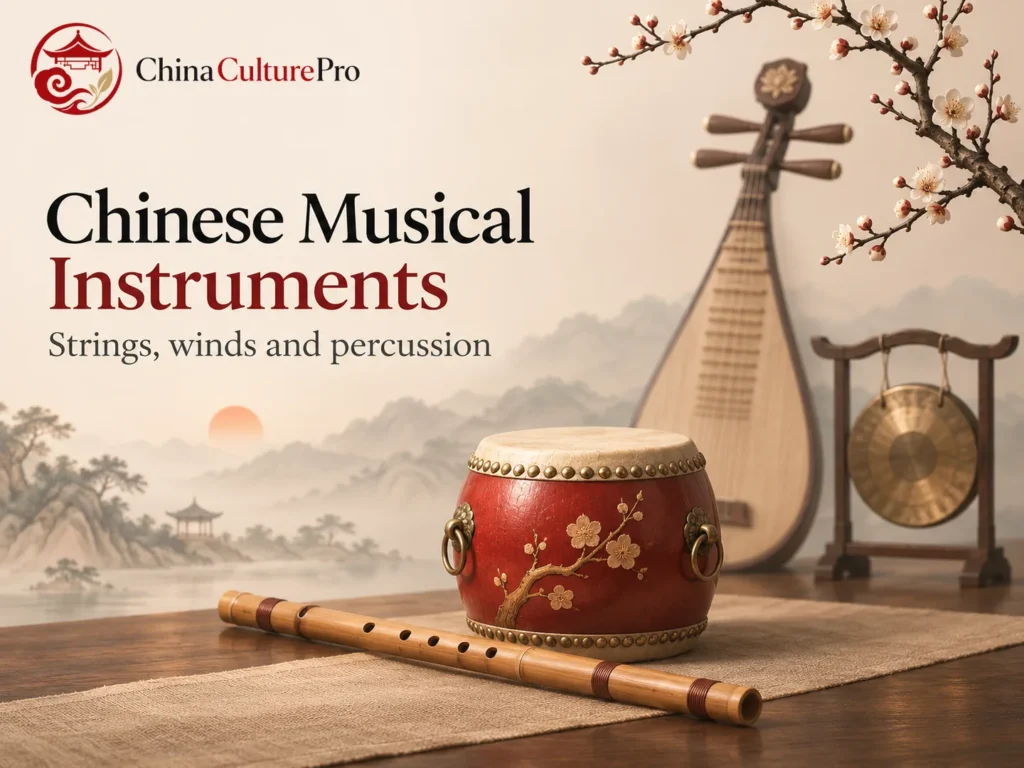

Quick Answer: What Are the Main Chinese Musical Instruments?
Chinese musical instruments are commonly grouped by how players make them sound. A modern Chinese orchestra generally separates bowed strings, plucked strings, winds and percussion. [1][2]
- Bowed strings: The erhu uses a bow to keep a string vibrating.
- Plucked strings: The pipa, guzheng and guqin sound when a fingertip or pick releases a string.
- Winds: The dizi is a flute, the sheng uses free reeds, and the suona uses a double reed.
- Percussion: Drums, gongs, cymbals and bells produce sound when struck.
These groups help you identify a sound. The makeup of an ensemble depends on the repertoire and setting.
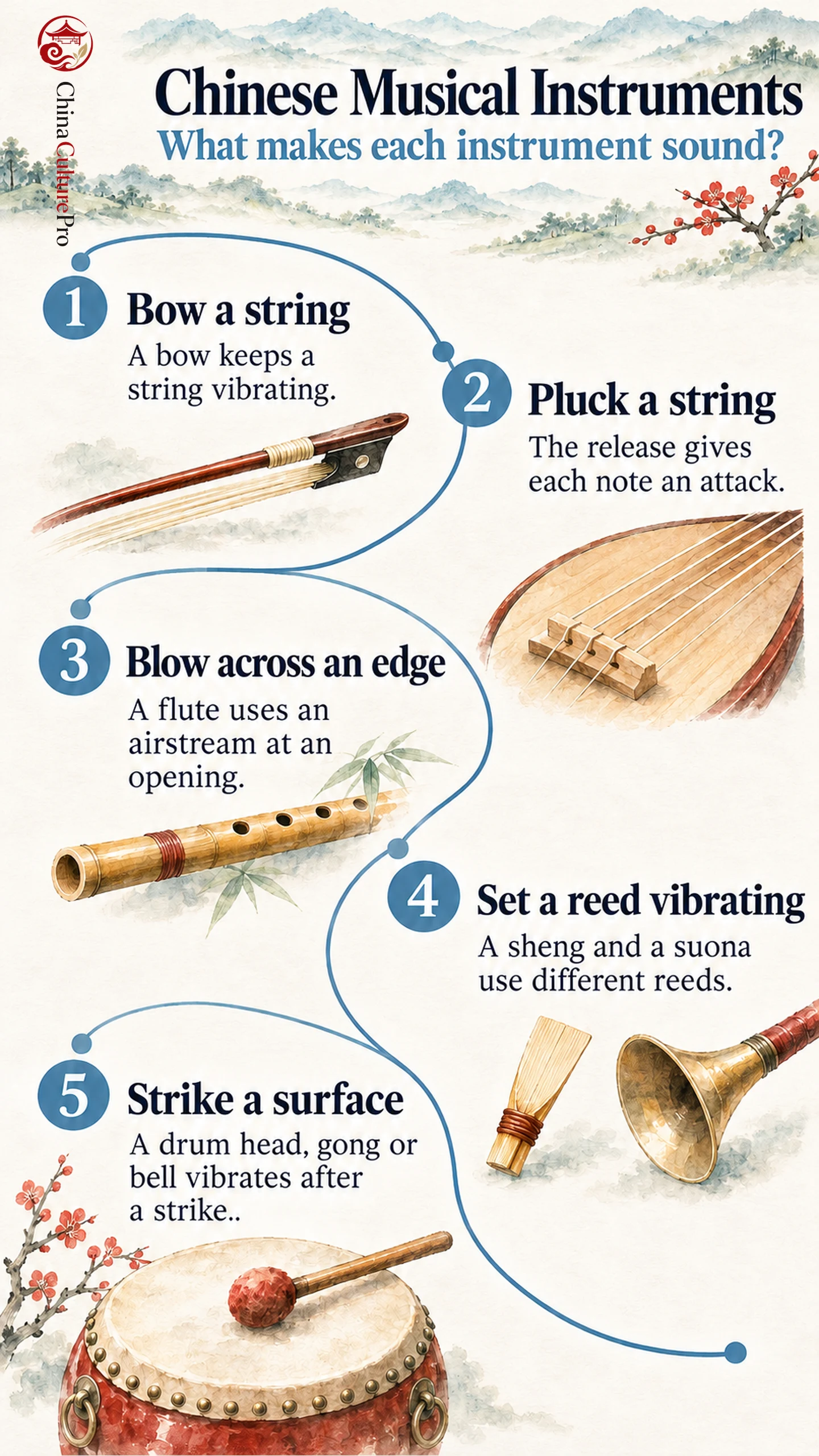
When several instruments play together, start with the beginning of a note. You may hear a sharp pluck, a bow that keeps the sound going, a breath-driven tone or a struck accent. Then check what the performer is doing. The same instrument can play different roles depending on the piece.
Bowed and Plucked Strings
The upright erhu is a two-string fiddle. A stroke of the bow can support a continuous sound while a finger slides to another pitch. Compare that with a pipa, a fretted lute usually held upright in modern performance. Its repeated finger strokes can create a sustained effect, but the start of each pluck still supplies the energy. [1][2]
The guzheng and guqin both have strings that run lengthwise above a horizontal body. This makes them zithers. The guzheng has a row of individual raised bridges. On a guqin, the player can slide a stopped string along the surface, and a row of position marks helps locate finger placements. Look at the body and bridges as well as the performer’s hands. [1]
Winds: Flutes, Free Reeds and Double Reeds
On a dizi, the player blows across a hole while holding the flute sideways. A thin membrane over a separate opening adds a buzz to many models. A sheng sends air through reeds fitted inside pipes. It can sound more than one note at once, which makes it useful for both sustained chords and melodic passages. [1][3]
The suona also uses reeds, but in a different way. Two thin blades vibrate against each other at the mouthpiece. The reed drives a tone through the tube and flared bell. Listen for a more pointed reed attack alongside the different onset of an edge-blown flute. The contrast depends on both the instrument and how it is played. [1][3]
Percussion: From Drum Cues to Pitched Bells
A drum sounds through a stretched head. A gong or bell sounds through the struck metal itself. In Peking opera, a drum or gong accent can shape the timing of movement, action and entrances. The broader guide to Chinese performing arts explains what to watch for when those sounds cue a performer. [1][5]
Percussion can carry precise pitches, too. The early Warring States chime set excavated from the tomb of Marquis Yi of Zeng has 65 bells. The set demonstrates how a bell can yield two distinct notes, depending on where it is struck. That is a different musical task from using a gong accent to punctuate a gesture. [4]
How the Eight Sounds Classify Instruments
The older Eight Sounds system, or bayin (八音, bāyīn), groups instruments by materials. Its categories are metal, stone, silk, bamboo, gourd, clay, hide and wood. The categories describe a traditional system of classification. An instrument can combine several materials, and contemporary makers may use new ones. [1]
Compare a bell and a drum. One belongs to metal and the other to hide in a material-based classification. Both can be grouped as percussion by how they sound. See Chinese traditional music for how different combinations of instruments serve different repertories.
FAQs About Chinese Musical Instruments
What Is the Chinese Two-String Fiddle Called?
The erhu is a common example. It rests upright on the player’s leg, and the bow hair passes between the strings. [1]
Is Every Chinese Bamboo Wind Instrument a Flute?
No. Bamboo can form a flute tube or a pipe in a reed instrument. Look for whether the player blows across an edge or sends air through a reed. [1][3]
Do All Chinese Ensembles Use the Same Instruments?
No. A Chinese orchestra groups winds, bowed and plucked strings, and percussion. Smaller ensembles and opera groups choose instruments for a particular repertoire. [1][2][5]
Sources
[1] Hong Kong Education Bureau. Listening to Chinese Music
[2] Hong Kong Music Office. Chinese Musical Instruments
[3] Hong Kong Chinese Orchestra. Wind Instruments
[4] Hubei Provincial Museum. Chime-bells from the Tomb of Marquis Yi of Zeng
[5] UNESCO. Peking opera