


Quick Answer: What Is a Guzheng?
A guzheng (古筝, gǔzhēng) is a Chinese plucked zither with a long wooden soundboard and individual movable bridges. Players sit beside it and reach over the strings, which run along the length of the instrument.
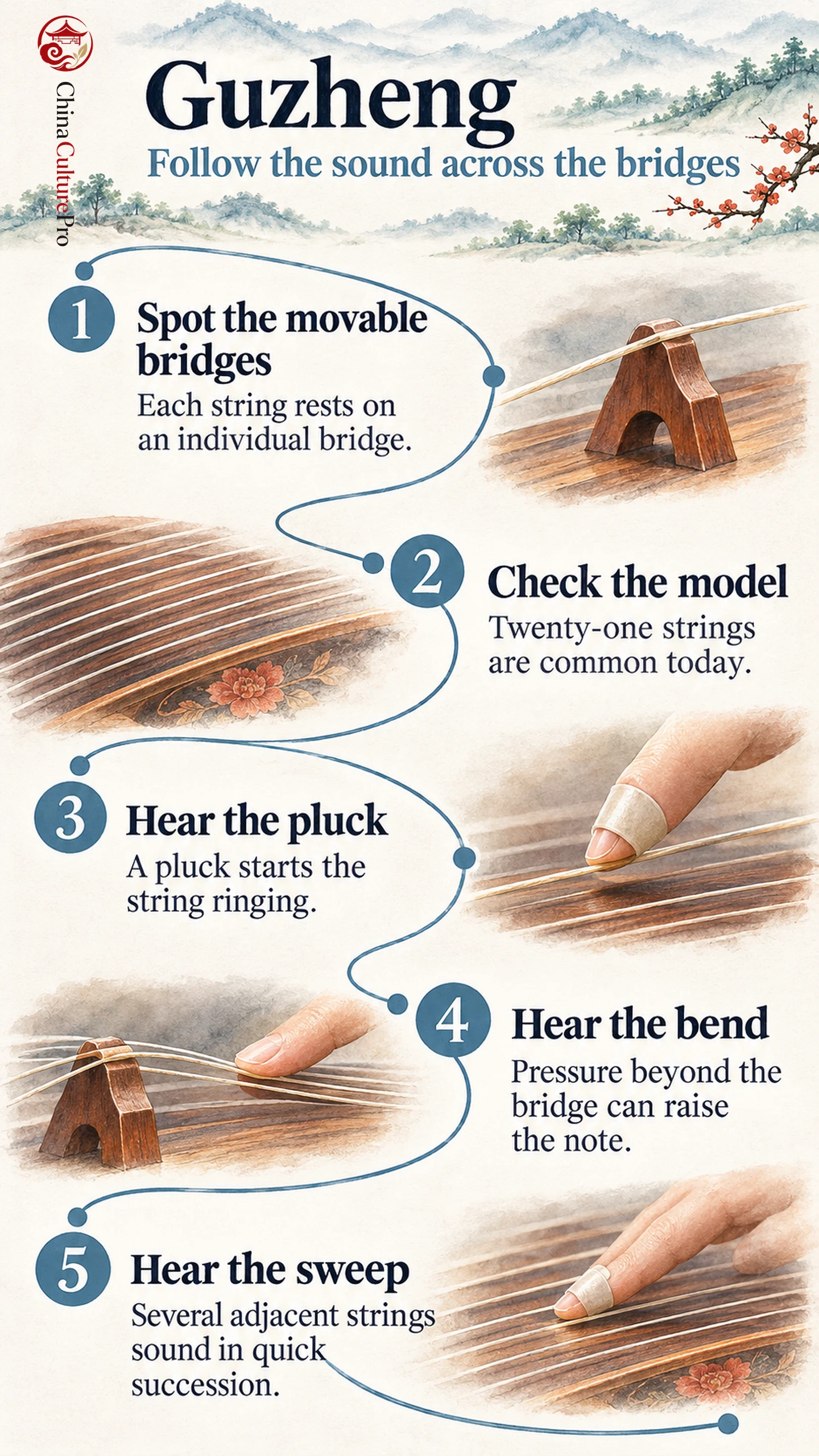
- Look for the bridges: Each string rests on its own raised bridge. Together the bridges form a staggered line across part of the soundboard.
- Listen for the attack: A single pluck rings out clearly. A quick sweep can set a row of strings sounding in succession.
- Watch the hands: The right hand often starts the note while the left hand presses beyond the bridge to bend it.
Twenty-one strings are common on modern instruments. Older and specialist examples can have other counts. [1][2]
If a bright note seems to swell upward after it has already sounded, look at the player’s left hand. One of the guzheng’s characteristic sounds comes from changing the tension of a string while it is still ringing. The individual bridges make it possible to hear what each hand contributes. [1]
How to Recognize the Instrument
The guzheng belongs to the zither family of Chinese musical instruments. Its strings run parallel to the top of a long, shallow resonating body. The movable bridges lift those strings off the soundboard. They make a more reliable visual clue than the color of the wood or decoration at the ends. [1]
The modern concert model is only one point of reference. One surviving wooden nineteenth-century zheng from Chizhou, Anhui, measures just under a meter long. That measurement belongs to the museum object. Modern 21-string examples and historical regional instruments can differ in length, string material and arrangement. [1][2][3]
What the Two Hands Do
In a common playing position, the right hand plucks the segment to the right of the bridge. Players often use attached finger picks. Plucking closer to or farther from the bridge changes the color of the attack, even when the same string sounds. With several adjacent strings, the player can sweep through a succession of pitches. [1]
The left hand may press the other side of the bridge, tightening the string and raising the pitch of the sounding segment. Small repeated changes in pressure produce vibrato. A stronger motion can bend the note farther before the finger releases it. Modern repertoire also asks the left hand to pluck on the sounding side, so the division of labor can change within a piece. [1]
Watch for two different motions. A sweep travels across several strings, so you hear a run of attacks. A bend changes the sound after a pluck, so you hear a pitch move within a single ringing note. [1]
Where the Guzheng Fits in Chinese Music
Guzheng repertoire includes regional traditions associated with places such as Henan, Shandong and Chaozhou. A useful way to hear the differences is to compare how players shape a sustained note with the left hand. Listen for when a note bends and how far it moves before the next note starts. Modern works also give the instrument roles in concertos and small ensembles, where a brief plucked gesture may pass between the zither and another instrument. [1][2]
The wider guide to Chinese traditional music puts solo and ensemble listening into context. For a closer visual comparison of two horizontal zithers, see guzheng vs guqin.
FAQs About Guzheng
How Many Strings Does a Guzheng Have?
Twenty-one is the usual count on a common modern model. Historical and contemporary specialist forms vary, so the number alone is an unreliable way to identify a zheng.
Is a Guzheng the Same as a Guqin?
The guzheng has a separate movable bridge under each string. A typical seven-string guqin has position marks along its top and lacks that raised row of bridges. [4]
Does a Guzheng Only Play Five Notes?
A pentatonic tuning uses five scale degrees, repeated in different octaves. Players can reach additional pitches through bends, and some pieces use other tunings. [1][2]
Sources
[1] Michael Sidney Timpson. Zheng’s Musical Functionalities and Techniques
[2] Eastman School of Music. Music Without Borders: About the Guzheng
[3] The Metropolitan Museum of Art. Chizhou Zheng
[4] The Metropolitan Museum of Art. Guqin