


Quick Answer: What Are Chinese Performing Arts?
Chinese performing arts include forms of theater, instrumental and vocal music, dance, and storytelling. The categories overlap because a single tradition can use voice, movement and instruments for different jobs.
- Opera: Singers and actors bring characters to life through speech, melody, movement and stylized action.
- Music: Solo and ensemble traditions foreground sound. Winds and drums, for example, can carry the music of a procession.
- Dance: Movement takes the lead, sometimes through a costume or prop that changes the dancer’s silhouette.
- Storytelling: A narrator leads the audience through events, sometimes alternating between speaking and singing.
Start with what carries the performance, then notice how the other elements support it.
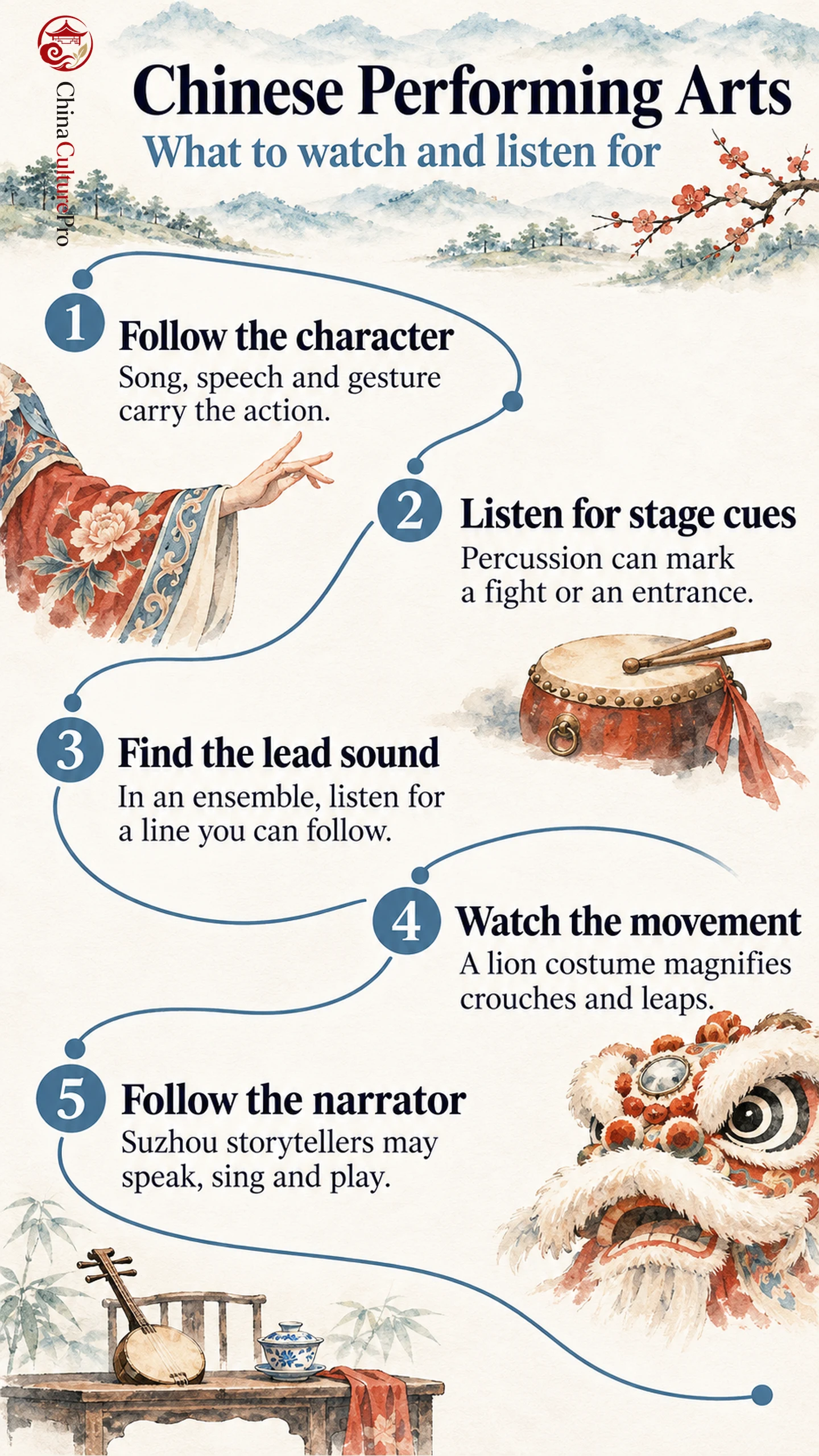
At a Peking opera performance, a drum accent can mark a sudden turn in the action. At a Suzhou storytelling performance, a plucked instrument may punctuate a sung passage. In both cases, the music makes more sense when you notice what the person onstage is doing. [1][4]
Chinese Opera: Follow the Character
Chinese opera, or xiqu (戏曲, xìqǔ), is an umbrella term for theatrical traditions. In Peking opera, performers combine singing and heightened speech with gesture, acting and martial movement. Listen for the change in pace when percussion comes forward during a fight or entrance. A bowed string or flute line may come forward in scenes centered on dialogue and feeling. [1]
Kunqu offers another way to watch the relationship between voice and motion. This tradition developed in the Kunshan area during the Ming dynasty. Its long melodic lines and carefully patterned gestures give the viewer time to register what a character is feeling. The two forms have distinct musical and movement conventions, even when a visitor recognizes familiar features such as elaborate costume or stylized speech. [2]
Instrumental Music: Listen for the Ensemble
The range of Chinese traditional music runs from quiet solo playing to performances that fill a public space. A guqin solo directs attention to the sound of a single plucked string and the space around it. In the Xi’an wind and percussion tradition, drums and winds work together, sometimes with singers. The repertoire includes both seated and walking performances, and settings include temple fairs. [6]
When several Chinese musical instruments are playing, start with the easiest line to follow. Then listen for an instrument that marks the beat, stretches the melody or signals a change. This works whether the ensemble is on a stage or moving past you.
Dance: Follow Movement and Rhythm
In a lion dance, a costume can turn small changes in posture into the apparent movements of an animal. The Quanzhou lion dance of southern Fujian is one local tradition that draws on martial arts. The crouches and leaps bring the martial vocabulary into view. Watch when it appears to hesitate, brace or lunge. That changes how a sequence reads even before you know the occasion or the conventions of the troupe. [5]
Storytelling: Listen for the Narrator
Quyi (曲艺, qǔyì) includes spoken and sung narrative forms. Suzhou pingtan (评弹, píngtán) encompasses both spoken storytelling and sung narrative in the local speech of Suzhou. In a tanci performance, two narrators may sing and play a three-stringed lute and the pipa. Listen for how a performer moves from telling you what happened to voicing a character. The audience follows a narrator even when the story briefly sounds like a dialogue. [3][4]
FAQs About Chinese Performing Arts
Is Peking Opera the Same as Chinese Opera?
Peking opera is one Chinese opera tradition. Kunqu, for example, has a distinct repertoire and performance style.
Can a Folk Performance Combine Several Arts?
Yes. Lion dance can combine choreography, percussion and martial skills. A storytelling performance can alternate between speech, song and instrumental playing.
Do I Need to Understand the Words?
A synopsis can help with plot and character relationships. Movement, rhythm and the change from speech to song also offer ways to follow a performance.
Sources
[1] UNESCO. Peking opera
[2] UNESCO. Kun Qu opera
[3] State Council of China. National intangible cultural heritage categories
[4] Suzhou Municipal Government. Suzhou Pingtan
[5] Fujian Provincial Government. Quanzhou lion dance
[6] UNESCO. Xi’an wind and percussion ensemble