

Quick Answer: What Is Chinese Nuo Opera?
Chinese nuo opera, or nuoxi(傩戏,nuóxì), is a group of regional theatre traditions associated with local ritual practice. Performers can use masks, stylized movement, speech or song to present figures and stories. The meaning of a performance depends on the community, the occasion and which part of the event is being shown.
Ritual action, dance and dramatic scenes can belong to the same event. Their functions differ. The traditions of Chizhou and Dejiang offer two examples. Anshun ground opera is a related masked form with its own repertoire and heritage entry.
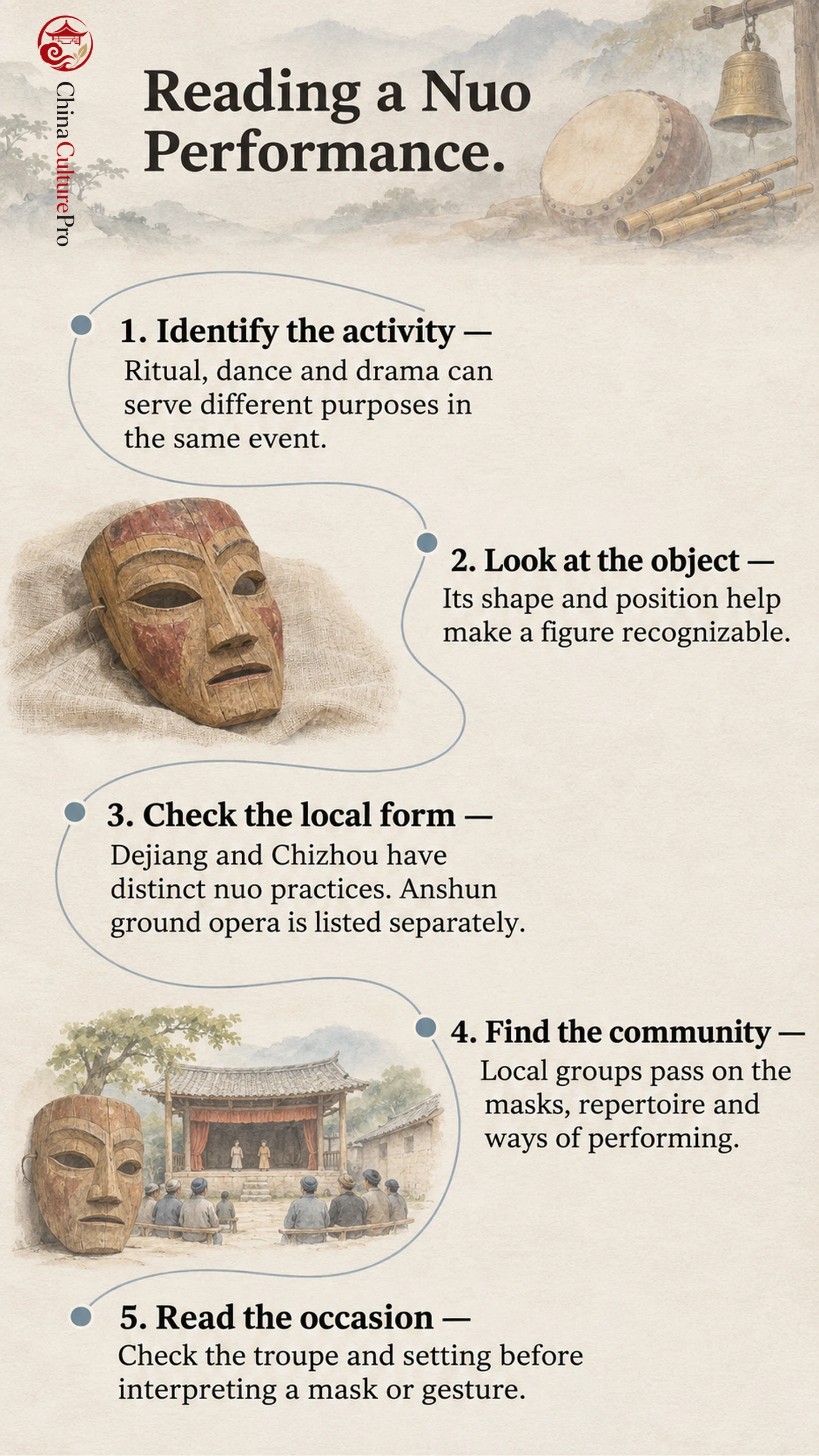
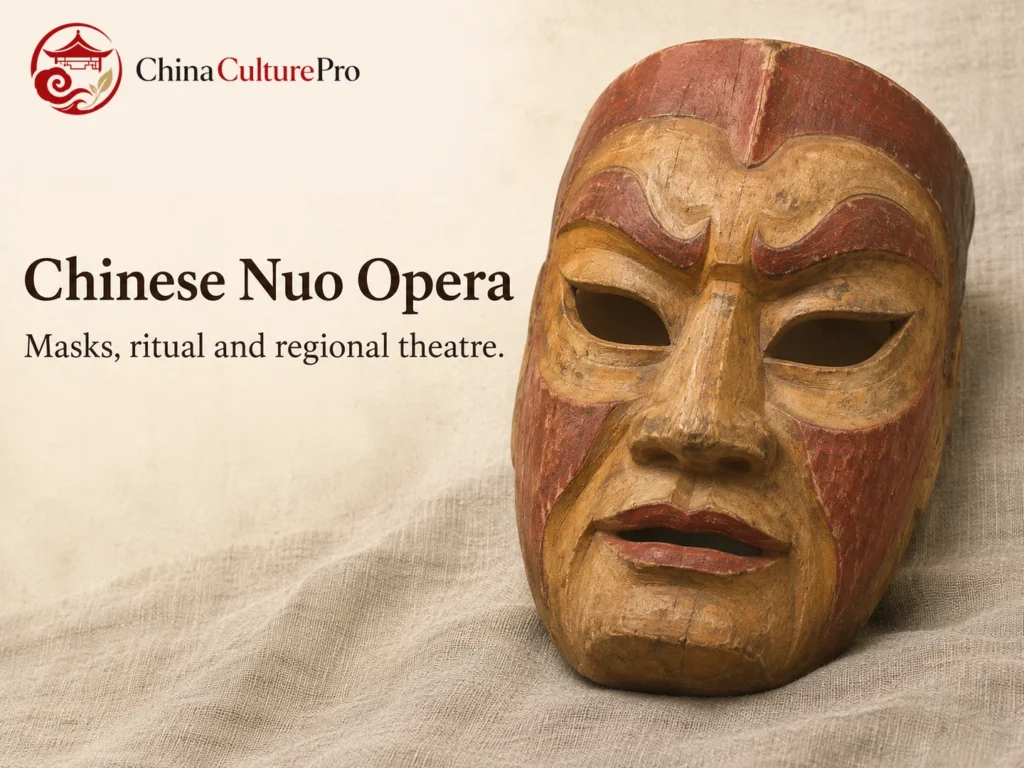
A mask can make a figure recognizable before the actor speaks. To understand what that figure is doing, look beyond the mask. The scene and occasion tell you whether the performer is taking part in a ceremony, a dance or a play.
Ritual, Dance and Drama
Chizhou’s heritage record distinguishes nuo ritual, nuoyi(傩仪,nuóyí), nuo dance, nuowu(傩舞,nuówǔ), and theatrical performance. A ritual can address ancestors or express wishes for protection and good fortune. A dance can make movement and formation the focus. A play can bring named characters and a sequence of events into the performance. [1]
These functions can sit alongside one another. In Dejiang, dramatic scenes are one part of a larger practice associated with an altar and a community occasion. A short stage extract can show a piece of the repertoire without showing the events around it. A programme may identify a dramatic extract as part of Chinese theatre even when it shows only one part of the wider practice. [2]
What the Mask Does in Performance
A mask is a separate object worn over the face or attached above it, depending on the tradition. Its outline and position affect the figure the audience sees. In some roles the mask helps distinguish an official, warrior or other figure. Because the performer’s own expression can be less visible, posture, pace and the direction of the head become useful clues. [1]
Anshun ground opera provides a distinct example of mask placement. The heritage account describes masks worn at the forehead, with cloth covering the head. That placement gives the figure a different silhouette from a mask worn directly over the face. Read the object with the costume and movement as well as with the character named in a programme. [3]
Dejiang, Chizhou and Anshun Compared
These documented practices show why one description cannot cover every performance. Anshun dixi(地戏,dìxì), often translated as ground opera, is included here as a related masked theatre tradition.
| Example | Place | One performance clue |
|---|---|---|
| Dejiang altar theatre | Dejiang, Guizhou | Masked drama can occur within a wider ritual event, with main and inserted scenes. [2] |
| Chizhou nuo opera | Chizhou area, Anhui | Local lineages maintain performances that distinguish ritual, dance and drama. [1] |
| Anshun ground opera | Anshun, Guizhou | Forehead masks and a repertoire of martial stories help identify the form. [3] |
Check the local name when comparing two recordings. An audience may see a familiar shape or character in more than one tradition, with a different occasion and role for the performance.
Community Practice and Heritage Records
Dejiang and Chizhou entered China’s first national intangible cultural heritage list in 2006 under the nuo opera project. Anshun ground opera was listed separately in the same batch. The national heritage records identify named practices and their places. Anshun’s separate entry shows why the wider comparison should preserve local distinctions. [3]
The community context matters as much as the costume. In Chizhou, lineages maintain performance knowledge across generations. [1] In Anshun, village groups perform on particular occasions. A presentation outside the original setting can show an element of the practice, while the local context helps explain why it is performed. [3]
How to Watch a Nuo Performance in Context
Check the troupe, place and occasion first. Look for whether the clip shows a ritual action, a dance or a scene with a plot. Then follow one performer’s steps and direction of gaze. If the mask obscures the face, the movement and sound may carry much of the characterization.
The worn masks in these traditions differ from Peking opera face painting, where patterns are commonly applied to the performer’s face. Both can help the audience recognize a character from a distance. Their materials and settings shape the effect. [4]
FAQs About Chinese Nuo Opera
Is every nuo ritual an opera?
Ritual and drama can be part of one occasion. In documented traditions such as Chizhou’s, they have distinct functions.
Are nuo masks the same as Peking opera face paint?
A worn mask is a separate object. Peking opera’s familiar painted designs are generally applied directly to the face.
Is Anshun ground opera the same as Dejiang altar theatre?
They are related masked performance traditions with different settings and repertoires. China’s national inventory lists them as separate projects.
Sources
[1] China Intangible Cultural Heritage Digital Museum. Chizhou Nuo Opera
[2] China Intangible Cultural Heritage Digital Museum. Dejiang Nuo Altar Theatre
[3] China Intangible Cultural Heritage Digital Museum. Anshun Ground Opera
[4] China National Peking Opera Company. Peking Opera Face Painting