
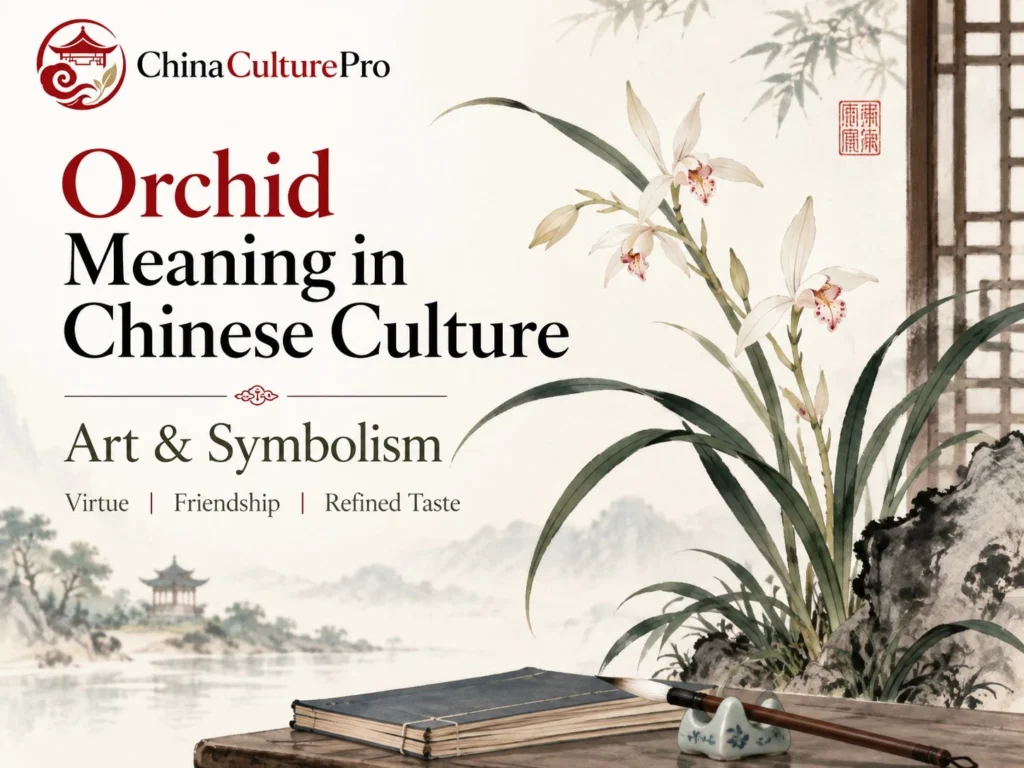

Quick Answer: What Does the Orchid Symbolize in Chinese Culture?
Lan (兰, lán), usually translated as “orchid,” can represent the junzi (君子, jūnzǐ), a cultivated or noble person whose integrity does not depend on public recognition. In Chinese literature and painting, its most established associations are quiet virtue, refined learning, hidden talent, friendship, loyalty, and—in a narrow historical setting—fidelity to the fallen Song dynasty.[1][3][4]
- The orchid’s subtle fragrance may suggest moral influence that spreads without display.
- A wild orchid growing unseen can represent an able person whose worth remains unrecognized.
- Orchid language can describe like-minded friendship, especially when supported by a classical quotation or inscription.
- A court flower study or decorative orchid may primarily express natural beauty, seasonal interest, or elegant taste.
These are contextual cultural metaphors, not universal definitions. Orchid art, jewelry, tattoos, or houseplants cannot attract wealth, secure love, improve fertility, protect a home, or change fortune.
Ma Lin’s early-thirteenth-century Orchids is a refined Southern Song court album leaf: lavender, white, and green flowers are carefully balanced for visual and poetic pleasure. Zheng Sixiao’s ink orchid (墨兰, mòlán) of 1306 works differently. Painted after the Song fell, it lacks supporting earth and became a statement of loyalty to a lost dynasty. The first image rewards close looking; the second turns a plant into political memory.[1][2][6]
This contrast gives the essential rule for reading orchids within the wider system of Chinese flower and plant symbolism: meaning comes from date, medium, inscription, composition, and the maker’s circumstances. An orchid is not a permanent code for virtue, love, or luck.
Lan, Guolan, Cymbidium, and Modern Orchids: What Is the Difference?
“Orchid” is convenient English, but it can hide several different Chinese concepts. The lan of an early poem, the slender plant in a scholar’s ink painting, and a large-flowered orchid sold by a modern florist need not be botanically or culturally identical.
| Term | Best English handling | What it means in context | Important limit |
|---|---|---|---|
| Lan (兰, lán) | lan; often translated “orchid” | A classical name associated with fragrant plants and, later, orchids in literature and art | An early textual lan cannot always be assigned to one modern species |
| Secluded orchid (幽兰, yōulán) | secluded or hidden orchid | A literary image of fragrance in an overlooked valley or forest | An image and mood, not a botanical category |
| Guolan (国兰, guólán) | traditional Chinese cultivated orchid | A horticultural and cultural umbrella for elegant, often fragrant Cymbidium orchids | Not every orchid sold in China belongs to this tradition |
| Ink orchid (墨兰, mòlán) | ink orchid | A calligraphic painting subject made with ink | The phrase names an artistic genre here, not necessarily the plant species also called mòlán |
| Modern lanhua (兰花, lánhuā) | orchid | The broad everyday name for members of the orchid family | It includes showy florist plants without an automatic literati meaning |
| Mulan (木兰, mùlán) | magnolia | A woody magnolia-family plant, or a name built from those characters | It is not an orchid |
The National Museum of Asian Art describes Cymbidium as the plant at the center of the historic painting tradition.[1] Its long leaves and comparatively small flowers match the calligraphic forms favored by scholar-painters. Modern Phalaenopsis orchids, with broad leaves and large butterfly-shaped blooms, belong to another visual and commercial setting. They may acquire contemporary gift meanings, but they should not be used as the model for identifying an old ink orchid.
Even “guolan” is not a precise species label for every historical picture. Stylized brushwork can make identification uncertain, and premodern writers did not classify plants according to modern botanical rules. When an artwork has an established Chinese title or museum identification, that evidence takes priority over guessing from a few leaves or petals.
Why Does the Orchid Represent the Junzi, Hidden Talent, and Moral Fragrance?
The orchid’s moral meaning developed through analogy. Writers observed—or imagined—a fragrant plant growing away from crowds, then used that picture to describe a person who preserves principle without applause. The plant does not literally possess humility or integrity; it becomes a vehicle for thinking about those qualities.
| Observed or literary feature | Human association | Interpretive boundary |
|---|---|---|
| Growth in a secluded place | A talented person outside court or public recognition | Most relevant to poetry, inscriptions, and literati painting |
| Fragrance that spreads quietly | Virtue whose influence is sensed rather than advertised | A moral metaphor, not a supernatural aura |
| Slender leaves and restrained blossoms | Self-command, refinement, and unshowy learning | Does not make every orchid picture a portrait of an ideal person |
A passage transmitted in the Kongzi Jiayu says that fragrant plants grow in deep forests without ceasing to be fragrant because no one is present; likewise, a cultivated person does not abandon principle in hardship. The wording strongly shaped later orchid interpretation, although the Kongzi Jiayu is a later compilation and should not be treated as a verbatim contemporary record of Confucius.[3]
The idea also appears visually. The National Museum of Asian Art connects the Cymbidium tradition with principled figures whose talent and integrity may go unrecognized.[1] This is the logic of moral fragrance: worth remains real even when power ignores it.
How Orchid Symbolism Changed Across Chinese History
Orchid symbolism accumulated rather than moving through one clean sequence. Early fragrant-plant language, court flower painting, calligraphic ink orchids, loyalist art, and later decoration could coexist. A date narrows the possibilities, but it does not decide meaning by itself.
Early Fragrant Herbs in Classical Texts
In early texts, lan belongs to a larger vocabulary of aromatic plants. The Li Sao speaker describes wearing river angelica, fragrant angelica, and autumn lan as ornaments. These plants embody cultivated qualities and distance from a corrupt world, but the word lan in this setting cannot safely be equated with one modern orchid species.[5]
The distinction matters because later viewers often project the slender-leaved Cymbidium of Song and Yuan painting backward into every ancient line. Early botanical identity is debated, while the literary function is clearer: fragrance and adornment help represent ethical cultivation. This layer predates the fully developed ink-orchid genre and the later Four Gentlemen (四君子, sì jūnzǐ) framework.
The Book of Changes supplies another lasting association. “Words spoken by people of one heart are fragrant like orchids” joins accord of mind with shared fragrance.[4] Later friendship language drew on this comparison, but the verse does not make every painted orchid a friendship gift. The connection is strongest when an inscription, dedication, paired composition, or documented exchange points toward companionship.
Song–Yuan Orchid Painting and Scholar Self-Expression
The orchid became an independent painting subject during the Song dynasty. Two approaches developed side by side. Court and professional painters could use outline and color to describe a flower with exquisite precision. Ma Lin’s Orchids, dated to the second quarter of the thirteenth century and catalogued by the Met as object 1973.120.10, exemplifies the formal realism favored by the aristocratic Southern Song court. Its asymmetrical arrangement and subtle color recall lyric poetry about flowers.[2]
Scholar-painters increasingly used monochrome ink and calligraphic strokes. Long, turning leaves could be drawn with movements related to writing, making the orchid a test of brush discipline as well as a moral image. A work might evoke solitude, learning, or an unrecognized official, but the inscription and the artist’s situation remain essential. It is too strong to call every ink orchid political protest.
After the Mongol conquest of the Song and the establishment of the Yuan, the genre gained a specific loyalist charge for some artists. Refusal to serve a new court, grief for lost territory, and preservation of personal principle could be expressed through an orchid denied ordinary ground. This meaning reached its most famous form in Zheng Sixiao’s 1306 handscroll.[1][6]
Ming–Qing Literati, Monks, Courtesans, and Decorative Orchids
The ink orchid did not remain the exclusive property of male scholar-officials. The National Museum of Asian Art notes that Chan monks adapted the subject in the fourteenth century and that renowned courtesan painters made it a mainstay in the late Ming and early Qing.[1] Those makers brought different social positions and artistic aims to the same brush vocabulary.
A monk’s orchid might support meditation or disciplined brush practice; a courtesan’s orchid could participate in exchanges with scholars while asserting artistic accomplishment. Later literati continued to use it for self-cultivation, friendship, or personal circumstance. None of these works should be reduced to a single gendered ideal.
Orchids also entered ceramics, textiles, fans, and other decorative arts. In these media the flower could signal elegant taste, complement another motif, or simply organize a surface. A patterned bowl is not automatically a confession of loyalism. By the Qing dynasty, moral associations remained available, but they existed alongside lighter ornamental and social uses.
The Orchid in the Four Gentlemen
The Four Gentlemen (四君子, sì jūnzǐ) are plum blossom, orchid, bamboo, and chrysanthemum. Together they became a durable framework for learning brushwork and discussing cultivated character. The individual plant associations are older, but the collective system crystallized in late-imperial painting culture and manuals; it should not be treated as a fixed category already operating in early antiquity.
Within the group, orchid usually represents quiet fragrance, modesty, and inward cultivation. Plum blossom brings wintry resilience, while bamboo contributes flexibility, uprightness, and articulated “joints” that invite ideas of moral integrity. Chrysanthemum is often associated with autumn and reclusion.
Seasonal charts commonly assign orchid to spring, but that arrangement is a useful later convention rather than a universal ancient law. A lone orchid painting is still an orchid painting, not a complete Four Gentlemen composition. Conversely, a set of four panels may invoke the collective theme even when each plant appears separately. The object’s title, format, and inscriptions settle the question.
Common Orchid Motifs and Their Meanings in Chinese Art
The table offers leading readings, not permanent equations.
| Motif | Leading interpretation | Evidence to check | Do not assume |
|---|---|---|---|
| Colored single orchid | Courtly flower study, poetic naturalism, refined taste | Album format, color, museum title, court context | Loyalism or hidden-talent symbolism |
| Calligraphic ink orchid | Literati cultivation, solitude, integrity, learned brushwork | Artist, inscription, ink technique | Every example protests a government |
| Orchid without supporting earth | Song loyalism in Zheng Sixiao’s case; possible later quotation of that model | Date, roots/ground, inscription, maker’s biography | All exposed-root orchids share one politics |
| Orchid with bamboo and rocks | Composite scholar virtues: modest learning, integrity, endurance | All elements and their catalogue context | Four Gentlemen or a feng shui “support” formula |
| Orchid with lingzhi (灵芝, língzhī) | Orchid elegance plus a longevity or immortality association supplied by lingzhi | Secure fungus identification and inscription | Orchid itself means long life |
| Potted or repeated decorative orchid | Refined domestic taste, display, or surface ornament | Vessel function, workshop pattern, use | Wealth, fertility, or household protection |
Rootless Orchids and Zheng Sixiao’s Loyalty
The rootless orchid (无根兰, wúgēn lán) is best understood through one artist rather than as a generic dictionary entry. Zheng Sixiao was a Song loyalist who refused service under the Yuan. In his 1306 Orchid, held by the Osaka City Museum of Fine Arts, the plant appears without supporting soil; the museum interpretation connects its displaced root to the Song ruler after the loss of his land. The work expresses mourning and protest against the new dynasty.[6]
This is not simply “an orchid means patriotism.” Artist, date, composition, and political biography reinforce one another. “Loyalty to the fallen Song” is more precise than projecting a modern national identity onto a thirteenth-century dynastic conflict.
Later artists could quote or imitate Zheng’s form, but resemblance alone does not prove the same conviction. A copy might honor art history, practice brushwork, or create an antiquarian mood. Look for an inscription naming Zheng, language about lost land, or evidence about the painter’s own circumstances before assigning loyalist politics.
Orchids with Bamboo, Rocks, or Other Plants
Composite images distribute meaning among their parts. The Cleveland Museum of Art’s Yuan handscroll Bamboo, Rocks, and Lonely Orchids (1963.515), attributed to Zhao Mengfu, offers a clear example. Its label associates bamboo with moral integrity, endurance, and loyalty; wild orchids with modesty and learnedness; and rocks with miniature mountains. Calligraphic ink unites the group visually.[7]
The orchid’s role is therefore not to carry every idea by itself. It adds restrained fragrance and scholarly cultivation to bamboo’s resilience and the rock’s enduring landscape presence. Such a painting may present a composite ideal of the scholar-official, but it is not automatically the Four Gentlemen because plum and chrysanthemum are absent.
Other combinations must be read afresh. Orchid with plum may bring together two refined flowers; orchid with a bird may be a seasonal flower-and-bird subject; orchid with an inscription to a friend may make companionship primary. No universal chart can replace the catalogue, title, and image.
Potted Orchids, Lingzhi, and Decorative Orchid Patterns
A potted orchid can indicate cultivated taste, studio display, or the act of caring for a prized plant. It differs from a wild orchid whose solitude is central to the composition. On porcelain or textiles, repeated leaves and flowers may work mainly as graceful ornament, especially when no inscription or narrative clue specifies a moral subject.
The orchid-and-lingzhi pairing shows why meanings cannot be pooled indiscriminately. Lingzhi (灵芝, língzhī), often called the fungus of immortality, can carry longevity or immortality associations. In Hu Jiusi’s 1838 fan Orchid and Fungus-of-Immortality by a Torrent, the Smithsonian notes that the two were not traditionally grouped and that the longing for immortality comes from the fungus.[8] The orchid contributes elegance and perhaps personal or scholarly resonance; it does not become a universal longevity flower.
Likewise, a decorative orchid beside another auspicious object inherits only what the whole documented composition supports. It is poor method to list every favorable association of every component and declare that the object promises all of them.
What Does Lan Mean in Chinese Idioms and Language?
Language preserves important orchid associations, but an idiom does not automatically explain a picture.
| Expression | Usual meaning | Boundary |
|---|---|---|
| “Words of one heart are fragrant like orchids” | Harmony of thought and sincere companionship | A classical comparison; not a claim that orchid always means friendship |
| Golden-orchid friendship (金兰之交, jīnlán zhī jiāo) | A close bond between like-minded friends | Friendship, not a standard term for romance |
| Zhilan yushu (芝兰玉树, zhīlán yùshù) | Promising, accomplished, or virtuous younger people in a family | A literary expression, not a botanical scene description |
| Orchid room (兰室, lánshì) | A refined environment or morally improving company | Does not require a literal potted orchid indoors |
| Orchid Pavilion (兰亭, Lántíng) | The historical site and calligraphic gathering associated with Wang Xizhi | A proper name and cultural event, not orchid symbolism |
The Book of Changes phrase about words “of one heart” supports orchid’s strong friendship association.[4] The older character 臭 in that line means scent, not the modern everyday sense “stink.” Later expressions such as “golden-orchid friendship” elaborate the idea of congenial minds and enduring trust.
These phrases belong to language and social ethics. A ceramic with an orchid need not refer to a sworn friendship unless its inscription, pair, dedication, or use provides that connection. Similarly, an object named for the Orchid Pavilion concerns calligraphy and gathering even if no orchid is depicted.
Does the Orchid Symbolize Love, Friendship, Beauty, or Fertility?
The answer changes by category:
- Friendship: Yes, this is a well-grounded association. Classical language compares united words to orchid fragrance, and later jinlan vocabulary describes close, like-minded friendship. An inscription or documented gift makes the reading stronger.
- Beauty: Sometimes. Orchid can suggest refined, restrained elegance and may praise any person’s cultivated bearing. It is not inherently female and should not be reduced to physical attractiveness.
- Love: Not as a universal classical default. A later painting, poem, or modern bouquet can use orchids romantically, but the evidence must come from that work or occasion rather than the plant alone.
- Fertility: Not a stable general meaning of orchid in Chinese art. Family or descendant wishes may occur in a particular rebus, inscription, or modern commercial setting, but orchid by itself does not establish them.
Modern global floristry has added meanings to many orchid types and colors. Those conventions can be appropriate for contemporary gifts, but they are not a key for decoding a Song ink painting. Friendship and moral character are historically stronger Chinese associations than a generic equation with romance or fertility.
What a Chinese Orchid Symbol Does Not Automatically Mean
| Common claim | More accurate interpretation |
|---|---|
| Every orchid represents a morally perfect junzi | The junzi reading is strongest in literati texts and paintings; court studies and decoration may prioritize beauty or design |
| Every rootless orchid is anti-Yuan patriotic art | Zheng Sixiao’s work has that documented context; later images require their own evidence |
| Orchid always means love, fertility, wealth, or longevity | None is a universal default; combinations and inscriptions may create narrower meanings |
| Each orchid color has a fixed Chinese fortune | No cross-era code governs all literature, painting, porcelain, floristry, and modern design |
| A modern Phalaenopsis carries the full meaning of classical lan | Modern florist orchids and the Cymbidium-centered literati image belong to different visual histories |
| Mulan and Lanting prove a connection to orchid symbolism | Mulan is magnolia-related or a name; Lanting is the Orchid Pavilion proper name and calligraphy tradition |
| Orchid art or a houseplant changes luck | It can express values or wishes but cannot attract money, protect a home, or alter outcomes |
| Japanese or Western flower language explains Chinese orchid painting | Shared plants do not make separate symbolic systems interchangeable |
The strongest correction is not that orchids “mean nothing.” It is that a plausible association must match the object. Quiet integrity can lead in a calligraphic ink orchid; lyric beauty can lead in Ma Lin’s colored album leaf; dynastic loyalty can lead in Zheng Sixiao’s landless plant; immortality can come from a companion lingzhi rather than from the orchid.
How to Interpret or Use a Chinese Orchid Symbol Correctly
Use this six-step sequence:
- Identify the term and plant as far as the evidence allows. Separate early aromatic lan, Cymbidium-centered guolan, a painted ink orchid, modern Phalaenopsis, and magnolia.
- Establish the date. An early literary fragrant herb, Southern Song court leaf, Yuan loyalist handscroll, Qing fan, and modern tattoo do not share one code.
- Identify the medium and original function. Court album, literati handscroll, porcelain ornament, potted display, and commercial bouquet invite different questions.
- Read inscriptions and biography. They are especially important for claims about friendship, unrecognized talent, religious practice, or political loyalty.
- Read the whole composition. Bamboo, rocks, lingzhi, a pot, other flowers, and dedicatory text can change which meaning leads.
- Separate historical evidence from modern choice. A contemporary designer may create a new meaning, but should label it as adaptation rather than ancient law.
In a museum, Ma Lin’s colored orchid should first be read through Southern Song court aesthetics, while Zheng Sixiao’s plant requires the fall of the Song and his refusal to serve the Yuan. In a logo, orchid can suggest restrained excellence or quiet confidence as a modern design choice. In a tattoo, calligraphic leaves may reference literati integrity, but there is no ancient orchid-tattoo canon or lucky orientation. For a home or gift, appreciate beauty and association without treating the plant as an instrument of fortune. This context-first approach follows the broader logic of Chinese symbols and meanings.
FAQs About Orchid Symbolism in Chinese Culture
Is the Orchid One of the Four Gentlemen?
Yes. Orchid is one of the Four Gentlemen with plum blossom, bamboo, and chrysanthemum. In that later collective framework it commonly represents subtle fragrance, modesty, and inward cultivation. A single orchid picture is not automatically a complete Four Gentlemen subject; the full set, title, format, or curatorial context should establish the category.
Do Orchid Colors Have Fixed Meanings in Chinese Culture?
No universal historical code gives red, white, yellow, or purple orchids one permanent meaning. Color may matter within a particular court painting, ceramic palette, local custom, Buddhist setting, or modern bouquet, but it cannot be transferred automatically to every Chinese orchid image. Count, direction, and placement likewise have no cross-era fortune chart.
Does the Orchid Symbolize Love or Fertility?
Not by default. Friendship, cultivated character, hidden talent, and refined fragrance are more securely grounded traditional associations. A particular poem, wedding object, inscription, or modern gift can give orchid a romantic or family meaning, but the flower alone does not establish love or fertility and has no power to influence either.
Is Mulan a Type of Orchid?
No. Mulan (木兰, mùlán) refers to magnolia-related woody plants in botanical contexts and also functions as a personal name. It is unrelated to the orchid family. The shared syllable lan does not make the terms botanically or symbolically equivalent, so “mulan” should not be translated as “orchid.”
What Does a Chinese Orchid Tattoo Mean?
A modern orchid tattoo may express quiet integrity, self-cultivation, understated talent, friendship, or loyalty. A Zheng Sixiao-inspired rootless orchid can make a more specific historical reference if the design preserves that context. There is no premodern Chinese orchid-tattoo canon, fixed color or direction rule, or supernatural promise of love, wealth, or protection.
Sources
[1] Smithsonian National Museum of Asian Art. The Orchid in Chinese Painting
[2] The Metropolitan Museum of Art. Ma Lin: Orchids
[3] Chinese Text Project. Kongzi Jiayu: In Distress
[4] Wikisource. Zhouyi Zhengyi: Xici Commentary
[5] Chinese Text Project. Chuci: Li Sao
[6] Osaka City Museum of Fine Arts via Google Arts & Culture. Zheng Sixiao: Orchid
[7] Cleveland Museum of Art. Bamboo, Rocks, and Lonely Orchids
[8] Smithsonian National Museum of Asian Art. Orchid and Fungus-of-Immortality by a Torrent