
Quick Answer: What Do Animals Symbolize in Chinese Culture?
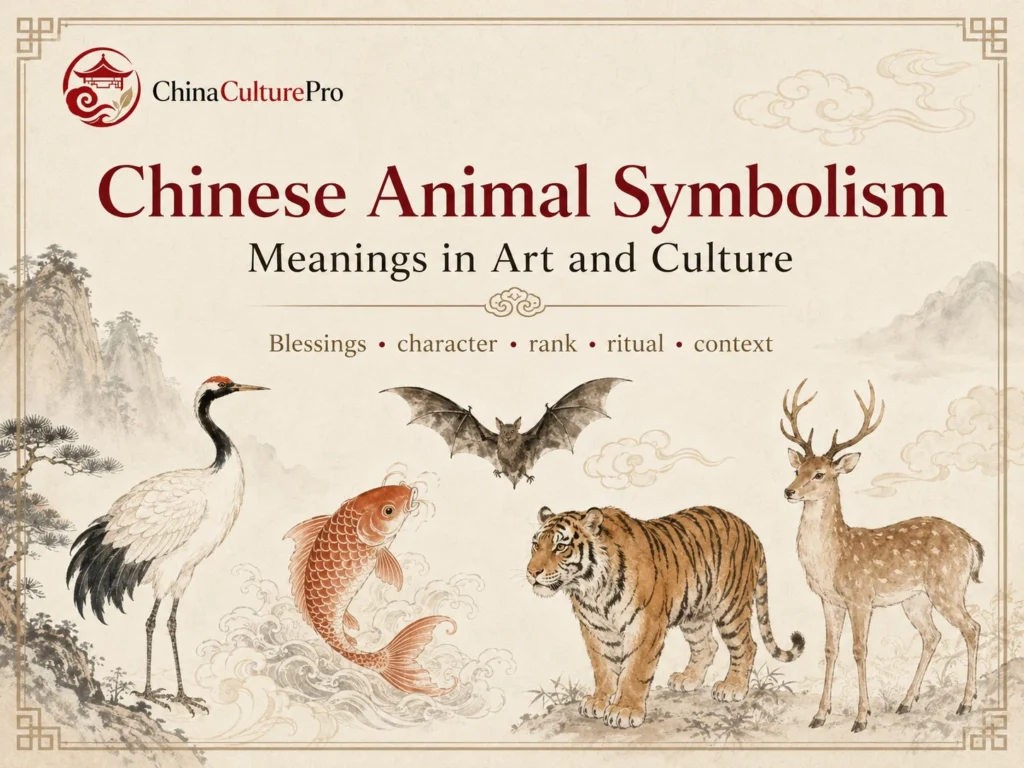
Animals in Chinese culture can express blessings, moral qualities, social rank, cosmic order, religious ideas, or political messages. No animal has one permanent meaning in every artwork. Interpretation depends on the species, historical period, medium, cultural system, inscription, and surrounding motifs.[1][2]
- Auspicious wishes: Wordplay and familiar stories can express longevity, abundance, advancement, marriage, or good news.
- Moral character: Artists may use perceived animal behavior to praise courage, loyalty, refinement, or talent.
- Social hierarchy: Ming and Qing rank badges used specific birds and beasts as institutional markers.
- Cosmological order: Zodiac animals and the Four Symbols organize time or celestial direction.
- Religious and political meaning: Animals can belong to Buddhist, Daoist, funerary, or critical visual narratives.
An animal image may also be descriptive or decorative. It is not automatically a lucky charm, religious figure, or source of supernatural protection.
A crane embroidered on a Qing court badge and one painted beside a pine tree may depict the same species but perform different cultural jobs. The first can mark official rank; the second may evoke long life, transcendence, or an ideal landscape. Similar shifts occur with deer, ducks, tigers, tortoises, and dragons.
A Qing court badge makes the problem visible. Its crane does not primarily offer a wish for long life. On this regulated garment, the bird identifies a first-rank civil official. A crane on a birthday vase or in a Daoist landscape can carry a different message.[3] Period, object, system, and companion motifs must come before a one-word definition.
What Is Chinese Animal Symbolism?
Chinese animal symbolism is a visual and literary language formed from real animals, imagined creatures, spoken puns, classical texts, social institutions, and changing artistic conventions. The animal, its image, and the cultural system using that image are related but not identical. The wider history of Chinese symbolism in art shows how these meanings move across painting, ceramics, jade, textiles, architecture, and other media.
“Symbolism” does not mean that an animal carries a hidden code wherever it appears. A fish in an observed river scene may remain a fish; the same species beside a lotus, inscription, or cash motif may become a rebus. Meaning begins when the object’s setting, audience, and visual conventions support it.
Four basic categories help establish the scope:
- Animal motif: An image of a real creature, such as a crane, deer, tiger, or fish. Its meaning comes from the dated object and composition, not from biology alone.
- Zodiac animal: One of the twelve animals in the recurring calendar cycle. A zodiac tiger performs a different job from a tiger painted as a protective beast.
- Mythical creature: An imagined or composite being such as the dragon, Fenghuang, or Qilin. Some have extensive textual traditions, but they do not form one unified religion or mythology.
- Religious animal figure: An animal serving a specific sacred narrative, such as the lion associated with Manjushri or the white elephant associated with Samantabhadra in Buddhist art.
The broader guide to Chinese symbols and meanings explains the same context-first method across characters, plants, colors, numbers, and objects. This page applies it specifically to animals.
Common Chinese Animal Symbols at a Glance
The associations below are starting points, not universal translations. A date, inscription, institutional setting, or companion image can narrow or replace the familiar reading.
| Animal | Chinese and pinyin | Type | Common associations | Typical contexts | Interpretation limit |
|---|---|---|---|---|---|
| Bat | 蝙蝠, biānfú | Real animal motif | Blessing or good fortune through the sound shared by 蝠 and 福, both fú | Porcelain, textiles, lacquer, carving | One bat can evoke fortune, but its number and companions define the fuller message. A bat is not proof that every object is a good-luck charm. |
| Fish or carp | 鱼/魚, yú; 鲤鱼/鯉魚, lǐyú | Real animal motif | Abundance through 鱼/余; advancement in the carp-leaping-the-Dragon-Gate tradition | New Year prints, ceramics, jade | The Dragon Gate story specifically concerns carp. Fish may also be naturalistic, Buddhist, or purely decorative. |
| Crane | 鹤/鶴, hè | Real animal motif | Longevity, transcendence, refined withdrawal, or court rank | Paintings, porcelain, textiles, rank badges | A crane on a Qing badge marks first-rank civil status rather than a general birthday wish.[3] The “thousand-year crane” is cultural imagery, not zoology. |
| Deer | 鹿, lù | Real animal motif | Official emolument through the sound shared with 禄/祿; longevity and immortal realms | Painting, porcelain, lacquer, court art | A deer can instead describe a landscape or hunt. Official benefit and longevity are separate readings that depend on context. |
| Mandarin ducks | 鸳鸯/鴛鴦, yuānyāng | Real animal motif | Marital affection and a harmonious pair | Wedding textiles, paintings, porcelain | The bond is a cultural ideal, not a claim that the species always mates for life. On a Ming badge, the birds identified a seventh-rank civil official.[4] |
| Magpie | 喜鹊/喜鵲, xǐquè | Real animal motif | Joy, welcome news, and seasonal celebration | Painting, embroidery, porcelain, New Year art | A magpie gains a more precise message from its position, inscription, and companion plant; it is not always a generic luck symbol. |
| Tiger | 虎, hǔ | Real animal motif | Courage, military force, authority, and protection in some folk settings | Bronze, jade, military objects, New Year art | An ordinary tiger is not automatically the White Tiger of the west within the Four Symbols. |
| Horse | 马/馬, mǎ | Real animal motif | Speed, stamina, talent, ambition, service, or the Horse zodiac sign | Handscrolls, sculpture, tomb art, court painting | Horses may praise able people, record elite life, or criticize political conditions. They do not always promise instant success. |
| Monkey | 猴, hóu | Real animal motif | A marquis or noble title through the sound shared with 侯, hóu | Ceramics, jade, painting, rebus designs | The official-career message is clearest when other images complete a phrase. A monkey can also be comic, mischievous, or zodiacal. |
| Rooster | 鸡/雞, jī | Real animal motif | Auspiciousness through its near-homophone 吉, jí; punctuality and vigilance | New Year pictures, ceramics, mirrors, zodiac art | The visual pun depends on language and context. Roosters also appear in calendrical, domestic, and protective folk imagery. |
| Tortoise | 龟/龜, guī | Real animal motif and numinous creature | Durability, longevity, divination, and enduring order | Oracle traditions, inkstones, ritual art, decorative objects | A lone tortoise is not Xuanwu. The northern emblem is normally a tortoise entwined with a snake and belongs to a directional system. |
| Butterfly | 蝴蝶, húdié | Real animal motif | Joy, weddings, spring, and longevity wordplay in later art | Jade, painting, porcelain, embroidery | The surrounding flowers, animals, and occasion determine whether romance, season, or age is emphasized. |
| Chinese dragon | 龙/龍, lóng | Mythical creature | Water and rain, auspicious power, cosmic order, imperial authority | Ritual art, court dress, architecture, festivals | A generic dragon is not automatically a zodiac dragon, the Azure Dragon, or a Dragon King. |
| Fenghuang | 凤凰/鳳凰, fènghuáng | Mythical bird | Virtue, peaceful rule, nobility, harmony, and later wedding auspice | Court art, textiles, ceramics, wedding design | It is neither the Vermilion Bird nor the Western phoenix defined by death and rebirth in fire. Early texts could distinguish feng and huang; later art commonly treats Fenghuang as one compound name. |
| Qilin | 麒麟, qílín | Mythical creature | Benevolent virtue, peaceful government, worthy people, and later family blessings | Court painting, textiles, stone carving, folk art | It is not simply a Chinese unicorn. Later child-related imagery does not define every classical Qilin. |
The broader animal tradition also includes the elephant, associated in different settings with power, peace, courtly imagery, or Buddhist narratives; the swallow, often connected with spring, return, and domestic life; and the cicada, whose meanings changed across early jade, funerary, literary, and seasonal contexts. These animals require the same period-and-object test as the more familiar motifs in the table.
Other specialized creatures have their own histories. Pixiu moved from fierce and funerary associations toward modern wealth symbolism; Jin Chan developed from lunar and immortal imagery into the modern Money Frog; and Chinese guardian lions are stylized lions rather than “Foo Dog” species. The Chinese mythical creatures guide compares these identities without turning them into one interchangeable bestiary.
How Chinese Animal Meanings Are Created
Observed Traits and Human-Animal Relationships
Artists and writers often selected an animal trait and translated it into human values. A horse’s speed and usefulness could suggest ability or service. A tiger’s force could visualize military power. Cranes acquired associations with exceptional age, transcendence, and elegant withdrawal. Paired mandarin ducks became models of marital harmony.
These are cultural readings, not scientific definitions. Real cranes do not live for a thousand years, mandarin ducks do not guarantee lifelong monogamy, and a tiger image has no inherent protective force. Artists also used animals to record courtly life, landscapes, pets, hunting, or political conditions. Observed nature supplied material; human institutions and stories decided what that material meant.[1][2]
The selection could also be ironic. A graceful or apparently harmless animal did not force a positive interpretation if an inscription, bleak setting, or historical circumstance pointed toward criticism. This is why posture, environment, and the artist’s text matter as much as the species.
Homophones, Rebuses, and Visual Wordplay
Chinese decorative art frequently works like a rebus: an image stands for a word with the same or a similar pronunciation. Bat, 蝠 (fú), can evoke the Fu symbol, 福 (fú), for blessing. Fish, 鱼/魚 (yú), can suggest surplus, 余/餘 (yú). Deer, 鹿 (lù), can evoke official emolument, 禄/祿 (lù). Monkey, 猴 (hóu), can suggest marquis, 侯 (hóu).
A single pun may establish a broad association, but multiple motifs create the complete sentence. On a Qing plate, a monkey, bees, magpie, and deer together form a visual wish for wealth and noble appointment. The meaning belongs to the composition, not to four independent “powers.”[5]
Wordplay must still be dated and documented. Modern Mandarin can explain many familiar rebuses, but it should not be projected automatically onto every region, dialect, and early archaeological object.
Inscriptions can confirm, redirect, or complicate the pun. A birthday dedication may settle a longevity reading, while a poem can turn a familiar bird into a personal or political metaphor. Without such evidence, “can evoke” is usually more accurate than “always means.”
Myth, Religion, Cosmology, and Social Rank
Some animal meanings come from formal systems rather than natural traits or puns. The Chinese zodiac uses twelve animals in a recurring calendrical order that was established by the Eastern Han dynasty. Later tomb figures, domestic objects, personality readings, and popular customs added new functions to that calendar framework.[7]
The Four Symbols of Chinese mythology map the Azure Dragon, White Tiger, Vermilion Bird, and Black Warrior to celestial directions. A seventh-century mirror presents them as east, west, south, and north, showing why a generic dragon, tiger, bird, or tortoise should not inherit a directional identity without supporting context.[8]
Institutions could be even more exact. Ming and Qing dress regulations used birds for civil rank badges and beasts for military rank. On the surviving examples used here, a crane identifies first civil rank and mandarin ducks identify seventh civil rank.[3][4] Their familiar longevity or marriage associations do not control those garments. The wider guide to Chinese symbolism in clothing explains how motifs can mark rank, identity, protection, occasion, or auspicious wishes in different dress systems.
Zodiac Animals, Mythical Creatures, and Cosmological Beasts: What Is the Difference?
The categories below answer different organizing questions. Only some are formal classical systems; “ordinary motifs” and “specialized creatures” are practical art-historical groupings.
| Category | Organizing principle | Examples | Typical carriers | Critical boundary |
|---|---|---|---|---|
| Ordinary animal motifs | Real creatures interpreted through art, language, and social use | Bat, crane, deer, fish, tiger | Painting, porcelain, textile, jade | The object and composition decide which association is active. |
| Zodiac animals | Twelve-animal recurring calendar cycle | Rat through pig in conventional order | Calendars, tomb figures, folk art, personal zodiac objects | Zodiac identity is calendrical; it does not replace every other meaning of the animal.[7] |
| Four Symbols | Four celestial regions and cardinal directions | Azure Dragon, White Tiger, Vermilion Bird, Black Warrior | Mirrors, tomb art, star and directional imagery | These are specific cosmic emblems, not generic versions of four ordinary animals.[8] |
| Four Numinous Creatures | Classical ritual order and an ideal flourishing world | Qilin, Fenghuang, tortoise, dragon | Classical texts and later auspicious art | The Book of Rites names this group; it is not the Four Symbols and has no matching four-direction scheme.[10] |
| Specialized mythical or guardian creatures | A distinct visual, architectural, religious, judicial, or folk role | Pixiu, Jin Chan, guardian lions, Xiezhi | Tombs, buildings, ritual art, decorative objects | Similar protection or prosperity associations do not make these creatures members of one formal group. |
This separation prevents common equations such as zodiac dragon = Azure Dragon = Dragon King, Fenghuang = Vermilion Bird, or tortoise = Xuanwu. Shared animal features do not erase different cultural jobs.
Membership is also not transferable by resemblance. The real tortoise can appear among the Four Numinous Creatures, while Xuanwu uses a tortoise-and-snake form in the Four Symbols. A dragon may belong to a ritual quartet on one object and appear as an anonymous rain creature on another. Classification should follow the named system present in the text or artwork, not whichever group looks most familiar.
Why the Same Animal Can Mean Different Things by Context
The carrier often settles the interpretation faster than the animal’s species. A rank badge, tomb figure, birthday vessel, handscroll, and logo were made for different readers and purposes.
| Context | Primary job of the animal | Typical carrier | Interpretation limit |
|---|---|---|---|
| Literati painting | Character, private emotion, social position, or political commentary | Handscroll, album leaf, hanging scroll | Not every animal painting is an auspicious wish. Five quails in one medieval painting were read as a pun on “no peace,” shaped by political conditions.[2] |
| Auspicious decorative art | Wishes expressed through rebuses, stories, and familiar combinations | Porcelain, textile, lacquer, jade | Many mature combinations flourished in Ming and Qing art; they should not be projected unchanged onto much earlier objects. |
| Court dress | Rank, office, loyalty, and regulated hierarchy | Ming and Qing rank badges | The creature identifies institutional status, not the wearer’s personality.[3][4] |
| Funerary art | Ordered space, celestial time, protection, or the afterlife | Tomb murals, burial figures, mirrors | A funerary meaning does not automatically apply when the same creature appears in a home or festival. |
| Religious art | A sacred companion, guardian, teaching image, or participant in a narrative | Temple sculpture, ritual painting, altar object | An animal beside a deity is not necessarily an independently worshipped god. |
| Zodiac calendar | Year, time cycle, and later personal or popular associations | Calendars, zodiac sets, New Year art | A zodiac horse or tiger should not replace the broader history of horse or tiger imagery. |
| Modern design | Heritage, aesthetics, personal identity, branding, or fictional adaptation | Tattoo, logo, fashion, film, game art | Modern meanings are valid creative choices when labeled as modern; they are not evidence of ancient intent. |
Mandarin ducks show the shift clearly. Swimming beside lotuses on an early eighteenth-century vase, they represent the husband-wife relationship within a wider image of five social bonds.[6] On a sixteenth-century rank badge, paired mandarin ducks identify a seventh-rank civil official.[4] In an uninscribed nature painting, they may simply be birds in a waterscape.
How Companion Motifs Create Complete Messages
Companion motifs act like visual grammar. They can narrow a broad association, join several wishes, or turn familiar animals into a phrase that no single image could express. The same method appears throughout Chinese flower and plant symbolism, where the plant may carry its own history while also completing an animal rebus.
| Combination | How it works | Combined message | Interpretation limit |
|---|---|---|---|
| Fish and lotus | 鱼/魚 (yú) evokes surplus; 莲/蓮 (lián) can evoke 连/連, continuous | 连年有余/連年有餘, continuing abundance year after year | The established rebus belongs to the combined design, not every pond scene. |
| Bats around a Shou character | Bats evoke 福, while 寿/壽 states longevity | Blessings gathered around long life; number and arrangement may add another layer | One bat does not automatically mean the full “Five Blessings” formula. |
| Magpie on a plum branch | 喜鹊/喜鵲 supplies joy; the plum branch supports seasonal and verbal play | Joy reaching the brow, commonly expressed as 喜上眉梢 | A separate plum or magpie may have a different subject. |
| Mandarin ducks and lotus | Paired birds meet a plant linked with harmony, continuity, and purity | Marital harmony in a suitable wedding or relationship context | It does not automatically promise children, and rank-badge ducks retain an institutional meaning. |
| Monkey, bees, magpie, and deer | Their names and images combine into a courtly rebus | A wish for wealth and the conferral of noble rank | Removing or changing a component can change the phrase.[5] |
| Deer, crane, and the Three Friends of Winter | Long-life animals join pine, bamboo, and plum, associated with endurance and renewal | Longevity, endurance, and an otherworldly flourishing landscape | Deer alone can instead evoke official emolument; the full composition decides.[9] |
The same principle explains why the early eighteenth-century “Five Relationships” vase uses five bird pairs to represent ruler and officials, father and son, husband and wife, siblings, and friends. The vase communicates a social order through the complete arrangement, not through five isolated bird definitions.[6]
How to Interpret a Chinese Animal Motif Correctly
Use the following order when reading museum objects, antiques, tattoos, logos, or decorative patterns:
- Identify the creature accurately: Decide whether it is a real animal, mythical hybrid, directional emblem, zodiac figure, or religious companion. One horn, one color, or a stylized body is rarely enough.
- Date the object and identify its use: A Shang ritual bronze, Han tomb mirror, Ming rank badge, Qing birthday vase, and modern pendant follow different visual conventions.
- Determine the cultural system: Ask whether the image belongs to ordinary decoration, the zodiac, Four Symbols, court dress, Buddhist or Daoist art, funerary practice, or a later folk tradition.
- Read the complete composition: Note inscriptions, numbers, plants, people, objects, posture, direction, and other animals. The message may be a rebus or narrative rather than an isolated emblem.
- Check the strongest available evidence: Prefer an inscription, archaeological context, museum identification, classical passage, or specialist catalogue. Without these, describe possibilities and uncertainty instead of declaring one fixed meaning.
For permanent or commercial designs, preserve the distinction between historical source and modern adaptation. Cultural symbolism can communicate a wish or value; it does not prove that a motif changes luck, health, wealth, or fate.
A useful design brief should therefore name the intended layer: for example, “a Qing-inspired longevity composition with cranes and pine” is clearer than “a Chinese crane for luck.” That wording gives the artist a period, message, and visual grammar to research while leaving room for a visibly modern style.
Common Misreadings of Chinese Animal Symbols
| Misreading | More accurate interpretation |
|---|---|
| Every animal has one fixed meaning | Meaning changes with period, medium, system, inscription, and companion motifs. |
| All animal motifs are lucky | Animals can record rank, time, religion, politics, funerary order, nature, or decoration without functioning as blessings. |
| Fenghuang is a fire-reborn Western phoenix | The Fenghuang centers on virtue, peaceful rule, nobility, and harmony; rebirth from ashes is not its defining Chinese story. |
| Every tortoise is Xuanwu | Xuanwu is the northern Four Symbols emblem, conventionally a tortoise entwined with a snake. A lone tortoise has other possible roles. |
| Every tiger is the White Tiger | The White Tiger is a specific western celestial emblem. Ordinary tigers can express force, courage, protection, hunting, or natural observation. |
| Every dragon is zodiacal, Azure, or a Dragon King | Generic dragons, zodiac dragons, the Azure Dragon, imperial dragons, and personified Dragon Kings occupy different contexts. |
| A rank-badge animal describes the wearer’s character | The regulated animal identifies an office or grade; it is not a personality profile. |
| An animal motif produces real-world results | The motif records cultural beliefs and wishes. It cannot guarantee protection, promotion, marriage, wealth, or changed fortune. |
Final Takeaway
Chinese animal symbolism is a changing visual language, not a fixed dictionary. Identify the animal, date the object, determine the cultural system, read the companion motifs, and check reliable evidence. That sequence explains why a crane can mark civil rank on one textile and longevity on another—and why later popular meanings should not be used automatically to decode ancient art.
FAQs About Chinese Animal Symbolism
Is There One Most Auspicious Animal in Chinese Culture?
No animal holds a universal first place across Chinese history. Dragons, Fenghuang, and Qilin perform different roles in court, ritual, mythic, and auspicious traditions. Fish, bats, and magpies are popular in everyday decorative wishes. “Most auspicious” therefore depends on the occasion, message, period, and cultural system.
Can One Animal Motif Carry More Than One Meaning at Once?
Yes. A motif may layer a spoken pun, seasonal reference, social role, and occasion. A deer beside a crane and pine can join ideas of longevity and endurance, while deer alone may evoke official emolument. The object’s use and complete composition show which layer is dominant; possible meanings should not simply be stacked without evidence.
Do Chinese Animal Symbols Have the Same Meanings Across East Asia?
Not exactly. Chinese motifs influenced art in Japan, Korea, Vietnam, and other regions, but local religions, institutions, languages, and artistic traditions changed their names and meanings. A related animal image should be interpreted through the country, period, and object that produced it rather than through a universal “East Asian” definition.
Sources
[1] The Nelson-Atkins Museum of Art. Lively Creatures: Animals in Chinese Art
[2] Norton Museum of Art. Symbolic Messages in Chinese Animal Paintings
[3] Cleveland Museum of Art. Rank Badge (buzi), 1736–95
[4] Cleveland Museum of Art. Rank Badge (buzi), c. 1500–1550
[5] The Metropolitan Museum of Art. Plate with Monkey, Bees, Magpie, and Deer
[6] The Metropolitan Museum of Art. Vase Decorated with Auspicious Animals
[7] The Metropolitan Museum of Art. Set of Twelve Zodiac Animals
[8] The Metropolitan Museum of Art. Mirror with Symbols of the Four Cardinal Directions
[9] The Metropolitan Museum of Art. Gourd-Shaped Bottle with Deer and Crane in Landscape
[10] Chinese Text Project. Liji: Li Yun