
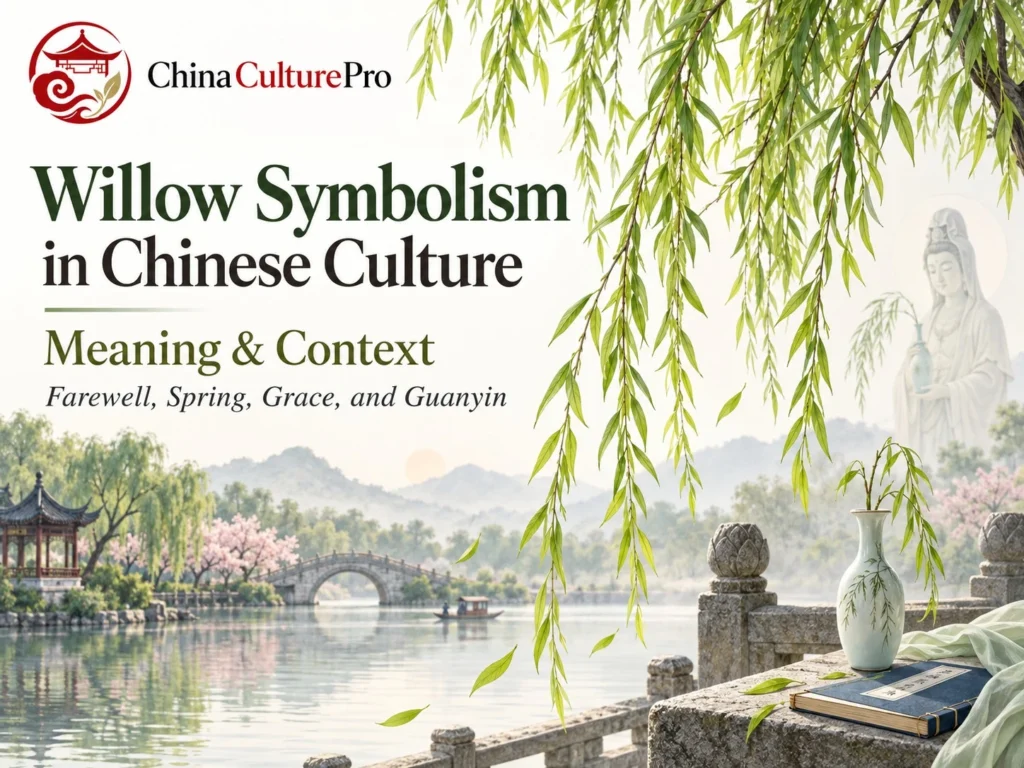

Quick Answer: What Does Willow Symbolize in Chinese Culture?
Willow (柳, liǔ) has no single meaning in Chinese culture. Its interpretation depends on the season, setting, accompanying figures, text and type of willow shown.
- Farewell and longing: Willow branches and willow-lined roads became enduring images of parting in poetry and departure scenes.
- Spring and renewal: Early green leaves and supple branches evoke fresh growth, youth and the return of spring.
- Grace and flexibility: Slender, moving branches can suggest elegance or resilience, especially in literary description.
- Buddhist compassion: In images of Guanyin holding a willow branch and vase, the branch belongs to a specific religious iconography of purification and relief from suffering.
- Seasonal customs: Willow appears in some historical Qingming (清明, Qīngmíng) customs, while pussy or silver willow (银柳, yínliǔ) is a regional modern Lunar New Year decoration.
- Landscape beauty: A willow beside water may simply identify spring, a garden or a riverbank without carrying an auspicious message.
Willow does not automatically symbolize love, mourning, longevity, luck or protection. Those readings require a supporting literary, ritual, religious or visual context, and none implies a real supernatural effect.
A willow in a Chinese poem can color a farewell with longing; the same tree in a garden painting may do nothing more than locate the scene beside water in spring. A branch in Guanyin’s hand belongs to yet another symbolic system. Reading these images correctly requires context, not a universal dictionary meaning.
This guide separates the willow’s literary, artistic, Buddhist and seasonal uses. It also distinguishes classical willows from modern pussy-willow decorations and from the British Blue Willow pattern. That context-first approach follows the broader logic of Chinese flower and plant symbolism: form, setting and companion motifs determine what a plant means.
What Does “Willow” Mean in Chinese Names and Botany?
The ordinary Chinese word for willow is liu, while yangliu (杨柳, yángliǔ) is a long-established compound used in classical writing. It should not always be split mechanically into the modern botanical categories “poplar” and “willow.” The intended plant depends on the text, period and visual form.
Botanically, willow is the genus Salix, which contains many species. The familiar weeping willow, Salix babylonica, is accepted as native from northern and eastern China to Korea. Its scientific name does not mean that the species came from Babylon.[1] Classical poems and stylized paintings, however, rarely provide enough evidence to identify an exact species.
| Name or form | Typical visual clue | Common cultural setting | Interpretive limit |
|---|---|---|---|
| Liu or yangliu | General willow wording or long leafy branches | Poetry, gardens and painting | May be a broad literary name rather than a precise species |
| Weeping willow | Long branchlets hanging toward water or the ground | Spring landscapes and departure scenes | The English word “weeping” does not prove a Chinese meaning of grief or death |
| Pussy or silver willow | Upright cut stems with soft silvery catkins | Modern Lunar New Year flower displays | Not interchangeable with the leafy willow of classical farewell poetry |
The florist name “pussy willow” can cover more than one catkin-bearing willow species or cultivar. For cultural interpretation, the visible form and use are often safer evidence than attaching one Latin name to every arrangement.
Why Willow Became a Symbol of Farewell and Separation
Breaking Willow Branches in Departure Customs
Breaking willow (折柳, zhé liǔ) became a conventional gesture of departure: a person staying behind broke or presented a branch to someone setting out. The received text of the Sanfu Huangtu describes travelers being seen off at Baqiao (灞桥, Bàqiáo), east of Chang’an, with willow branches broken as parting gifts.[2] The passage preserves an influential account of a custom associated with Han Chang’an, but the complicated transmission and dating of the text mean that it should not be treated as an untouched contemporary Han record.
The setting made the image powerful. Bridges, post roads, riverbanks and city gates were thresholds between staying and leaving, while willows commonly lined waterside routes. A pliant branch could be taken as a portable token of the place and the person left behind. Baqiao later became one of the best-known literary landscapes of departure, but neither the location nor the gesture represented every farewell throughout China.
Modern retellings sometimes add that a cut willow can root easily, making the gift a wish that the traveler will establish a new life elsewhere. This is a meaningful later explanation, not a securely documented single origin of the custom. Place, season, poetic repetition and sound association all helped the symbol endure.
Willow in Classical Farewell Poetry
The Classic of Poetry places the line “昔我往矣,杨柳依依” (“When I departed, the willows were soft and swaying”) against a snowy return. The poem Cai Wei is about military service, hardship and homecoming; its willow scene marks the remembered season of departure rather than proving a formal branch-giving ritual.[3] Even so, the contrast helped make spring willow and separation available to later poets as a shared emotional language.
In Wang Wei’s Tang poem Seeing Off Yuan Er on His Mission to Anxi, rain settles the dust at Weicheng and the inn stands beside newly green willows. The friend is urged to drink one more cup before traveling west beyond Yang Pass. Here willow does not “cause” sadness. It establishes spring, the departure point and the freshness of a familiar world that the traveler is about to leave.[3]
This is why willow may imply longing even when no branch is shown. A river embankment, inn, road or traveler can activate the farewell tradition; a lone willow in an unrelated landscape may not.
Does 柳 Really Mean “Stay”?
In Standard Mandarin, liu for willow is liǔ, with a third tone, while liu meaning “to stay” or “to retain” is liú, with a second tone. They share the same consonant-and-vowel sequence but are not fully homophonous when tone is counted. Historical pronunciations and modern regional varieties also differ, so one simple claim cannot describe every period.
It is still reasonable to say that a tone-different sound association reinforced the idea of asking someone to stay. It is not reasonable to make the pun the entire explanation. The real departure custom, willow-lined routes and centuries of poems gave the association its cultural depth.
Willow as a Sign of Spring, Youth and Grace
Willows leaf out early, so fresh green branches became a clear sign of spring. He Zhizhang’s Tang poem Ode to the Willow imagines a tall tree dressed in green jade, with countless hanging branches like silk ribbons and fine leaves cut by the “scissors” of the second-month spring wind.[4] The poem celebrates natural freshness and elegant movement rather than separation.
Literary expressions such as “willow brows” and “willow waist” compare a woman’s features or figure to narrow leaves and slender, bending branches. These metaphors explain why willow can suggest youth, grace or feminine beauty in a garden or boudoir scene. They do not make the plant inherently female, nor do they turn every willow image into a romantic symbol.
The branch’s ability to bend without immediately breaking also supports modern readings of adaptability and resilience. This interpretation fits the plant’s visible form, but it is less fixed than the classical farewell tradition. A museum label, inscription or artist’s text should take priority over a generic “willow means strength” list.
Willow in Buddhist Art and Festival Customs
Guanyin and the Willow Branch
Yangliu Guanyin (杨柳观音, Yángliǔ Guānyīn) is an East Asian form of the bodhisattva associated with compassion. In a typical image, Guanyin holds a willow branch or appears beside a vase. The branch may be imagined as sprinkling purifying water, while Buddhist references to chewing a “yang branch” also connect the object with cleansing and the calming of affliction. The exact title’s origin is uncertain; the earliest known dated examples identified by the Palace Museum belong to the Northern Zhou Tianhe era, not solely to a later Sui prototype.[5]
The meaning depends on the complete iconography. A willow branch with Guanyin and a vase can express compassion, purification and relief from suffering. A willow beside a secular pavilion does not inherit that meaning. The image expresses religious hope; it is not evidence that a physical branch can cure illness or remove misfortune.
Willow Customs at Qingming
A Song-era account records willow decorations at door lintels around Cold Food and Qingming, while later local traditions also include wearing sprigs or willow rings. These practices joined springtime outings with folk ideas about vitality, protection and the avoidance of seasonal pests or harmful influences.[6]
Their form and explanation varied by place and period. Song-era urban descriptions do not establish an unchanged nationwide ritual, and many communities today do not practice it. References to warding off disease or malign forces describe historical belief, not medical or supernatural protection. Readers who want the festival’s broader chronology, ancestor rites and modern observance can continue to the Qingming Festival guide.
Pussy Willow at Lunar New Year
Pussy or silver willow is familiar in Lunar New Year flower markets in parts of southern China, Hong Kong and overseas Cantonese communities. Its upright stems and swelling silver catkins visually suggest the arrival of spring. Commercial displays may be dyed bright colors and decorated with red ornaments.
Prosperity readings come from the word “silver,” the full buds and regional wordplay about money remaining in the household. These explanations belong to modern or regional festive practice, not to an ancient national doctrine. Silver willow should therefore not be used to reinterpret the leafy, drooping willow in a Tang departure poem.
How Willow Appears in Chinese Poetry, Painting and Gardens
In visual art, willow often works first as a scene-setting device. Long branches reveal wind and movement; roots at the water’s edge define a bank; early leaves indicate spring. Traditional gardens use the same qualities to soften architecture, frame reflections and connect pavilions with ponds or streams.
Three contextual patterns are especially useful:
- Departure scene: A willow near a bridge, city gate, inn or road, combined with travelers, attendants, horses, boats or a farewell inscription, can activate the parting tradition.
- Spring or courtly scene: Willows with orioles, blossoms, garden figures or elegant women may establish season, youth and grace rather than permanent sorrow.
- Ordinary landscape: A tree beside water can simply create atmosphere, depth and rhythmic brushwork. Without a title, inscription or narrative cue, symbolic certainty is unwarranted.
The safest order of evidence is the work’s title and inscription, then its people and companion motifs, followed by season, setting, medium and date. The tree alone rarely settles the interpretation.
Does Willow Symbolize Love, Mourning or Good Luck?
| Proposed meaning | When it can apply | What not to assume |
|---|---|---|
| Love | A poem or image about separated lovers, longing, or a named literary story may use willow romantically. | A willow flower, branch or tree is not a general Chinese emblem of romantic love or marriage. |
| Mourning | Willow can carry sorrow when a departure, absence or memorial text supplies that emotion. | Parting is not automatically death, and the English name “weeping willow” cannot define a Chinese work. |
| Luck or protection | Qingming folk practice, Lunar New Year silver willow or Guanyin iconography may add a conditional blessing or protective idea. | A secular willow has no automatic power to protect, heal, attract wealth or change fortune. |
| Longevity | A larger design might acquire a longevity theme from cranes, peaches, a shou character or another explicit motif. | Longevity is not a core willow meaning; it is more firmly associated with subjects such as the pine tree. |
Chinese Willow Symbolism vs the Blue Willow Pattern
Blue Willow, also called the Willow pattern, is not an ancient Chinese legend or a standard code of Chinese porcelain symbolism. British manufacturers created the well-known ceramic design in the late 18th century, drawing on visual elements seen on Chinese export wares. Its pagoda-like buildings, bridge, boat, willow and birds form a European chinoiserie composition.[7]
The tragic love story said to explain the figures and birds was added later as marketing. Evidence does not support presenting it as a tale transmitted from Chinese antiquity.[7] The distinction matters: a willow painted on an actual Chinese object must be read from that object’s period, composition and inscription, not from the British story.
How to Interpret a Willow Motif Correctly
- Identify the form: Is it a leafy weeping tree, a cut branch, an upright pussy-willow stem or only a few stylized leaves?
- Locate the scene: A bridge, gate, inn or road favors a departure reading; a pond or garden may simply indicate spring scenery.
- Check companion figures and objects: Travelers, Guanyin and a vase, Qingming dress, or New Year ornaments lead to different symbolic systems.
- Read the text and date: A poem, title, inscription, museum record and period usually outweigh a modern symbolism list.
- Separate cultural layers: Distinguish classical Chinese usage, regional modern custom and Western chinoiserie before assigning meaning.
This method also applies to tattoos and contemporary design. A modern artist may choose willow for personal ideas such as memory, flexibility or home, but that personal meaning should be labeled as a new interpretation rather than ancient Chinese doctrine. The same context-first principle is explained more broadly in Chinese Symbols and Meanings.
Common Misreadings of Willow Symbolism
- Universal love: Romantic meaning needs a lover, a separation narrative or a specific text; many willows represent spring or scenery.
- Perfect homophones: In Standard Mandarin, liǔ and liú have different tones. The sound association reinforces farewell but does not explain it alone.
- Automatic death symbolism: “Weeping” describes the hanging form in English. Chinese departure sorrow should not be confused with a funeral meaning.
- One meaning for every willow: Classical leafy willows, Guanyin’s branch and modern silver-willow stems have different contexts.
- A universal Qingming custom: Willow practices have varied historically and regionally and are not observed everywhere today.
- Buddhist meaning in every picture: Guanyin’s willow reading requires the religious figure and supporting iconography.
- Modern silver willow as ancient tradition: Its prosperity associations belong to regional modern New Year display culture.
- Blue Willow as Chinese folklore: The familiar pattern is a British chinoiserie design, and its romance was attached later.
- Real supernatural effects: Cultural associations are human beliefs and artistic conventions, not guaranteed powers.
FAQs About Willow Symbolism in Chinese Culture
What does willow symbolize in Chinese culture?
Willow most often evokes farewell and longing in departure contexts, or spring, renewal and grace in seasonal art. Guanyin images, Qingming customs and modern silver-willow displays add separate religious or regional meanings. A landscape willow may have no symbolic message at all.
Why are willow branches associated with farewell?
Branch-giving customs, willow-lined departure routes, classical poetry and the tone-different sound association between liǔ and liú reinforced one another. No single pun or legend fully explains the tradition.
Does willow symbolize love or sadness in China?
Only conditionally. Willow can express longing between lovers or the sadness of parting when a poem, figure or narrative establishes that context. It is not a universal Chinese symbol of romance, grief or death.
What does the willow branch mean in Guanyin images?
With Guanyin and a vase, the willow branch belongs to an iconography of compassion, purification and relief from suffering. That meaning does not transfer automatically to a secular willow tree.
Is the Blue Willow story a traditional Chinese legend?
No. British ceramic manufacturers developed the Willow pattern in the late 18th century from Chinese-inspired imagery. The familiar tragic romance was added later and is not an ancient Chinese tale.
Sources
[1] Royal Botanic Gardens, Kew. Salix babylonica L.
[2] Chinese Text Project. Sanfu Huangtu, Volume 6
[3] University of Virginia Chinese Text Initiative. Shijing and 300 Tang Poems
[4] Peking University. An Ode to the Willow Tree from an Octogenarian Professor
[5] Palace Museum. Guanyin with a Willow Branch
[6] Meng Yuanlao. Dongjing Meng Hua Lu, Volume 7
[7] Victoria and Albert Museum. Beyond Willow