
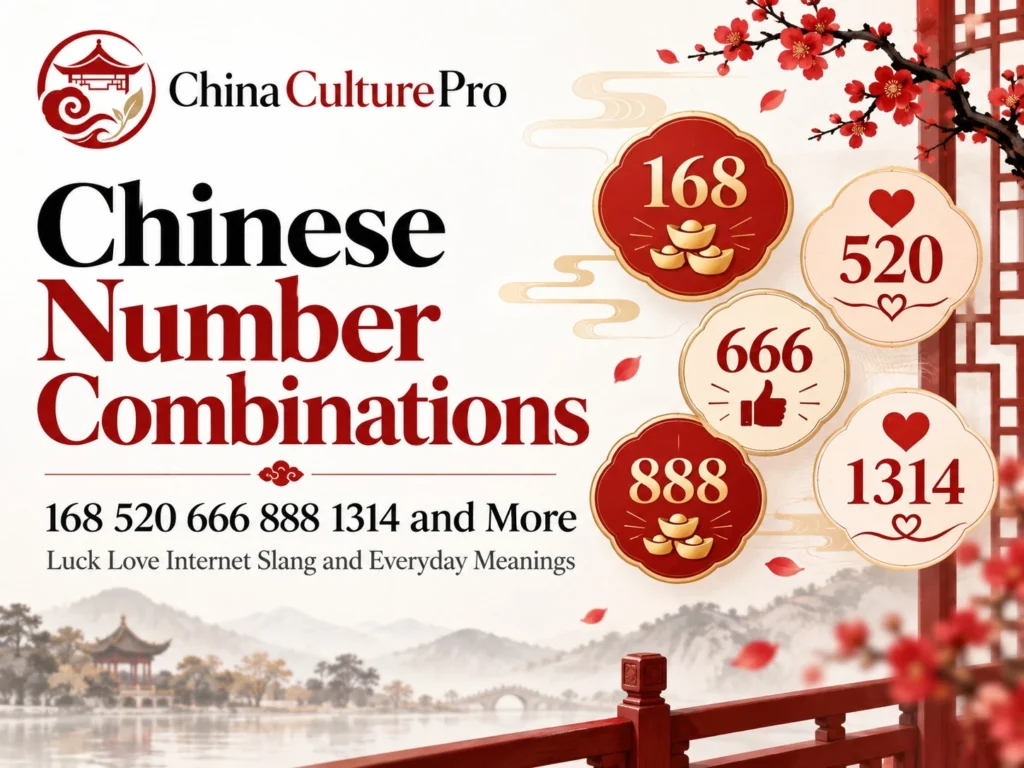

Quick Answer: What Do Common Chinese Number Combinations Mean?
Chinese number combinations can express prosperity, affection, praise, humor or insult, but they do not follow one universal decoding system. Their meanings come from sound resemblance, repeated digits, online convention and context.
- 168: Yilu Fa (一路发, yīlù fā), a commercial wish meaning “prosper all the way.”
- 520: Wo Ai Ni (我爱你, wǒ ài nǐ), “I love you,” in modern romantic messaging.
- 666: Praise for something skillful, impressive or smoothly done; it can also be sarcastic.
- 888: A repeated prosperity wish based on the favorable association of 8.
- 1314: Yisheng Yishi (一生一世, yīshēng yīshì), “for a lifetime,” often paired with 520.
These readings are social conventions, not ancient formulas or forces that change wealth, love or fate. The same string may also mean something different in a business setting, a private chat or another Chinese language variety.
A row of digits can look like a secret code when it appears in a Chinese message, red-envelope amount or business name. Yet 520, 666 and 888 do not all belong to the same tradition. Some are modern numeronyms, some repeat favorable single-digit associations, and others are ordinary spoken expressions written as numbers.
This guide focuses on multi-digit strings. For the broader distinction between classical numerical systems, modern lucky numbers and taboos, start with the guide to Chinese number symbolism.
How Chinese Number Combinations Acquire Meaning
Exact Homophones, Near-Homophones and Conventional Readings
Some number meanings rest on exact homophones. Nine, 九 (jiǔ), and “long-lasting,” 久 (jiǔ), match in standard Mandarin, which makes 99 or 999 a relatively transparent wish for continuity. Most longer codes are looser. The syllables in 520 do not exactly reproduce 我爱你, and 1314 is an approximate rhythmic substitute for 一生一世.
Chinese internet wordplay includes both narrow homophones with matching pronunciation and broader substitutions that change consonants, vowels or tones. Context completes the match, so community recognition matters as much as phonetic precision. Some codes, such as 233, are conventional symbols with no homophonic decoding at all.[1]
Why the Whole Sequence Matters More Than Each Digit
Read the established sequence before interpreting its individual digits. In 520, the separate numbers 5, 2 and 0 do not independently mean “I,” “love” and “you” in ordinary Chinese culture. The romantic reading belongs to the complete string. Likewise, the 4 in 1314 does not make the expression unlucky because the full code represents “for a lifetime.”
This whole-sequence rule also prevents invented explanations. A plausible sound can help a code spread, but it does not create an automatic dictionary in which every digit always corresponds to one word. Recognition, platform history and conversational setting decide whether a reading works.
Mandarin, Cantonese and Cross-Language Wordplay
Mandarin and Cantonese have different sound systems, and many Chinese language varieties are not mutually intelligible. A pun that feels close in Cantonese may be weaker or absent in Mandarin.[2] The prosperity association of 8 is especially strong in Cantonese, while avoidance of 4 can also be more noticeable in Cantonese-speaking commercial settings.
Not every code stays within one Chinese variety. In online chat, 88 can echo the English loanword “bye-bye,” written in Chinese as 拜拜 (bàibài), and 3Q combines Mandarin 三 (sān) with the English letter Q to approximate “thank you.” Cross-language play is therefore one real mechanism, although it should not be projected onto every number string.
Common Chinese Number Combinations at a Glance
The table prioritizes combinations that are widely recognized or frequently explained to Chinese learners. Online slang changes over time, so “informal” does not mean every speaker uses the expression equally often.[3]
| Combination | Common reading | Meaning | Category | Register and limit |
|---|---|---|---|---|
| 66 | liù liù | Smooth progress; “everything goes well” | Favorable repetition | Casual wishes and some celebratory amounts |
| 88 | bā bā | Prosperity, or “bye-bye” | Favorable repetition / chat slang | Business context favors prosperity; chat may signal goodbye |
| 168 | yī liù bā | “Prosper all the way” | Commercial rebus | Conventional reading, not an exact Mandarin homophone |
| 250 | Erbaiwu (二百五, èr bǎi wǔ) | A foolish or reckless person | Colloquial insult | Older spoken expression, not originally an internet numeronym |
| 233 | èr sān sān | Laughter, similar to “LOL” | Platform convention | Derived from an early web-emoticon number, not sound resemblance |
| 520 | wǔ èr líng | “I love you” | Romantic numeronym | Modern and conventional rather than phonetically exact |
| 521 | wǔ èr yī | Romantic variant or positive reply | Romantic numeronym | Interpretations vary; less fixed than 520 |
| 555 | wǔ wǔ wǔ | Crying or playful sadness | Sound imitation | Informal; may be sincere, exaggerated or cute |
| 666 | liù liù liù | Skilled, impressive or smooth | Internet praise | Often positive, sometimes ironic |
| 748 | qī sì bā | “Go away” or the harsher “go die” | Hostile slang | Offensive; avoid using it casually |
| 888 | bā bā bā | Repeated prosperity wish | Commercial blessing | Celebratory convention, not a guarantee of wealth |
| 999 | jiǔ jiǔ jiǔ | Long-lasting affection or wellbeing | Favorable repetition | Based on 九/久; not “triple imperial power” |
| 1314 | yī sān yī sì | “For a lifetime” | Romantic numeronym | Usually paired with a relationship message |
| 5201314 | wǔ èr líng yī sān yī sì | “I love you for a lifetime” | Combined romantic code | More ceremonial or playful than ordinary conversation |
Lucky and Commercial Number Combinations
66, 88 and 888
The favorable reading of 66 is reinforced by Liuliu Dashun (六六大顺, liùliù dàshùn), a conventional wish that everything will proceed smoothly. It suits a friendly congratulation, celebratory amount or business opening, but it does not specifically promise wealth.
By contrast, 88 and 888 emphasize prosperity. Eight, 八 (bā), resembles words associated with prospering, especially Cantonese 發 (faat3). Repetition makes the wish more visible and emphatic, which is why strings of 8 appear in phone numbers, license plates, property marketing and celebratory amounts. Research on apartment transactions in Chengdu found that units on floors ending in 8 could attract faster sales or a resale premium in that particular market, demonstrating an effect on consumer behavior rather than supernatural luck.[4] Readers who want the single-digit background can compare the guides to number 6 and number 8.
What 168 Means
The usual reading of 168 is 一路发, “prosper all the way.” This is a conventional commercial rebus, not a strict syllable-by-syllable Mandarin homophone: yī liù bā and yīlù fā merely provide enough sound and semantic cues for the intended wish to be recognized.
The combination works especially well in business names, opening promotions, red-envelope amounts and memorable identifiers because it joins the idea of an ongoing journey with prosperity. Its meaning is now understandable beyond Cantonese-speaking communities, but use still reflects preference rather than a mandatory custom.
Why Repetition Strengthens a Wish but Not Its Effect
Repeating a digit adds rhythm, symmetry and emphasis. Thus 888 feels more emphatic than 8, while 999 extends the sound association between 九 (jiǔ) and 久 (jiǔ), “long-lasting.” Repetition is a rhetorical device, not a multiplier: 888 does not produce three times the wealth, and 999 cannot make a relationship or life objectively longer. For the history and limits of the latter association, see number 9 in Chinese culture.
Love and Relationship Number Codes
520 and 521
520 is the best-known Chinese romantic numeronym. Its loose resemblance to 我爱你, “I love you,” became conventional in digital communication even though the sounds are not exact. May 20, written 5/20, is consequently promoted as an unofficial online Valentine’s Day, with messages, gifts and commercial campaigns built around the code.[3]
521 is a related romantic variant, but it has no single equally stable translation. It may repeat the “I love you” idea or serve as a positive response; “I am willing” is another popular gloss. Treat the surrounding message as authoritative instead of claiming that 521 always encodes one sentence.
1314 and 5201314
1314 approximates 一生一世, literally “one life, one lifetime,” and conveys “for a lifetime.” It is commonly attached to a declaration of affection or used in an anniversary message. The sequence also illustrates why complete-string meaning outranks individual digits: the final 4 does not introduce the death-related association that may affect a standalone 4.
Combining 520 and 1314 produces 5201314, conventionally read as “I love you for a lifetime.” The longer string is understandable but more performative than everyday prose. It suits a romantic message, gift amount or campaign slogan better than formal communication.
Dates, Red Envelopes and Romantic Marketing
Romantic codes often appear where the number itself is visible: May 20 promotions, digital red envelopes, order totals, anniversary messages and product bundles. The amount can add a playful layer, but relationship, budget and context matter more than reproducing an exact symbolic figure. These practices are contemporary social and commercial conventions, not historical wedding rules or guarantees of a lasting relationship.
Chinese Internet Slang and Emotional Number Codes
666: Praise, Skill and Possible Sarcasm
In Chinese gaming and social-media language, 666 normally praises a skillful move, an impressive result or something done smoothly. The reading is connected with 溜 (liù or liū in different uses), which can describe something slick, skillful or smooth. A shorter “6” can perform a similar job.[3]
Tone changes the interpretation. “666” after an excellent play is praise; “真6” after an absurd mistake may be sarcastic. The Chinese usage developed independently of the Christian “number of the beast,” although an international audience may still notice that unrelated association.
555: Crying or Playful Sadness
555 represents 呜呜呜 (wūwūwū), the written sound of sobbing or whimpering. It can express genuine disappointment, but it is often deliberately cute, exaggerated or playful. Because it is an informal emotional cue rather than a literal statement, its strength depends heavily on the relationship and conversation.
88, 886 and Informal Goodbyes
In chat, 88 can sound like “bye-bye,” while 886 extends the joke toward 拜拜了 (bàibài le), “bye-bye, then.” This usage is separate from the prosperity reading of 88 in commercial or celebratory settings. Both remain recognizable, but platform and generation affect how natural they feel; plain words are safer when clarity matters.
233 and Number Codes That Are Not Homophones
233 means laughter, but not because èr sān sān sounds like 哈哈哈 (hāhāhā). The code is commonly traced to the numbered laughing emoticon on the early Chinese forum Mop. Users could lengthen it to 2333 or 233333 for stronger laughter.[3] It is an important reminder that historical platform convention, not pronunciation, can create a number code.
Negative, Insulting and Sensitive Number Combinations
Why 250 Means a Foolish Person
250 is read as Erbaiwu and describes someone simple-minded or reckless. The expression appears in authoritative dictionaries as a colloquial label, but popular stories explaining its origin are not securely established.[5] It is therefore better treated as a fixed spoken insult than as an unlucky number or a numeronym assembled from the meanings of 2, 5 and 0.
The word may sound teasing among close friends, but it can still offend. Do not use it for strangers, professional contacts or formal writing.
748 and Other Hostile Online Codes
748 is conventionally associated with 去死吧 (qù sǐ ba), literally “go die,” and can function like “go to hell” or “get lost.” The phonetic match is loose and the code is much less useful to learners than 520 or 666, but its hostile reading is documented in contemporary slang references.[3] Recognition does not make it socially safe: avoid using it unless you are explaining the expression.
Why 14 and 24 Depend on Cantonese Context
Strings containing 4 can attract stronger avoidance in Cantonese-speaking commercial settings because 四 (sei3) resembles 死 (sei2), “death.” Folk readings of 14 and 24 sometimes intensify that association, but their exact glosses and sensitivity vary. They are not nationwide fixed insults or universally forbidden numbers.
In Mandarin-dominant settings, a person may still avoid a room, plate or phone number containing 4, but this does not mean that 14 and 24 have one special sentence-like translation. The deeper historical and regional limits are covered in the guide to number 4 in Chinese culture.
How Context Can Reverse a Number Combination’s Meaning
| Combination | One context | Another context | Best interpretation rule |
|---|---|---|---|
| 88 | Prosperity in gifts or business | “Bye-bye” in chat | Identify whether the number is a blessing or a message |
| 666 | Genuine praise | Sarcasm after an absurd action | Read the tone and preceding event |
| 1314 | “For a lifetime” | No common negative reading | Interpret the complete romantic code, not the final 4 |
| 250 | A literal quantity in calculation | A colloquial insult when applied to a person | Grammar and target determine whether it is merely a number |
Where Chinese Number Combinations Are Used
| Setting | Common choices | Practical boundary |
|---|---|---|
| Red envelopes and gifts | 66, 88, 168, 520, 999 or 1314 | Match the relationship and local custom; the amount matters more than wordplay |
| Openings and business promotions | 66, 168, 888 | Appropriate as celebratory branding, not as a promise of business results |
| Phone numbers, plates and property | Repeated 6, 8 or 9; sometimes fewer 4s | Demand and pricing vary by market and individual preference |
| Romantic messages and dates | 520, 521, 1314 and 5201314 | Informal contemporary codes, not traditional wedding requirements |
| Chats, games and comments | 233, 555, 666, 88 or 886 | Casual, generation-sensitive and often unclear in formal communication |
How to Interpret a Chinese Number String Correctly
- Identify the setting: Decide whether the string appears in a gift, business name, room number, romantic message, game or argument.
- Check the language variety: Ask whether the proposed wordplay relies on Mandarin, Cantonese or another variety.
- Read the complete sequence: Test an established whole-string reading before assigning meanings to individual digits.
- Check current recognition: Separate widely recognized codes from platform-specific, aging or invented lists.
- Assess register and risk: Decide whether the expression is suitable for celebration, private chat only or potentially offensive.
This method cannot produce one correct answer without context. It prevents the more serious error of treating every plausible-sounding number string as a timeless Chinese cultural rule.
Common Misreadings of Chinese Number Combinations
- Every code is an exact homophone: Most long combinations are approximate sound substitutions or conventions; 233 is not phonetic at all.
- Each digit represents one fixed word: Meanings such as 520 and 1314 belong to the complete sequence, not a universal digit-by-digit dictionary.
- Popular combinations are ancient traditions: 520, 666 and 233 belong to modern digital communication, while 250 is an older colloquial expression.
- More repetition creates more luck: Repetition strengthens rhythm and emphasis, not real-world effects.
- Every string containing 4 is negative: 1314 is a familiar positive counterexample because its complete romantic reading controls the meaning.
- Chinese 666 is the Western religious symbol: The identical digits developed unrelated meanings in the two cultural contexts.
- Every long list online is commonly understood: Some codes are obsolete, platform-specific or manufactured from a phrase after the fact.
- 250 is an unlucky number: It becomes insulting when used as the word 二百五 for a person; the quantity itself is neutral.
FAQs About Chinese Number Combinations
What does 520 mean in Chinese?
520 is a modern romantic code for 我爱你, “I love you.” The pronunciation is only approximate, but convention makes the meaning widely recognizable in messages, gifts and May 20 promotions. It is not an ancient love symbol.
What does 666 mean in Chinese slang?
666 usually means “awesome,” “skillful” or “smoothly done” in Chinese gaming and social-media language. It may become sarcastic when the preceding action was foolish or absurd. This usage is historically unrelated to the Western religious meaning of 666.
What do 88 and 888 mean in Chinese?
In commercial and celebratory contexts, 88 and 888 strengthen the association between 8 and prosperity. In an informal chat, 88 can instead mean “bye-bye.” The surrounding setting determines whether the intended message is a blessing or a farewell.
Does every number combination containing 4 have a negative meaning?
No. Although 4 can be avoided because it resembles the word for “death,” a recognized complete sequence can override that association. The romantic code 1314 means “for a lifetime,” so its final 4 is not normally read as a negative sign.
Are Chinese number codes the same in Mandarin and Cantonese?
No. Mandarin and Cantonese have different pronunciations, so a sound-based association may be stronger, weaker or absent in the other variety. Some codes have spread nationally through media and commerce, but their phonetic explanation may still come from one language community.
Sources
[1] Qian Tang, University of Alberta. A Study of Chinese Internet Homophones from the Systemic Functional Perspectives
[2] University of Texas at Austin. Chinese Language Overview
[3] The Chairman’s Bao. Chinese Number Slang
[4] Shum, Sun and Ye. Superstition and “Lucky” Apartments: Evidence from Transaction-Level Data
[5] Ministry of Education, Taiwan. 二百五