

Quick Answer: What Are the Chinese Symbols for Happiness?
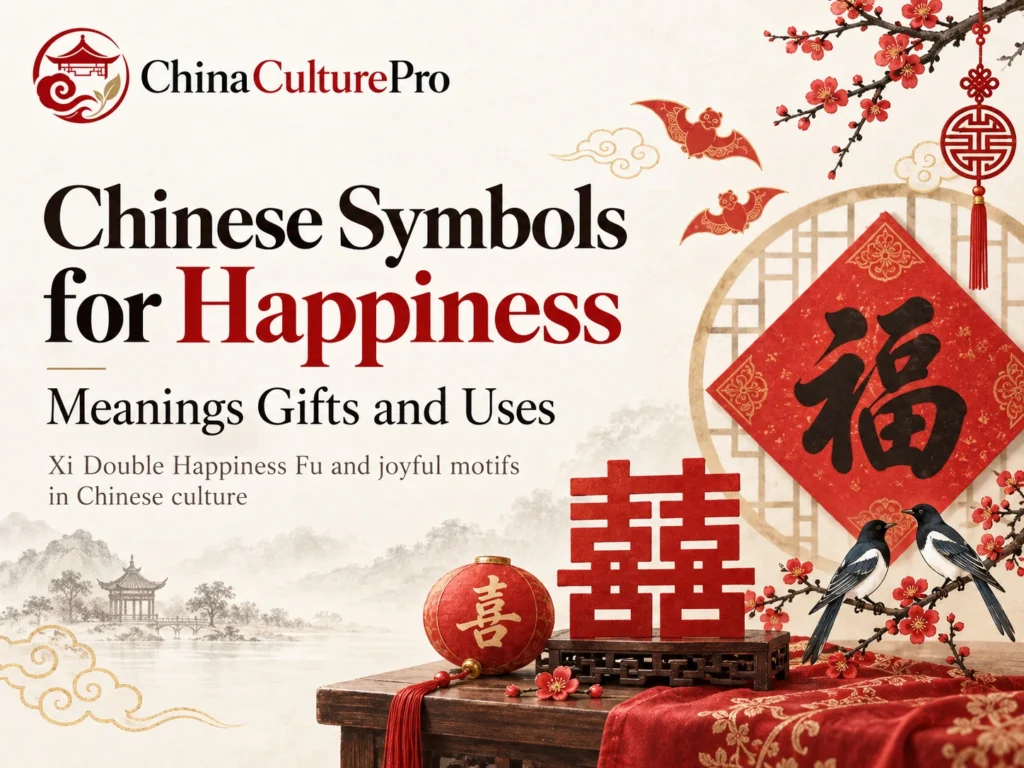
Chinese symbols for happiness express several different wishes: joy, wedding happiness, blessings, or harmony. Choose the meaning before choosing the design.
- Xi: Xi (喜, xǐ) means joy and celebration, including happy occasions beyond marriage.
- Double Happiness: Double Happiness (囍, xǐ), commonly called Shuangxi (双喜, shuāngxǐ), is the joined wedding emblem for paired joy.
- Fu: Fu (福, fú) expresses blessings and good fortune across life, rather than a cheerful mood alone.
- Pictorial motifs: Birds, bats, and paired figures can convey good news, blessings, or marital harmony through their names, attributes, and setting.
There is no universal happiness symbol for every occasion. These are cultural wishes, without verified power to change emotions, secure a marriage, or alter fate.
Choosing a Chinese gift, reading a decorated antique, or planning a character design starts with one distinction: “happiness” can mean joy, a happy event, a fortunate life, or harmony between partners. The right symbol depends on which wish you intend.
How Is Happiness Written in Chinese?
Chinese has several words that English may translate as “happiness.” Some work as standalone decorative characters; others are everyday words used in greetings or descriptions. This table compares their main uses, rather than treating them as interchangeable logos.
| Form and pronunciation | Core meaning | Suitable use | Interpretation limit |
|---|---|---|---|
| Xi 喜 (xǐ) | Joy, gladness, or a happy occasion | Celebrations, congratulations, festive lettering | Does not itself mean paired or married happiness. |
| Double Happiness 囍 (xǐ); commonly 双喜 (shuāngxǐ) | Paired joy, especially at marriage | Wedding invitations, paper cuts, gifts for newlyweds | Strongly suggests a wedding; not the traditional form of 喜. |
| Fu 福 (fú) | Blessings, good fortune, favorable circumstances | New Year decoration and broad wishes for wellbeing | Wider than feeling pleased or cheerful. |
| Le 乐/樂 (lè) | Pleasure or joy | Expressions of enjoyment and happy wishes | The reading yuè refers to music, not this meaning. |
| Xingfu 幸福 (xìngfú) | Happiness in a fulfilling life or favorable circumstances | Wishes for someone’s life and descriptions of wellbeing | A two-character word, not a single ancient emblem. |
| Kuaile 快乐/快樂 (kuàilè) | Feeling happy, joyful, or pleased | Everyday greetings and wishes for enjoyable occasions | Can suit written greetings too; formality depends on the whole message. |
These distinctions follow ordinary dictionary meanings: Xi concerns gladness and celebratory events; Fu covers fortunate circumstances; Le and Kuaile describe pleasure; Xingfu describes a happy, fulfilled condition of life.[1][2][3][4][5][6]
The scripts also matter. 喜 and 福 look the same in standard simplified and traditional Chinese. 乐 becomes 樂, while 快乐 becomes 快樂. 囍 is a joined form of two 喜 characters, not a conversion between scripts. Its dictionary reading is xǐ; shuāngxǐ is its familiar two-syllable name.
For a short celebration design, start with the intended message, then check the complete wording. The distinctions overlap in real speech; they are useful guides, not rigid categories of human emotion. The separate guides to the Xi character and the Fu symbol explain their wider uses.
Why Double Happiness Is Mainly a Wedding Symbol
Double Happiness points to a couple and their shared celebration. Its paired structure connects shared joy with the union of two people. The established wedding use is part of the sign’s meaning, not a requirement that the bearer follow a particular religion.[2]
You may encounter it on invitations, wedding paper cuts, tea sets, textiles, furnishings, and gifts for newlyweds. On such objects, it makes the occasion legible even when no longer inscription explains the gift. Red is familiar in wedding decoration, but the character also appears in gold, carved wood, and ceramic decoration. Changing its color or material does not automatically remove the marriage association.
For a birthday, graduation, or a friend’s new project, a wedding emblem can send an unintended message. Choose wording that names the occasion instead. Contemporary artists can reuse 囍 outside weddings, but an audience may still read it as a reference to marriage; design freedom and conventional meaning can coexist.
An often-told origin story credits the Song-dynasty statesman Wang Anshi with joining two joyful events into one sign. Treat that account as a legend, rather than an established invention date or documented authorship. The Double Happiness guide explores its forms, wedding uses, and origin stories in more detail.
How Magpies, Bats and Paired Figures Express Happiness
Magpies and Plum Blossoms: Joy Through Visual Wordplay
The magpie (喜鹊, xǐquè) carries Xi in its Chinese name, helping explain its association with welcome news. The whole word xǐquè is not a homophone of xǐ. In the familiar plum-and-magpie composition, another sound connection completes the message: plum, 梅 (méi), sounds like eyebrow, 眉 (méi).
Together, the bird and flowering branch evoke “Joy reaches the eyebrows” (喜上眉梢, xǐ shàng méi shāo): happiness showing on someone’s face. The image works as a visual rebus, combining names and placement to suggest a phrase.[7]
A late-Qing design drawing for a yellow-ground bowl shows three magpies among plum branches. This surviving object is a colored drawing on paper, not the finished ceramic bowl. Its composition demonstrates how the same wish could be planned for decoration on tableware.[7]
Check the combination before assigning the full phrase. A bird alone may suggest good news, while plum blossoms can express resilience or spring’s return. A title or inscription can clarify an ambiguous scene. The broader magpie symbolism guide covers readings beyond this particular pairing.
Bats and the Five Blessings: Fu in Pictures
Bats represent blessings through a precise sound connection: 蝠 (fú), the second character in the Chinese word for bat, sounds identical to 福 (fú). The first character, 蝙 (biān), does not supply the pun; the full word is 蝙蝠 (biānfú). This explains why an animal that may seem an unexpected decoration to an English-speaking viewer appears on celebratory Chinese objects.[8]
One bat can suggest good fortune broadly. Five bats together commonly refer to the Five Blessings (五福, wǔfú): longevity, wealth, health and peace, love of virtue, and a peaceful or natural death. These are wishes for a well-lived life, not five cheerful emotions. English labels such as “Five Happinesses” should be understood in that broader sense.[8]
Number and surrounding motifs help narrow the reading. A bat beside another auspicious image may contribute one part of a larger wish. It does not mean the whole object concerns marriage. For the wider range of bat motifs and the historical Five Blessings, use the dedicated guides rather than assuming every bat design has the same message.
He-He Immortals and Mandarin Ducks: Harmony in Marriage
The He-He Immortals (和合二仙, Héhé Èrxiān) express harmony through paired figures and their objects. A lotus, 荷 (hé), echoes 和 (hé), harmony; a box, 盒 (hé), echoes 合 (hé), union. The lotus-and-box pairing therefore helps identify the subject and explain the wish for harmonious relationships.[9]
A Qing bamboo-root carving shows two smiling monk figures, one standing with a lotus and the other seated beside a box, holding a lingzhi fungus. The collection record identifies the pair as the He-He Immortals. It is catalogued as 故雕000107N000000000 at the National Palace Museum in Taipei. Two smiling children without those attributes should not automatically receive the same identification.[9]
Mandarin ducks (鸳鸯, yuānyāng) offer a different route to marital happiness: a recognizable pair of waterbirds becomes an image of loving companionship. Their established place in Chinese art supports the wedding reading, especially when a pair appears with other marriage motifs.[10]
The familiar story that the birds remain together for life belongs to their cultural interpretation; it is not a reliable statement about their biology. Read paired mandarin ducks as a wish for a relationship, not evidence that nature guarantees lifelong fidelity.
Red, Lanterns and Knots in Festive Settings
Some objects create a celebratory setting without translating directly as “happiness.” Read their color, inscriptions, and occasion together.
- Red: Its strong associations with celebration and auspicious wishes explain its use in weddings, festive clothing, and New Year decoration. It also has other meanings, including status and political identity. A red object is not automatically a happiness emblem.[11]
- Lanterns: Red lanterns help mark festive space, especially at New Year and the Lantern Festival. Lettering or attached motifs can make the wish more specific.[11]
- Knots: Chinese decorative knotting includes many forms. The pan chang knot (盘长结, páncháng jié), or endless knot, is one named design. Its continuous interlacing can convey continuity; in Buddhist settings, its meaning includes the enduring Buddhist teaching.[12]
Use the guide to Chinese knots to identify the form before assigning a meaning. The wider meanings of red also extend beyond celebrations.
A Worked Example: Double Happiness and Five Bats on a Mirror
A brass mirror with a handle, dated about 1800 and attributed to the workshop of Tang Wanheng (汤万亨, Tāng Wànhēng), brings two wishes together. It belongs to the Cleveland Museum of Art, accession 1995.401.[13]
- Visible facts: A large Double Happiness character occupies the center. Five stylized bats surround it, while a smaller framed maker’s inscription appears below the central motif. The object has a handle.
- Context evidence: The Qing-dynasty attribution, workshop name, and combination of motifs support an auspicious reading. A proposed ceremonial marriage use appears in the collection description, but the wording remains tentative.
- Reasonable interpretation: The central sign expresses wedding joy; the five bats add a wish for broader blessings. The design combines related wishes rather than repeating one exact definition of happiness.
- What cannot be inferred: The decoration does not identify a particular couple, recipient, wedding date, or personal history. Nor does a plausible marriage association prove that this mirror was used in a specific wedding ritual.[13]
The example shows why an object can express several wishes while leaving its precise use uncertain.
How to Choose a Happiness Symbol for a Gift or Design
Work through the message before approving the artwork. Begin with the intended occasion, then check how the finished design communicates it.
- Define the wish: Decide whether you mean everyday joy, congratulations, marital happiness, or broad wellbeing. Write that intention in plain English before selecting Chinese wording. A clear message makes it easier to check a designer’s proposed translation.
- Match the recipient and occasion: For newlyweds, Double Happiness or paired marriage imagery fits naturally. For a general New Year wish, Fu offers wider scope. For a birthday or graduation, use a greeting that names the event rather than relying on a wedding sign.
- Check the complete composition: Keep the elements that carry the intended message. A magpie-and-plum rebus depends on their relationship; a five-bat blessing differs from one bat. Ask what remains readable if an animal, flower, or inscription is removed.
- Review the finished design: Check the exact glyph, simplified or traditional script, reading direction, and orientation. For an engraving or tattoo, have a fluent reader or qualified calligrapher inspect the actual final artwork, including any stylized strokes.
For a different wish, compare the related Chinese symbols by meaning before borrowing a design from another occasion.
FAQs About Chinese Symbols for Happiness
What Is the Chinese Character for Happiness?
There is no single equivalent for every meaning of happiness. Xi (喜) expresses joy and celebration; Fu (福) expresses blessings. Xingfu (幸福) is the ordinary two-character word for happiness in a fulfilling life.
Is Fu the Same as Xi?
No. Fu (福, fú) concerns blessings and favorable circumstances, while Xi (喜, xǐ) concerns joy and happy occasions. They can appear together, but their meanings are distinct rather than interchangeable translations.
Can Double Happiness Be Used Outside Weddings?
Artists can use Double Happiness outside weddings, but its conventional meaning still strongly suggests marriage. For an ordinary birthday, graduation, or general greeting, choose wording that makes the intended occasion clear.
Should a Happiness Character Be Displayed Upside Down?
The familiar upside-down convention concerns Fu and a pun on fortune arriving; it is not a rule for all happiness characters. Xi and Double Happiness are normally displayed upright. Fu practices also vary.[14]
Can Chinese Happiness Symbols Be Used in Tattoos?
Yes, as personal artistic expression. Check the complete wording, character form, orientation, and cultural context with a fluent reader before tattooing. The design expresses a chosen meaning; it cannot guarantee happiness or relationship success.
Sources
[1] Ministry of Education, Taiwan. 喜
[2] Ministry of Education, Taiwan. 囍
[3] Ministry of Education, Taiwan. 福
[4] Ministry of Education, Taiwan. 樂
[5] Ministry of Education, Taiwan. 幸福
[6] Ministry of Education, Taiwan. 快樂
[7] Palace Museum. 黄地梅花喜鹊海碗图样
[8] Metropolitan Museum of Art. Woman’s ceremonial robe
[9] National Palace Museum, Taipei. 竹雕和合二仙
[10] Metropolitan Museum of Art. Wine cup with two ducks
[11] Smithsonian National Museum of Asian Art. Chinese Red
[12] National Palace Museum, Taipei. 掐絲琺瑯八吉祥(盤長)
[13] Cleveland Museum of Art. Mirror with Handle, Decorated with “Double Happiness” and Five Bats
[14] National Heritage Board, Singapore. Who’s Your Neighbour?