
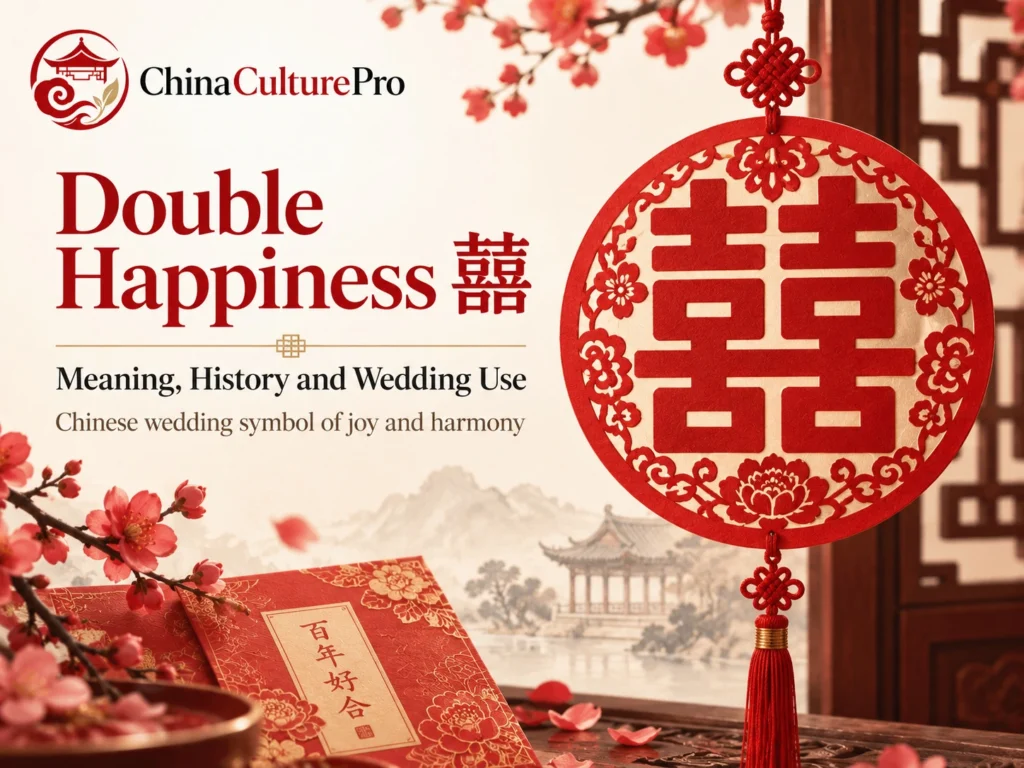

Quick Answer: What Does the Double Happiness Symbol Mean?
Double Happiness (囍, xǐ), or Shuangxi (双喜, shuāngxǐ), joins two 喜 characters in a Chinese wedding emblem for paired joy and marital harmony.
- Pronunciation: 囍 is read xǐ; its common name 双喜 is shuāngxǐ.
- Main setting: Weddings and gifts.
- Character form: A joined design, not a traditional or simplified form of 喜.
- Common uses: Invitations, paper cuts, wedding objects, red envelopes, textiles, and jewelry.
- Cultural limit: A blessing, not a promise of romance or a happy marriage.
Default meaning: wedding joy, not generic luck or love.
Seen on a red paper cut, porcelain vase, wedding invitation, or piece of gold jewelry, 囍 is immediately recognizable to many Chinese readers as a marriage emblem. Its visual simplicity can be misleading, however: its name, dictionary reading, historical evidence, and relationship to the ordinary character 喜 are not identical questions.
This guide places Double Happiness within the wider system of Chinese symbols and meanings, while keeping the focus on what the emblem actually communicates and how to use it without adding unsupported mystical claims.
How Is 囍 Formed and Pronounced?
Double Happiness is a ligature-like design made by placing two copies of Xi (喜, xǐ), meaning joy or a happy occasion, side by side and compressing them into a square-shaped unit. Its paired structure makes the wedding association visually legible even before any additional decoration is added.
| Form | Pronunciation | Function |
|---|---|---|
| 囍 | xǐ | The dictionary-listed character used mainly in wedding contexts |
| 双喜 / 雙喜 | shuāngxǐ | Its common name, literally “double joy” or “double happiness” |
| 喜 | xǐ | The ordinary character for joy, celebration, or a happy event |
An official dictionary describes 囍 as two 喜 characters written together for weddings and as a sign of paired auspiciousness.[1] It should not be treated as a grammatical plural of 喜 or as a normal substitute for 喜 in everyday sentences.
What Is the Difference Between 囍 and 喜?
喜 is an ordinary Chinese character with broad uses. It can describe joy, a celebration, a happy event, or liking something. 囍 is a specialized visual form whose default cultural setting is marriage.
| Feature | 喜 | 囍 |
|---|---|---|
| Basic form | One standard character | Two 喜 forms joined side by side |
| Language use | Common in words and sentences | Usually displayed as a stand-alone emblem |
| Core scope | Joy and happy occasions in general | Paired wedding joy and marital celebration |
| Typical settings | Speech, writing, festivals, many celebrations | Weddings, marriage gifts, bridal objects, decorative art |
The two forms are related, but not interchangeable. 囍 is not the traditional version of 喜—the character 喜 has the same shape in simplified and traditional Chinese—and it is not merely a more decorative spelling of every use of “happiness.”
Why Is Double Happiness Used at Chinese Weddings?
The design makes pairing visible: one 喜 is joined to another, turning joy into a shared wedding image. In practice, it can celebrate the couple, the union, and the happiness surrounding two families. Those wider associations come from the wedding context; the character itself does not literally spell out “two families” or a marriage vow.
Museum objects show how the emblem works with other motifs. On a Qing-dynasty vase from the Daoguang period, the 囍 character alludes to marital harmony, while bats and peaches add separate wishes for blessing and longevity.[4] The object therefore communicates a layered congratulatory message rather than treating every surrounding motif as another meaning of 囍.
This is also why “Double Happiness” is more precise than simply calling the design a love symbol. It marks wedding joy and an auspicious union, but the ordinary Chinese word for love is 爱 / 愛 (ài).
Is the Wang Anshi Double Happiness Story Historically True?
No reliable evidence establishes that Wang Anshi invented 囍. A popular story says that the Northern Song scholar passed the imperial examination and married on the same day, then joined two 喜 characters to mark his “double happiness.” It is memorable, but it should be presented as folklore rather than documented origin.
The story circulates with different protagonists and conflicts with parts of the historical record. Surviving histories, calligraphic models, and inscriptions have not supplied a definitive account of who created 囍 or exactly when it first appeared.[3]
The character is also absent from the ancient Shuowen Jiezi dictionary, but absence from one early dictionary does not by itself prove a later invention date.[2] The sound conclusion is narrower: 囍 became an established auspicious design in decorative and wedding culture, while its single inventor and exact origin remain unverified.
Where and How Is the Double Happiness Symbol Used?
Double Happiness can be written, printed, cut from paper, molded, painted, woven, carved, or cast. The object and its companions help determine whether a specific example functions as direct wedding decoration, a marriage gift, or a later design inspired by the tradition.
Wedding Decorations and Ceremonial Objects
Common modern settings include invitations, door and window paper cuts, bridal-room decorations, gift packaging, red envelopes, tea sets, candles, trays, textiles, and jewelry. A pair of early twentieth-century Chinese candles in the British Museum combines Double Happiness with bats, coins, and endless knots and identifies the character with marriage.[5]
These examples show a stable wedding association, not one compulsory national layout. Families and communities may differ in where the emblem is placed, how many copies are used, and whether the design is traditional, minimalist, or personalized.
Colors and Companion Motifs
Red is the most familiar wedding color for 囍, but the emblem is not required to be red. Gold lettering, blue-and-white porcelain, carved jade, metalwork, ink, and textile colors all appear in historical or modern designs. The meaning comes from the character and context, while color changes the visual tone. For the broader color tradition, see red in Chinese culture.
| Companion motif | Added association | Interpretation limit |
|---|---|---|
| Dragon and phoenix | Auspicious union and marital harmony | The meaning belongs to the paired creatures, not to 囍 alone |
| Bat | Blessing or good fortune through the 蝠 / 福 sound link | It adds a blessing layer rather than redefining 囍 |
| Peach | Longevity | It does not make “growing old together” a literal reading of 囍 |
These motifs retain their own symbolic logic when combined with Double Happiness.[6] Separate guides explain the dragon and phoenix pairing and bat symbolism in greater depth.
Modern Design and Use Beyond Weddings
Contemporary designers use 囍 on jewelry, clothing, homeware, exhibition graphics, logos, and tattoos. Museums preserve examples on bowls, jars, buckles, tea ware, candlesticks, locks, belts, and carved objects, showing that the emblem moves beyond wedding stationery.[3]
Its marriage association nevertheless remains strong. A non-wedding design is not automatically wrong, but most viewers familiar with the symbol are likely to read it through the ideas of couples, marriage, or paired celebration.
How Should You Use or Interpret the Double Happiness Symbol?
Use this five-step check before placing 囍 on a gift, artwork, logo, or permanent design:
- Confirm the glyph: Make sure it is a complete, correctly formed 囍 rather than a damaged character or an accidental pair of unrelated shapes.
- Identify the setting: A wedding invitation, bridal room, marriage gift, or couple’s jewelry strongly supports the wedding reading.
- Read the companions: Color, bats, peaches, dragons, phoenixes, flowers, and other characters may add meanings that do not belong to 囍 itself.
- Check orientation and legibility: Avoid mirror images, missing strokes, and highly stylized forms that no longer read clearly.
- Review permanent designs: Before producing a tattoo, engraving, sign, or logo, ask a fluent reader or qualified calligrapher to check the final artwork.
There is no universal compass direction or mandatory placement that gives 囍 special power. Cultural accuracy depends on the glyph, occasion, and design context—not a claim that it can attract a spouse or repair a relationship.
Common Misreadings of the Double Happiness Symbol
| Common claim | More accurate reading |
|---|---|
| 囍 means “double love” | It signifies paired wedding joy; 爱 / 愛 is the ordinary character for love |
| 囍 is the traditional form of 喜 | 喜 has the same standard form in simplified and traditional Chinese; 囍 is a joined wedding emblem |
| Wang Anshi definitely invented it | That account is a popular legend, not a verified historical origin |
| It must always be red | Red is common, but ceramics, metalwork, ink, jade, and other color schemes also carry the emblem |
| It suits every happy event | Its marriage association makes it less natural for an ordinary birthday, graduation, or business opening |
| It is a feng-shui cure for relationships | It is a cultural blessing and decorative symbol, not a guaranteed method for changing personal outcomes |
FAQs About the Double Happiness Symbol
How Do You Pronounce 囍?
The dictionary reading of 囍 is xǐ. Its conventional name is Shuangxi, written 双喜 in simplified Chinese and 雙喜 in traditional Chinese, and pronounced shuāngxǐ.
Does Double Happiness Mean Love or Marriage?
Double Happiness refers more precisely to wedding joy, an auspicious union, and wishes for harmony in marriage. It can express affection through a wedding context, but it is not the Chinese character for love.
Is 囍 a Normal Chinese Character?
囍 is listed in Chinese dictionaries, but its practical use is specialized. It is normally displayed as a decorative wedding emblem rather than used like 喜 in ordinary vocabulary and sentences.
Can Double Happiness Be Used Outside Weddings?
Yes. It can appear in contemporary art, jewelry, branding, homeware, or personal design. The use is not forbidden, but the symbol will still suggest marriage, a couple, or paired celebration to many Chinese readers.
Sources
[1] Ministry of Education, Republic of China. 囍 — Revised Concise Mandarin Chinese Dictionary
[2] Ministry of Education, Republic of China. 囍 — Dictionary of Chinese Character Variants
[3] National Museum of History. 史博有囍 | 喜字喜事館藏線上展
[4] The Metropolitan Museum of Art. Vase Decorated with Bats and Peaches amid Scrolling Floral Vines and “Double Happiness” Character
[5] The British Museum. Candle with Auspicious Designs and Double Happiness
[6] Asian Art Museum. Hidden Meanings in Chinese Decorative Motifs