
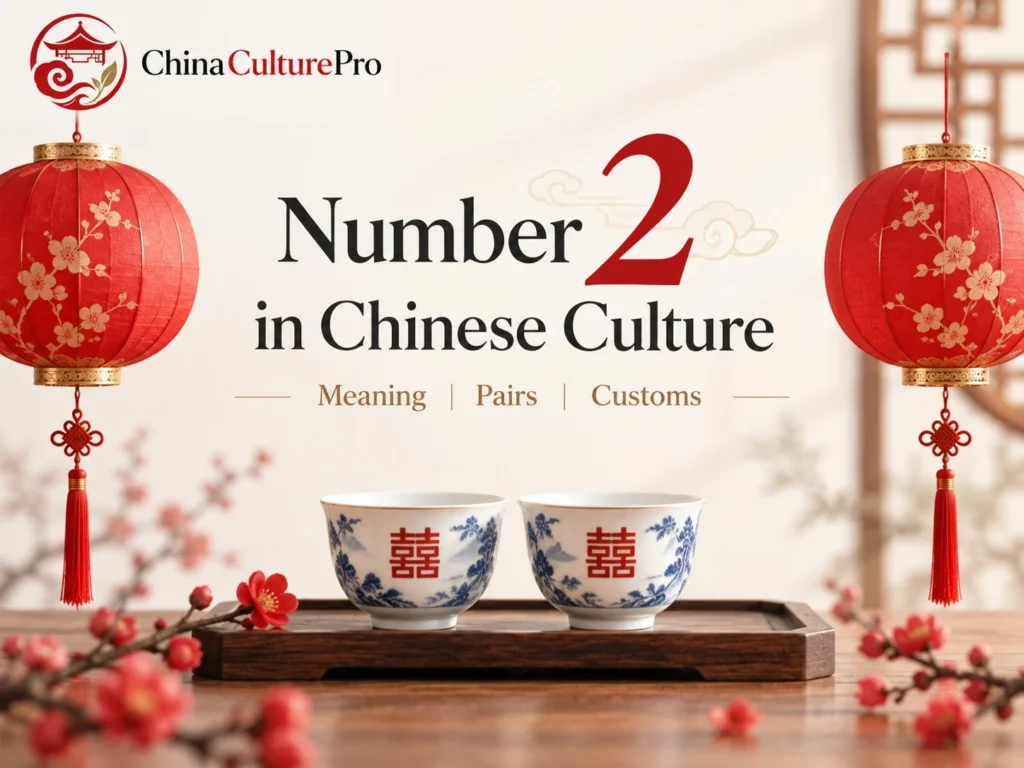

Quick Answer: What Does Number 2 Mean in Chinese Culture?
Number 2, usually written as Er (二, èr), is favorable in many Chinese celebrations because pairs suggest union, reciprocity and shared happiness. It is not lucky in every setting, however, and its meaning changes between ordinary language, wedding customs, classical philosophy and modern slang.
- Pairs and celebrations: Matching or doubled forms suit occasions centered on togetherness, giving rise to the familiar idea that good things come in pairs.
- Weddings: Double Happiness (双喜, shuāngxǐ), often written as the combined character 囍, and paired objects express marital union and shared joy.
- Classical philosophy: In traditional readings of the Dao De Jing, “two” marks the differentiation of Yin and Yang (阴阳, yīnyáng) within a larger process of generation.
- Modern slang: In certain informal expressions, èr can suggest foolish, awkward or rash behavior, but this does not make 2 an unlucky number.
The safest conclusion is that 2 is contextually auspicious, especially in paired celebratory forms. It is a cultural convention, not a force that changes luck, love or fate.
English-language explanations often reduce the meaning of number 2 in Chinese culture to “luck,” “balance” or “love.” Each label captures only part of the picture. Pairing belongs mainly to social and visual custom, Double Happiness to weddings, “two” in classical texts to cosmological differentiation, and negative meanings to particular words or slang.
These layers also belong to different periods and forms of evidence. A Qing wedding robe, a line in the Dao De Jing and a modern joke using èr cannot be interpreted by the same rule. This article therefore treats 2 as one part of the wider system of Chinese number symbolism, where language, medium and setting matter more than a fixed lucky-or-unlucky label.
Two Is Not One Chinese Word: Er, Liang and Shuang
English “two” can correspond to Er (二, èr), Liang (两, liǎng) or Shuang (双, shuāng). The words overlap in quantity but do different grammatical jobs. Their distinctions explain why the favorable idea of pairing cannot be assigned automatically to every appearance of the digit 2.[1]
| Term | Main function | Common examples | Interpretive limit |
|---|---|---|---|
| 二, èr | The number two, second place, dates, labels and fixed expressions | 二月, February; 第二, second; 二十, twenty | Usually a number or ordinal; it does not automatically mean a harmonious pair |
| 两, liǎng | A quantity before many measure words; two sides or both parties | 两个人, two people; 两本书, two books; 两边, two sides | It identifies quantity or two parties; auspiciousness depends on the complete phrase and setting |
| 双, shuāng | A pair, an even number or something doubled | 一双鞋, a pair of shoes; 双数, even number; 双喜, double happiness | “Pair” and “double” are basic meanings; a positive ritual reading comes from the object or celebration |
These are strong tendencies, not a one-line replacement rule. Èr remains standard in ordinals, months, arithmetic and many compounds. Liǎng is normal before many classifiers, but fixed forms and specialized contexts create exceptions. Shuang emphasizes pairing or doubling rather than simply counting two unrelated items.
The dictionary meaning of èr also includes “two-minded” or “different” in classical compounds such as 二心, “a divided or disloyal mind.” That meaning belongs to the full expression. It does not turn the numeral into a negative cultural symbol.
Why “Good Things Come in Pairs” Makes 2 Auspicious
The positive meaning of 2 comes mainly from structure rather than sound. The expression 好事成双 (hǎoshì chéng shuāng), “good things come in pairs,” fits celebrations in which matched gifts, repeated characters or symmetrical arrangements make togetherness visible. Cheng shuang simply means “to form a pair”; literary examples show that paired forms have long supplied an image of companionship.[1]
This preference should not be turned into a universal law. A pair can feel especially apt when the occasion itself concerns two people, mutual exchange or shared happiness. In routine counting, a room number or a document label, 2 is usually neutral. A single gift can also be perfectly polite when the object, value and relationship make sense.
Nor are all even numbers lucky. Four is even but is often avoided in modern Chinese-speaking communities because of its sound resemblance to the word for death. Pairing is therefore one source of favorable meaning, not a mathematical rule. More broadly, the non-mathematical meanings of numbers develop through particular cultural histories rather than from arithmetic alone.[2]
Double Happiness and Paired Symbols in Chinese Weddings
Chinese weddings provide the clearest setting in which doubled words, matching objects and paired motifs work together. Their meanings come from the wedding context and the identities of the motifs—not from an abstract belief that the digit 2 controls marriage.
What the Double Happiness Symbol Means
Double Happiness combines two copies of 喜 (xǐ), “happiness” or “joy,” into the familiar wedding graph 囍. It is not a historic way of writing the numeral two. Its message is visual and verbal: two joys are joined in one balanced design, making it well suited to a union between two people.
The symbol appears on wedding clothing, ornaments, furnishings and ritual objects. Surviving objects made for the Guangxu Emperor’s late-Qing wedding include robes embroidered with dragon, phoenix and Double Happiness motifs, a gold Double Happiness ruyi and paired hair ornaments bearing 囍.[3] These objects document court use in a specific period; they should not be treated as proof that every Chinese wedding in every region followed one design code.
Paired Objects and Motifs
Wedding pairs can carry several independent meanings:
| Pair or motif | Wedding reading | What sets the limit |
|---|---|---|
| Dragon and phoenix | A complementary imperial or marital pairing in the relevant historical design | The animals have histories beyond marriage; see the separate guide to dragon and phoenix symbolism |
| Mandarin ducks | Couplehood and marital affection in art and gifts | The meaning comes from the paired birds and surrounding scene; see Mandarin ducks in Chinese culture |
| Conjoined lotus blooms | Union and a wish for an affectionate marriage | The botanical image and accompanying inscription matter more than the count alone |
| Paired cups or divided-gourd vessels | Two participants sharing a marriage rite | The meaning depends on ritual use, not simply owning two vessels |
In the Qing court wedding rite, Hejin (合卺, hé jǐn) involved the bride and groom drinking from two parts associated with one divided gourd, expressing their joining as a married unit.[3] It is a useful example of how an object, an action and a pair work together to create meaning.
Number 2 in the Dao De Jing and Yin-Yang Thought
What “One Gives Birth to Two” Means
Chapter 42 of the Dao De Jing states, “Dao gives birth to one; one gives birth to two; two gives birth to three; three gives birth to the myriad things.” It immediately describes beings as carrying yin and embracing yang.[4] Traditional interpreters have therefore commonly read “two” as yin and yang, or as a first differentiation within an originally unified process.
The line is not a mathematical formula, and the numeral is not being ranked as lucky. It presents generation: unity differentiates, polar forces interact and the diverse world emerges. Modern scholarship also cautions that fully systematized yin-yang cosmology developed over time, so a later correlation table should not be read back into every word of the early text.[5]
Complementarity Is Not Good Versus Evil
Yin and yang are relational poles. They can describe patterns such as dark and light, yielding and forceful, or cool and warm, but the labels change with the relationship being analyzed. The same thing can be relatively yin in one comparison and relatively yang in another. Chinese philosophical accounts emphasize interaction, cyclic change and the emergence of new forms from these polar relationships.[5]
That does not mean yin and yang are two identical halves, nor does it make yin evil and yang good. It is also too broad to say the pair was never ranked: some later correlative political and social theories used yin-yang language to justify hierarchy. The accurate claim is narrower—yin and yang are not inherently a moral good-versus-evil opposition, and their philosophical meaning cannot be reduced to a modern “balance” slogan.
For the same reason, this cosmological “two” cannot determine whether two people are compatible or whether a date containing 2 is fortunate.
Is Number 2 Lucky in Gifts, Weddings and Everyday Life?
Number 2 is most useful as an optional celebratory cue. Its practical importance falls when numbers are assigned for ordinary counting or administration.
| Setting | Common reading | Practical guidance | Boundary |
|---|---|---|---|
| Weddings and celebrations | Pairs can reinforce union and shared happiness | Matching objects or a pair of suitable gifts can fit the occasion | There is no national rule requiring every item to appear twice |
| Everyday gifts | A pair may look deliberate or generous | Choose the object and relationship first; pairing is secondary | One meaningful gift is not inherently rude or unlucky |
| Cash gifts and red envelopes | Even totals are often preferred for happy occasions | Follow the family’s and region’s custom | Appropriate value and relationship matter more than the last digit |
| Phone numbers, rooms and addresses | 2 is generally neutral unless part of a meaningful sequence | Use it normally | It has no single nationwide reading comparable to the strongest associations around 8 or 4 |
| Ordinary counting | Pure numerical value | No special action is needed | Classical or wedding meanings should not be imported into routine use |
For comparison, the broader guide to lucky numbers in Chinese culture explains why 6, 8 and 9 acquired different favorable associations. The guide to unlucky Chinese numbers shows why evenness alone cannot decide whether a number is welcomed or avoided.
When Er Sounds Negative: Slang and Fixed Expressions
In informal modern Mandarin, calling someone 很二 or 太二 may suggest that the person is foolish, socially awkward or rash. The force varies with speaker, relationship and tone: it can be playful among friends but insulting when directed at a stranger. Because this use is colloquial and variable, learners should not treat it as the basic definition of èr.
The clearer fixed insult is Er Bai Wu (二百五, èr bǎi wǔ), used for a simple-minded or recklessly foolish person.[7] It is not merely the number 250 read neutrally, and it is inappropriate in formal or respectful speech. Several colorful origin stories circulate, but the dictionary definition does not establish one of them as the historical source.
These expressions illustrate a basic rule of interpretation: a complete word or phrase can acquire a meaning that its individual numeral does not possess. They do not make 2 taboo in gifts, dates or addresses.
Does Number 2 Represent Yin, Fire or a Wuxing Element?
Number 2 has no single, universal Wuxing (五行, wǔxíng) identity. Claims that it is simply “yin” or “Fire” combine different correlative systems.
| System | What 2 does | Interpretive limit |
|---|---|---|
| Odd-even yin-yang classification | Some traditional number schemes classify even numbers as yin | This is a rule inside a specific numerical model, not an everyday luck meaning |
| The Great Plan in the Book of Documents | Fire appears second in the list “first, Water; second, Fire” | The passage establishes an ordered list; by itself it does not say every appearance of 2 is Fire.[6] |
| Later correlative diagrams | Some later systems pair 2 and 7 with Fire | This specialized correlation should not be presented as a universal Chinese belief |
These models may matter when studying a particular commentary, diagram or ritual classification. They do not provide a general rule for choosing gifts, dates, room numbers or personal “lucky numbers.”
Common Misreadings of Number 2
- Always lucky: Two is most favorable when pairing matches the social or visual context; elsewhere it may be neutral.
- All even numbers: Evenness is not a general luck test. Four is the clearest modern counterexample.
- One gift is offensive: Pairing can enhance a celebration, but one suitable gift is not automatically unlucky or impolite.
- A numeral written as 囍: Double Happiness joins two forms of 喜; the standard numeral is 二.
- Every paired motif comes from 2: Dragons and phoenixes, Mandarin ducks, lotus designs and ritual vessels have their own histories and visual rules.
- Yin versus yang means evil versus good: They are relational categories used to explain interaction and change, though later theories sometimes mapped them onto hierarchies.
- Permanently Yin or Fire: Those labels belong to particular correlative systems, not all Chinese uses of the numeral.
- Negative slang makes 2 unlucky: 很二 and 二百五 are lexical expressions, not number taboos.
- Two sounds like love: Èr and ài are different syllables. Any 2-for-love reading is modern wordplay, not a standard traditional homophone.
FAQs About Number 2 in Chinese Culture
Is 2 a lucky number in Chinese culture?
It can be, especially in weddings, celebrations and designs built around a pair. The positive meaning comes from union, reciprocity and the idea that good things come in pairs. In ordinary counting and most identifiers, however, 2 is neutral rather than a universal lucky number.
Why do good things come in pairs in Chinese culture?
Pairs suit occasions centered on two people, mutual exchange or shared joy, so matched gifts and symmetrical decorations can make completeness visible. This is a flexible cultural and aesthetic preference. It does not mean every even number is lucky or that a single object is improper.
What is the difference between er, liang and shuang?
Èr is normally used for the numeral, ordinals and fixed forms; liǎng commonly expresses a quantity before a measure word or refers to two sides; shuāng means a pair, an even number or something doubled. Context and grammar—not symbolism alone—determine which word is correct.
What does the Double Happiness symbol mean?
Double Happiness, 囍, joins two forms of 喜, “joy.” It is strongly associated with Chinese weddings and expresses shared marital happiness through a doubled visual form. It is not a variant of the numeral 2, and its meaning depends on the wedding setting.
Does number 2 represent Yin or Fire in Wuxing?
Not universally. Some number systems classify even digits as yin, the Great Plan lists Fire second, and later diagrams may correlate 2 and 7 with Fire. These are separate, system-specific conventions and should not be turned into a general rule about number 2.
Sources
[1] Ministry of Education, Taiwan. Revised Mandarin Chinese Dictionary: 二, 兩 and 雙 Entries
[2] Liu Danqing, Chinese Academy of Social Sciences. The Mathematical and Cultural Meanings of Numbers
[3] Palace Museum. Qing Imperial Wedding Rituals
[4] Chinese Text Project. Dao De Jing, Chapter 42
[5] Stanford Encyclopedia of Philosophy. Metaphysics in Chinese Philosophy
[6] Chinese Text Project. The Great Plan, Book of Documents
[7] Ministry of Education, Taiwan. Dictionary Entry for 二百五