
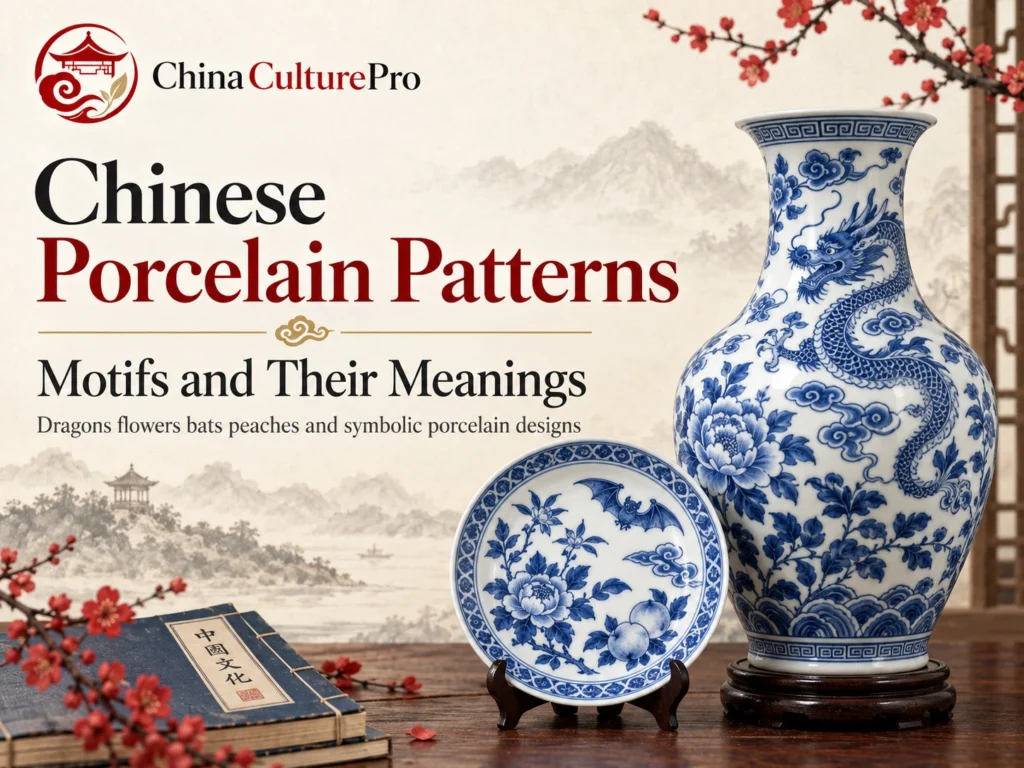

Quick Answer: What Do Chinese Porcelain Patterns Mean?
Chinese porcelain patterns can express blessings, longevity, abundance, family continuity, religious devotion or status. They can also depict stories, landscapes and decorative subjects. Meaning depends on the object’s date, purpose, inscriptions and complete design.
- Subject: Animals, flowers, fruits, figures and characters offer different interpretive clues.
- Combination: Several motifs may form a complete wish that one image cannot express alone.
- Placement: Check the interior, exterior and reverse before counting or identifying a design.
- Technique: A color scheme or painting method describes appearance, not a single symbolic meaning.
These are cultural associations and wishes, not guarantees of wealth, health or protection. Some decoration has no established symbolic reading.
A painted dragon, a flowering branch or a band of characters can tell you something about a Chinese porcelain object—but only when you read it alongside the rest of the vessel. This guide applies the broader Chinese patterns and motifs framework to porcelain, where decoration curves around surfaces, inscriptions identify donors, and images sometimes continue beneath the rim.
Pattern, Palette and Technique: What Is the Difference?
Start with three separate questions: what is depicted, how is it arranged, and how was it decorated? A lotus is a motif; a repeating lotus border is a pattern; painting it beneath the glaze is a technique. The palette is the range of colors used.
- Qinghua (青花, qīnghuā): Blue-and-white porcelain uses cobalt pigment painted beneath a transparent glaze. Its subjects can be animals, flowers, figures or landscapes.
- Fencai (粉彩, fěncǎi): A Qing overglaze enamel category associated with soft, shaded colors, often called famille rose in English. Neither term names a floral subject.
- Incised or molded decoration: Designs are cut or impressed into the clay surface, often covered by glaze. This differs from painting with underglaze pigments. [1]
Two bowls with lotus decoration may therefore share a subject while looking very different. Likewise, two blue-and-white bowls need not share a theme. Technique alone does not determine an object’s meaning or intended owner.
The Metropolitan Museum of Art’s Yongzheng-period dish with peaches and bats (1997.1.11) illustrates pink overglaze enamels. Its Song-dynasty lobed Ding bowl (17.118.37), dated to the eleventh–twelfth century, has incised lotus decoration beneath an ivory-white glaze. The first depends on painted color; the second on incised lines visible beneath the glaze. [2][3]
Common Chinese Porcelain Motifs at a Glance
Use these associations as starting points. The final column matters as much as the meaning: it explains what a motif cannot establish by itself. A recognizable plant can support more than one reading, while an unfamiliar animal may be part of a story rather than an auspicious emblem. Describe the image before assigning it a theme.
| Motif | Visual clues | Common association | Interpretive limit |
|---|---|---|---|
| Dragon (龙纹, lóngwén) | Long, scaled body; clouds or waves | Imperial authority; auspicious power | A dragon does not prove imperial ownership. [4] |
| Phoenix (凤纹, fèngwén) | Elaborate tail and crested head | Auspiciousness; courtly prestige | Do not identify every phoenix as an empress’s emblem. [1] |
| Bat (蝙蝠纹, biānfúwén) | Spread wings; often flying among fruit | Blessings; five bats can evoke the Five Blessings (五福, wǔfú) | Count the whole vessel, not one photograph. [4][5] |
| Fish (鱼纹, yúwén) | Swimming fish with water or plants | Surplus and abundance through wordplay | A fish does not necessarily mean monetary wealth. [1] |
| Lotus (莲花纹, liánhuāwén) | Flowers, leaves and seedpods | Purity; Buddhist or secular associations | Lotus decoration alone does not identify a temple object. [1] |
| Peony (牡丹纹, mǔdānwén) | Full, layered blossoms | Wealth, honor and flourishing life | Honor and prosperity extend beyond money. [1] |
| Peach (桃纹, táowén) | Rounded fruit with a crease and pointed tip | Longevity | A longevity wish does not establish a birthday commission. [6] |
| Pomegranate (石榴纹, shíliuwén) | Crown-like calyx; sometimes exposed seeds | Descendants and family continuity | This reflects historical family ideals, not a modern fertility requirement. [6] |
| Buddha’s hand citron (佛手纹, fóshǒuwén) | Finger-like fruit segments | Blessings through near-sound wordplay | The fruit’s name does not make a design Buddhist. [6] |
| Three Friends of Winter (岁寒三友, suìhán sānyǒu) | Pine, bamboo and plum together | Endurance and cultivated character | Moral associations differ from a generic good-luck wish. [7] |
| Auspicious characters | 福 (fú, blessings), 寿 (shòu, longevity), Double Happiness (囍, shuāngxǐ) | Written wishes | Read the actual character; Double Happiness is a marriage-related combination, not traditional-script 喜. |
| Eight Auspicious Symbols (八吉祥, bā jíxiáng) and other religious emblems | Recognizable groups of wheels, vessels, flowers or implements | Religious teachings and devotion | A vajra is a separate Buddhist emblem, not one of the standard eight. [8] |
How Do Borders, Panels and Vessel Shape Organize a Pattern?
The same image can perform different jobs depending on where it appears. Before interpreting a flower, identify whether it belongs to the main scene, a background or a framing band.
- Kaiguang (开光, kāiguāng): A reserved panel enclosing a separate picture, sometimes round or shaped like a flower. Here the word refers to decorative layout, not a religious consecration.
- Main design: The principal imagery, often on a vase’s broad body or a dish’s central field.
- Ground: Repeated decoration behind the principal imagery, helping it stand out.
- Border: A band at the mouth, shoulder or foot, organizing the transition between zones.
Floral scrolls (缠枝纹, chánzhīwén) connect flowers through winding stems. Their continuity can suggest ongoing vitality, although the flower species adds its own associations. Detached sprays (折枝纹, zhézhīwén) isolate a branch or sprig, making its particular fruit or flower easier to read. [4][6]
A Xuande-period bowl in the Palace Museum, Beijing (新00052485), has a plain interior but lotus-supported Buddhist emblems outside, with another band near the foot. Its reign inscription appears beneath the outer rim. Looking only inside would miss both the subject and an important piece of text. [8]
Shape also controls how a design unfolds. A plate can present one scene at a glance; a bottle may require several views. A branch crossing the rim connects surfaces that a catalog photograph might separate. Treat each photograph as a view of an object, not necessarily the complete composition.
How Do Motifs Combine Into Auspicious Wishes?
Homophones, Stories and Visual Associations
Images can function as a visual phrase. Sometimes pronunciation supplies the connection: the bat’s final syllable, fú, matches 福, meaning blessings; fish, yú, matches 余, meaning surplus. These are exact Mandarin homophones. The fó in Buddha’s hand citron is only a near-sound association with fú. Wordplay should not be described as an exact match when it is not. [1][4][6]
Other associations depend on stories or physical features. Peaches evoke mythic longevity traditions; a pomegranate’s many seeds suggest descendants. These mechanisms can work together, but identifying one element does not automatically decode the entire object.
Read the composition like a sentence: which images belong together, what has been repeated, and is there a character that clarifies the wish? Do not treat every nearby motif as another syllable in a rebus. First ask whether the elements form a recognizable combination, then test that reading against the object record. A flower in a border may frame the subject rather than contribute another word to the central blessing.
Four Combinations That Form Complete Wishes
| Combination | Elements | Complete wish | What to check |
|---|---|---|---|
| Fushou shuangquan (福寿双全, fúshòu shuāngquán) | Bats and peaches | Blessings together with longevity | Both themes must be present; the bat count need not be five. |
| Wufu pengshou (五福捧寿, wǔfú pěngshòu) | Five bats attending a longevity character or emblem | Five Blessings surrounding longevity | Check both the total count and the arrangement around the longevity element. |
| Three Abundances (三多, sānduō) | Buddha’s hand citron, peach and pomegranate | Blessings, long life and descendants | Identify all three fruits across the composition. |
| Yutang fugui (玉堂富贵, yùtáng fùguì) | Magnolia, crabapple and peony | Wealth and honor for the household | Recognize the flowers; do not substitute any three blossoms. |
The fruit combination appears on a Qianlong underglaze-red vase in the Palace Museum (新00096001). [6] The floral combination appears on the Asian Art Museum of San Francisco’s Kangxi vase with pheasant and flowers (B60P94+). Magnolia supplies “jade,” crabapple “hall,” and peony wealth and honor. [5]
A wish can be arranged around a central character or distributed across separate fruit subjects. Check which arrangement the object actually uses before naming the combination.
These phrases express wishes, not evidence of what happened to an owner.
What Do Landscapes, Figures and Antique Objects Mean?
Figures and landscapes require a different kind of reading from a fruit rebus. Look for actions, attributes and accompanying text: a group playing musical instruments is not interchangeable with a group receiving an immortal’s blessing.
- Immortals and deities: Identifying objects, dress and companions help distinguish religious figures from ordinary people.
- Scholarly or historical scenes: Activities such as writing, music or examining paintings can establish a cultivated setting; a specific story needs additional evidence.
- Landscapes: Mountains, buildings and travelers may support a literary theme or simply create an appealing scene.
- Bogu (博古, bógǔ): Antiquarian imagery depicts objects such as ancient bronzes, ceramics or jades, suggesting an interest in the cultured past. [9]
The Asian Art Museum’s Kangxi gourd vase (B60P47) places the Three Star Gods above eighteen Tang scholar-officials engaged in cultivated activities. One object therefore combines divine blessings with aspirations to scholarly rank. [5] For these subjects, the broader guide to Chinese symbolism in art offers a more useful next step than a list of lucky motifs.
How Do Court, Temple and Export Contexts Change the Reading?
Context determines whether a design signals institutional identity, devotion or the tastes of a particular market.
- Court context: A documented imperial commission makes rank and ceremonial associations relevant. Dragons or refined workmanship alone cannot establish that commission or identify the person who used the object.
- Temple context: Dedications, documented use and recognizable religious groups matter. The Buddhist eight-symbol group differs from the Hidden Eight Immortals (暗八仙, àn bāxiān), the attributes associated with Daoist immortals. A solitary lotus is insufficient evidence for either group.
- Export context: The place of manufacture, place of decoration and intended audience may differ. A design can combine conventions from several cultures rather than follow one Chinese symbolic system.
On Chinese decorative objects, the Buddhist set commonly includes the wheel, conch, parasol, canopy, lotus, vase, paired fish and endless knot. Daoist immortal attributes instead refer to particular figures through their implements. Count and identify the objects rather than assuming any eight treasures form the Buddhist group. Religious imagery can also be borrowed ornamentally, so identifying the group and proving ritual use remain separate tasks. [8][10]
The Met’s eighteenth-century dish with flowers and birds (1995.268.94) is a Chinese porcelain blank decorated by a Dutch painter in Japanese Kakiemon style. Its manufacture and decoration belong to different settings. [11]
The familiar Willow Pattern raises a related distinction. Its Chinese-inspired buildings, bridges and landscape imagery were arranged into a British ceramic design in the late eighteenth century. The lovers’ story attached to it was invented later; it is not an ancient Chinese tale encoded on the plate. [12] A Chinese-looking subject, therefore, does not necessarily have Chinese authorship or the meaning assumed by a modern seller.
What Can Characters, Inscriptions and Reign Marks Tell You?
Separate three kinds of writing before using text as evidence:
- Auspicious characters: Written blessings that form part of the decoration.
- Dedications or commemorative inscriptions: Text naming donors, recipients, occasions or religious purposes.
- Reign marks: Formulas naming an emperor’s reign, which may be contemporary with manufacture or copied later.
A British Museum Kangxi-period wine cup (PDF 666) bears a Chenghua reign mark referring to a much earlier Ming emperor. Such an apocryphal mark prevents a simple equation between the written reign and the object’s date. [13]
An inscription may record a wish rather than an accomplished event. A prayer for household peace documents the donor’s intention; it cannot tell you whether that household later prospered. Likewise, a poetic quotation needs to be read as a whole before assigning its subject to a historical episode.
Text also has a location. Look beneath the base, around the neck and under the rim, not just in the central picture. Use the catalog’s transcription and documented dating where available. Reading a reign name is not the same task as authenticating porcelain.
Two Worked Examples: Reading the Complete Porcelain Object
A Qianlong Plate with Eight Peaches and Five Bats
The Asian Art Museum of San Francisco’s Qianlong-period plate (B60P1707) has overglaze polychrome decoration. Its design continues across the rim.
- Visible facts: Five peaches and three bats appear on the front; three peaches and two bats appear on the reverse.
- Contextual evidence: Together they make eight peaches and five bats. The museum interpretation connects the peaches with the Eight Immortals and the bats with the Five Blessings.
- Reasonable reading: The complete design combines blessings and longevity.
- Limit: Its imagery does not identify a particular recipient or prove a specific birthday use. [5]
The interpretive gain comes from inspecting both surfaces. A front-only photograph would give the wrong total and conceal how the branch joins the decoration. Do not apply the eight-peach interpretation automatically to every vessel with eight pieces of fruit: the identified subject and catalog context still matter.
The David Vases: A Temple Dedication Changes the Reading
The British Museum’s David Vases (PDF B.613 and PDF B.614) are blue-and-white altar vases dated by their inscriptions to 1351, during the Yuan dynasty. They combine dragons with several decorative bands and elephant-head handles.
- Visible facts: Painted imagery shares the surface with substantial neck inscriptions.
- Contextual evidence: The dedication records Zhang Wenjin’s gift of two vases and an incense burner to a Daoist temple at Xingyuan, in present-day Wuyuan.
- Reasonable reading: Their documented role is devotional offering, rather than an imperial commission inferred from dragons.
- Limit: These dated examples do not define every Yuan blue-and-white vessel or make all similar dragon vases temple offerings. [14]
Here the inscription answers a question the dragon cannot: why were the vessels given? Date, donor and destination constrain the interpretation. You can recognize a dragon correctly and still misunderstand the object if you ignore its dedication.
How to Interpret a Chinese Porcelain Pattern
Use this sequence when looking at a museum object or a well-documented photograph:
- Establish the documented context: Read the catalog date, place and intended function. Keep unknown details unresolved.
- Inspect the complete vessel: Check the interior, exterior, reverse, neck and base; note what the available images do not show.
- Separate technique, layout and subject: Describe how the decoration was made, how it is arranged and what it depicts.
- Read text and combinations: Consult inscription transcriptions, count repeated elements and identify which motifs form a shared theme.
- Test the interpretation: Compare it with the museum explanation and distinguish observation, supported association and uncertainty.
If a catalog leaves a scene unidentified, keep the uncertainty visible. Note the figures, actions and any legible text rather than choosing a familiar legend simply because one detail resembles it. Additional views or a fuller transcription may resolve the question later.
This method lets you make a narrower, better-supported statement. “The decoration expresses blessings and longevity” may be justified where “this was the emperor’s birthday plate” is not. For an unfamiliar design, describing what you see is a useful result even when you cannot name its story.
FAQs About Chinese Porcelain Patterns
Is Blue-and-White Porcelain a Single Pattern?
No. Blue-and-white describes cobalt decoration beneath the glaze. It can depict many subjects, so identify the imagery separately from the technique.
Does a Dragon Pattern Prove Imperial Ownership?
No. Dragons occur in several contexts, including the David Vases’ temple dedication. Ownership needs documented evidence beyond the motif or claw count.
What Do Bats and Peaches Mean on Chinese Porcelain?
They commonly combine blessings with longevity. Five bats can add the Five Blessings association; check the reverse before deciding how many there are.
Do All Chinese Porcelain Designs Have Symbolic Meanings?
No. Some are chiefly ornamental, naturalistic or narrative. A recognizable subject need not contain a hidden auspicious message.
Is the Willow Pattern Originally Chinese?
The familiar pattern was developed in Britain from Chinese-inspired imagery. Its later lovers’ legend is an invented explanation, not a Chinese historical source.
Sources
[1] The Museum of Oriental Ceramics, Osaka. Guide to Enjoy the Exhibit
[2] The Metropolitan Museum of Art. Dish with peaches and bats
[3] The Metropolitan Museum of Art. Lobed bowl with lotus flower
[4] Hong Kong Palace Museum. Profusion of Lights and Colours
[5] SFO Museum; Asian Art Museum of San Francisco. Hidden Meanings: Symbolism in Chinese Art
[6] The Palace Museum. 釉里红三果纹梅瓶
[7] The British Museum. Large print guide – Room 95: Chinese Ceramics
[8] The Palace Museum. 青花缠枝莲托八吉祥纹碗
[9] The Palace Museum. 黄花梨博古格
[10] The Palace Museum. 透明珐琅八吉祥纹面盆
[11] The Metropolitan Museum of Art. Dish with flowers and birds
[12] Victoria and Albert Museum. Beyond Willow
[13] The British Museum. Wine-cup, PDF 666
[14] The British Museum. Altar-vase, PDF B.613