
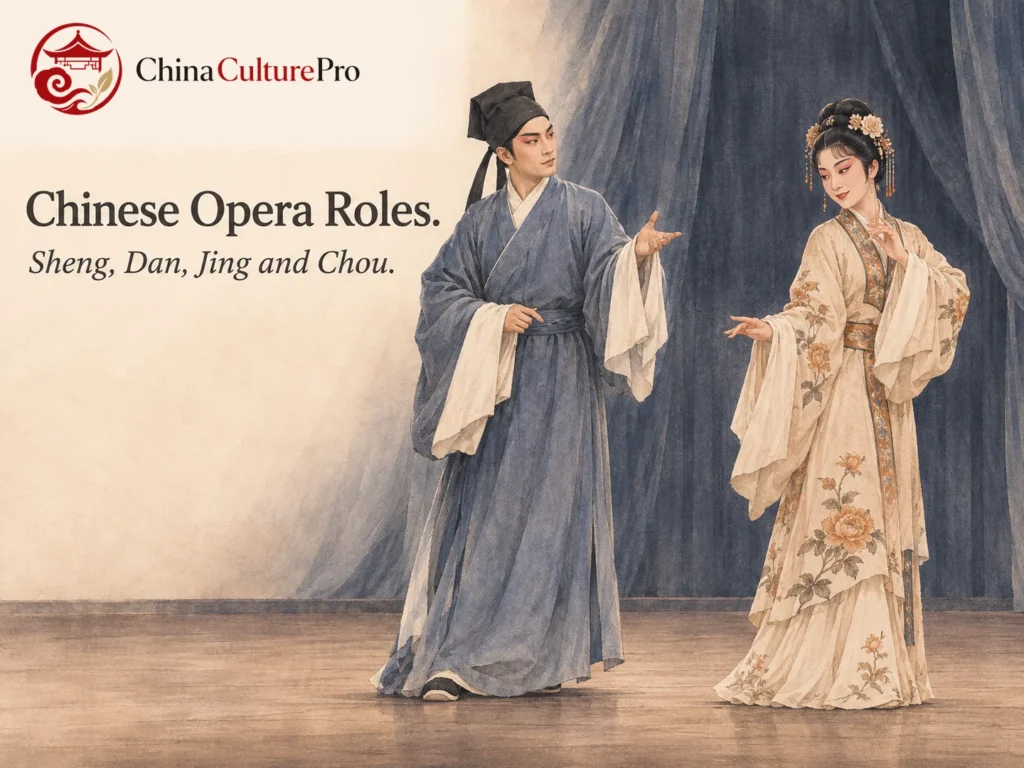

Quick Answer: What Are Sheng, Dan, Jing and Chou?
In Peking opera, sheng(生,shēng) covers male roles, dan(旦,dàn) female roles, jing(净,jìng) painted-face roles, and chou(丑,chǒu) comic or supporting roles. Each family includes specialties with different ways of singing, speaking and moving.
A role label tells you how a part is performed. The character’s name tells you who that person is in the story. The cast credit tells you who plays the part. Other forms of Chinese opera can group their roles differently, so check the genre when you read a programme.

An actor playing an older official and one playing a young scholar may belong to the same role family. Each part calls for a different voice and walk. That distinction is a starting point for understanding the work a role label does.
What a Role Family Tells You
A role family, or hangdang(行当,hángdang), groups parts that share conventions of portrayal. In Peking opera, these conventions guide the actor’s training. A role can call for a particular use of breath, gait, speech or stage movement. The actor learns those skills and uses them to portray different characters. [1]
For a viewer, the family can help explain why an actor moves or sounds as they do. The actor adapts those conventions to the part. Two parts within the same family can have different ages, occupations and temperaments. A specialist may adjust the way they perform according to the character and play. [2]
The Four Peking Opera Role Families Compared
Use the table to connect a programme’s role label to something you can hear or see. A performer’s specialty and the demands of a scene affect which cues are most apparent. [2]
| Role family | Common range of parts | Clues to notice |
|---|---|---|
| Sheng | Male characters, including scholars, older men and martial figures | Listen for the vocal register and watch how the actor carries the body through a step or turn. |
| Dan | Female characters of different ages and temperaments | Sustained singing, dialogue or martial action may be prominent, depending on the part. |
| Jing | Painted-face roles with different dramatic functions | Broad facial designs and characteristic vocal or movement techniques can help identify the role. |
| Chou | Comic and supporting roles, including martial ones | A small patch of white around the nose is common. Timing, speech and agility can help define the performance. |
Peking opera face painting can help recognize a role or character. Pay attention to the extent and placement of a design. A small white patch and a full-face pattern are different visual conventions, and the actor’s voice or movement gives further information. [3]
Specialties Within Each Family
Within sheng, laosheng(老生,lǎoshēng) covers older male characters and wusheng(武生,wǔshēng) specializes in martial parts. An older character’s measured speech and bearing can require different skills from the control and timing of a martial sequence. Both belong to the same broad family. [2]
Within dan, qingyi(青衣,qīngyī) often portrays a dignified woman, while wudan(武旦,wǔdàn) specializes in women’s martial roles. The jing family includes specialties that emphasize singing, acting or combat movement. Within chou, wuchou(武丑,wǔchǒu) can combine comic timing with physically demanding action. A specialty label can direct your attention to one of those skills. [1]
How Role Systems Vary Across Genres
Cantonese opera has related categories known by Cantonese names. It also has a system of six major roles that can describe how featured parts are distributed in a company. A term that organizes a troupe’s leading assignments may do a different job from a broad family label. [4]
Yue opera has its own customary divisions. Its Shanghai heritage entry lists six categories. The divisions distinguish young and older male and female characters as well as comic and painted-face roles. The categories overlap with those familiar from Peking opera, while their organization and training reflect the particular tradition. [5]
How to Read a Cast List
Start with the title and genre. Find one character, the performer’s name and any specialty listed. In *The Drunken Concubine*, Yang Yuhuan is the character and Mei Lanfang is an artist famous for portraying her. The dan category describes the kind of part and the skills used to perform it. [6]
Once you have those details, follow a short scene. Hear where the actor sustains a syllable, watch the way they stop or turn, and check how costume and makeup support the effect. Reading role and action together is more reliable than identifying a character from one color or movement.
FAQs About Chinese Opera Roles
Are the four role families used in every Chinese opera?
They are a standard way to describe Peking opera. Other genres may use related terms with different divisions and troupe arrangements.
Does a dan role have to be played by a woman?
Dan describes a female character role. Performers of different genders have trained in and performed these parts.
Does a painted face always identify a jing role?
Strong full-face designs are often associated with jing. Check the design, character and role credit because other specialties also use face paint.
Sources
[1] China National Peking Opera Company. How Many Role Families Are There in Peking Opera?
[2] Palace Museum. Peking Opera
[3] China National Peking Opera Company. Peking Opera Face Painting
[4] Education University of Hong Kong. Roles in Cantonese Opera
[5] China Intangible Cultural Heritage Digital Museum. Yue Opera, Shanghai Project
[6] Beijing Municipal Government. Peking Opera and Selected Classics