

Quick Answer: What Is Cantonese Opera?
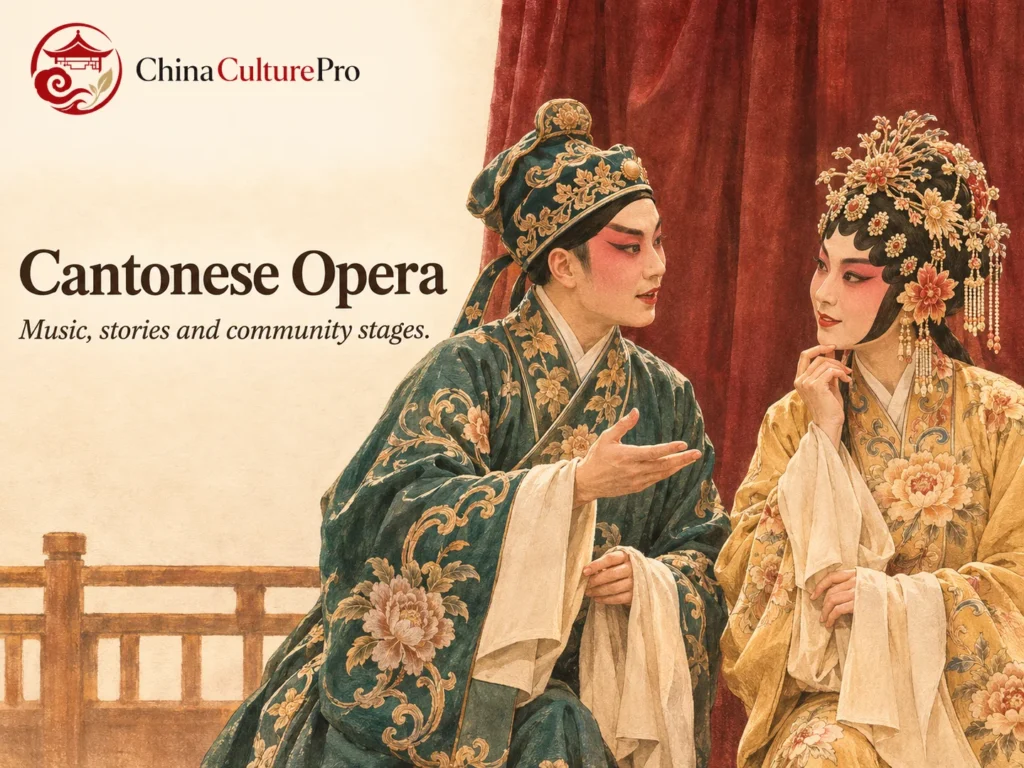
Cantonese opera, or Yueju(粤剧,Yuèjù), is a theatre tradition associated with Guangdong, Guangxi, Hong Kong and Cantonese-speaking communities elsewhere. It combines sung and spoken Cantonese with stylized movement, instrumental accompaniment and elaborate stage dress.
The repertoire includes historical dramas, love stories and accounts of everyday life. A performance may take place in a theatre or as part of a community occasion. The language, story and reason for staging the work help you understand what you are seeing.
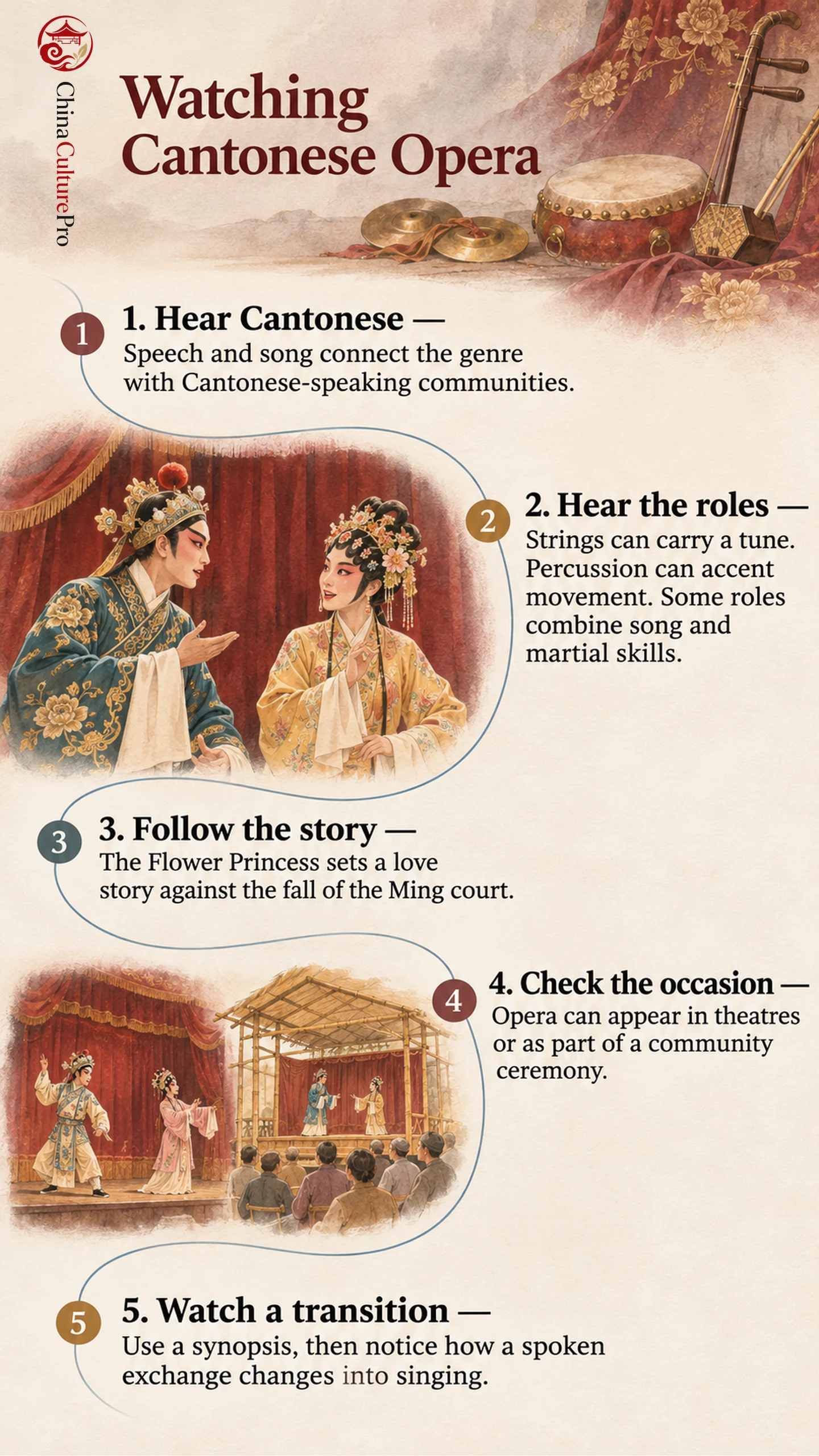
A Cantonese opera scene can move from a pointed exchange of dialogue into an extended sung line. The change may come just as a character weighs a decision. Listening for the shift between speaking and singing gives you one way to follow the action.
Language and the Cantonese-Speaking Stage
Cantonese opera developed in southern China as local performers adapted dramatic and musical practices from elsewhere. Cantonese speech and singing help make it recognizable from the voice alone. The genre has also become a way for Cantonese-speaking communities outside its early centers to maintain a shared repertoire. Production styles can differ even when performers share a language and play. [1]
The pinyin name Yueju needs context. The characters 粤剧 identify Cantonese opera. The form written 越剧, also romanized *Yueju*, is Yue opera, associated with Zhejiang and Shanghai. If a programme gives only the romanized name, look for the Chinese characters or the stated performance language.
Voices, Instruments and Role Specialties
Listen for the different jobs of the sung line, spoken words and instruments. Strings can help carry a melody. Drums, gongs and other percussion can mark the timing of a gesture or movement. The balance of those sounds can shift when a scene moves from dialogue or song to a fight or procession. [1]
A leading male role called wenwusheng(文武生,wénwǔshēng) draws on both singing and martial movement. Cantonese opera has its own role terms and ways of distributing leading and supporting parts. Some troupes moved from a ten-role structure toward a system of six major roles, a way of dividing the work among featured artists. These arrangements are one example of how a broader system of Chinese opera roles takes local forms. [2]
Stories and The Flower Princess
In *The Flower Princess*, a princess and her intended husband face the collapse of the Ming court. Their relationship becomes inseparable from decisions about loyalty and political survival. Tong Tik-sang wrote the play, which premiered in Hong Kong in 1957. The change of dynasty sets the stakes, and the play builds its drama around the lovers’ choices. [3]
A synopsis helps a new viewer follow the names, the relationships and the change in power. Then the performance can supply the sound and timing a synopsis leaves out. Listen to how long a character sustains a thought in song, and watch the other performer’s response before the next line. [3]
Theatres, Bamboo Stages and Community Ritual
The same theatre tradition can serve more than one purpose. The Hong Kong Heritage Museum presents costumes, postbills and photographs along with a reconstructed theatre in a bamboo shed. Such records place actors, audiences and performance spaces alongside the script and music. [4]
| Setting | What to look for | What to check |
|---|---|---|
| Theatre production | A named work, cast and sequence of scenes | Whether it is a full staging, a selection of scenes or an adaptation |
| Community ritual performance | Opera scheduled within a local celebration or religious occasion | The organizer, occasion and the role of performance in the event |
In some communities, shengongxi(神功戏,shéngōngxì) combines opera with religious or ceremonial purposes. Audiences can enjoy a performance while the event also serves a ceremonial purpose. A bamboo shed is a kind of performance space. The occasion determines whether a particular show has a ritual purpose. UNESCO added Cantonese opera to its Representative List in 2009. [1]
How to Watch a Cantonese Opera Scene
Start with a scene whose work and cast are identified. Use a synopsis to establish what the characters want. Then listen for the change from dialogue to song. Watch where a performer holds a pose and see whether the percussion accents the pause or carries the movement onward.
When comparing a theatre production with footage of a community celebration, note the occasion as well as the genre. A close camera view shows facial expression and costume details, while a wider view can show the space, musicians and audience. Both help explain how Chinese opera works as live theatre.
FAQs About Cantonese Opera
Is Cantonese opera the same as Yue opera?
They are distinct forms. Cantonese opera is 粤剧, while the Zhejiang and Shanghai tradition is 越剧.
What language is Cantonese opera performed in?
Cantonese is central to the genre’s singing and speech. The stage uses stylized vocal and spoken conventions.
Is Cantonese opera always part of a ritual?
It can be staged for entertainment, as theatre repertoire or within a community ceremony. The occasion gives the performance its particular purpose.
Sources
[1] UNESCO. Yueju Opera, Cantonese Opera
[2] Education University of Hong Kong. Roles in Cantonese Opera
[3] Chinese University of Hong Kong Press. The Flower Princess
[4] Hong Kong Heritage Museum. Cantonese Opera Heritage Hall