

Quick Answer: What Is Khoomei Throat Singing?
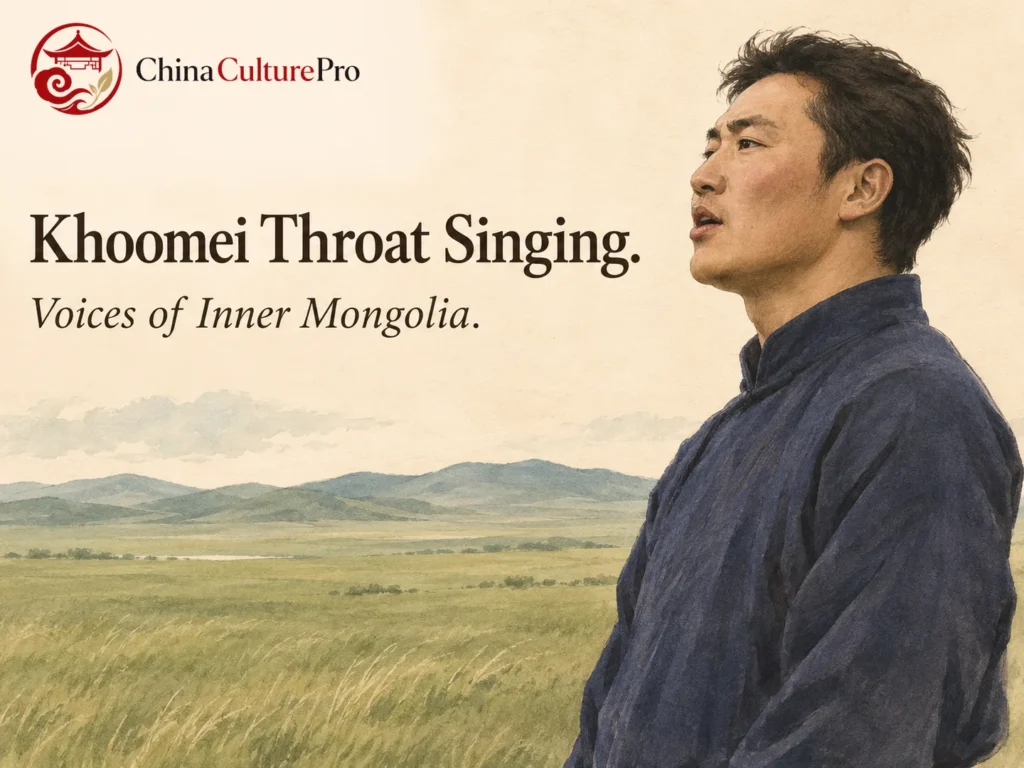
Khoomei is a vocal tradition practiced in Inner Mongolia and other places, including Mongolia and Tuva. In Chinese it is often called humai(呼麦,hūmài). A single singer can produce a sustained low sound while making a higher tone stand out. Deep styles can give the voice a different, lower texture.
The phrase “Chinese throat singing” often points to Mongolian performance traditions within China, especially in Inner Mongolia. Related traditions extend across borders, with local names, styles and performance settings.
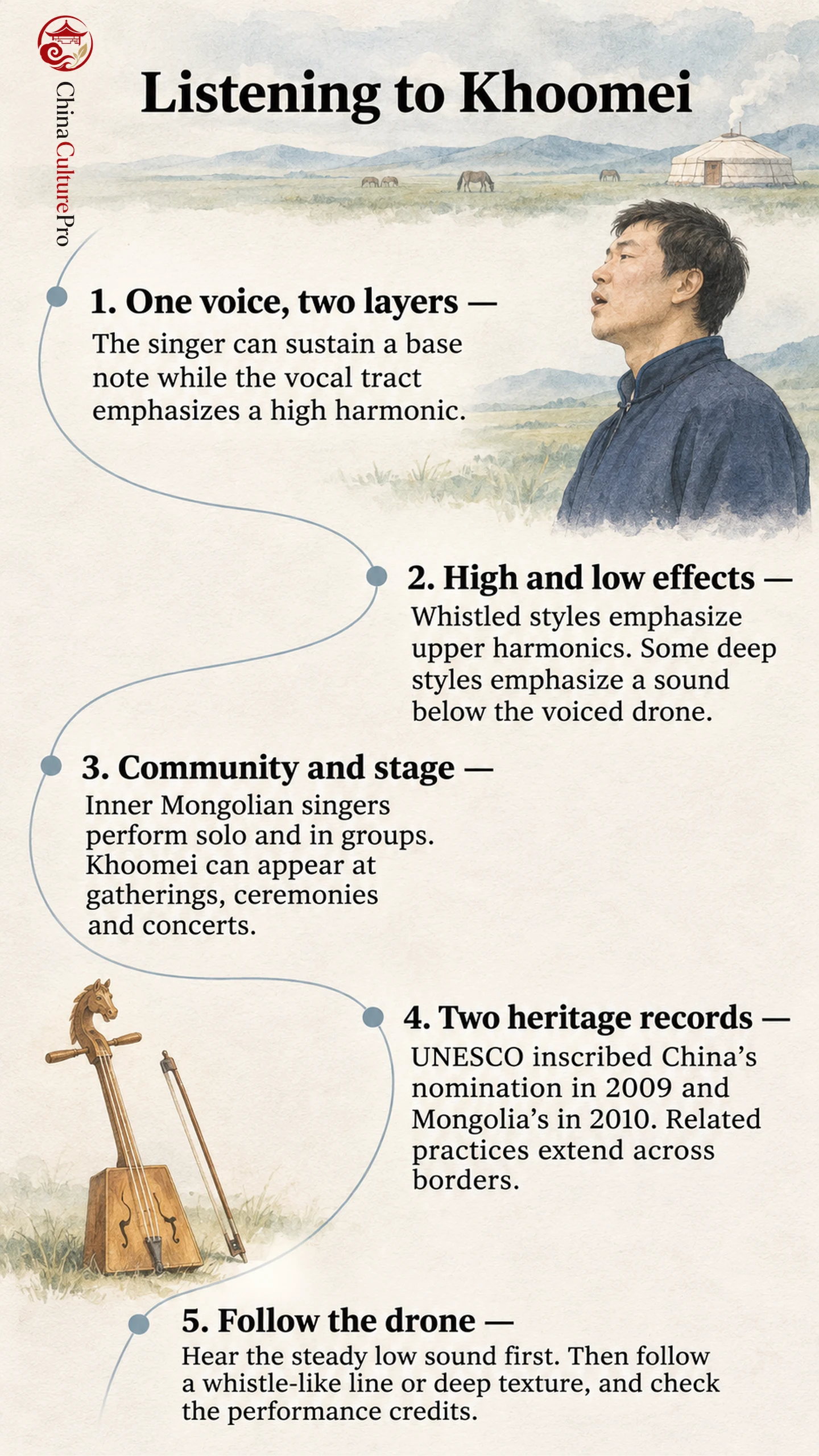
The high sound can resemble a flute above a steady low note. In a solo demonstration, both sounds can come from the singer. Learning to hear the two layers makes it easier to tell what the voice contributes when other singers or instruments join in.
How a Single Voice Can Sound Like Two
A voiced sound contains a fundamental pitch and higher components called harmonics. Most of the time we hear those components together as the color of one voice. In a whistled form of overtone singing, the singer shapes the vocal tract so that a narrow group of higher harmonics becomes particularly strong. The ear can then follow that emphasis as a separate high line while the base note continues.
A 2020 study used recordings of Tuvan singers, moving MRI images of one singer and acoustic modeling to investigate this effect. The researchers found that changes in the vocal tract concentrated energy in a narrow frequency range. The measurements support a filtering explanation for the high tone in those performances.[1]
That study concerns a specific technique. Other throat-singing styles may emphasize a low sound or use different adjustments. The audible combination is the starting point for listening, and the style and performer give it context.
Whistled and Deep Styles
Mongolia’s heritage documentation groups examples under a deep style and a whistled style. These labels describe musical effects within that account. Performers in different regions may organize and name their techniques differently.[2]
| Example from Mongolia’s documentation | What stands out | What to follow |
|---|---|---|
| Isgeree Khöömei | A whistle-like line formed by emphasizing upper harmonics. | The upper pitches change while a lower drone can remain steady. |
| Kharkhiraa | A low effect associated in the nomination with a subharmonic an octave below the voiced drone. | The weight and texture of the low sound. |
An octave below is a different relationship from a high overtone above the base pitch. As you compare recordings, notice where the emphasized sound sits in relation to the drone. A deep sound and a clear whistle give different impressions even when both recordings use the broad label Khoomei.
Khoomei in Inner Mongolian Performance
The Chinese heritage nomination describes Khoomei among Mongolian communities in Inner Mongolia, an autonomous region in northern China. It records performance at important gatherings and ceremonies, including competitions and banquets, and songs that honor nature, ancestors or heroes. Solo and group performances both occur. A concert performance can place the same vocal skill in a different setting from the ceremonies documented in the nomination.[3]
Ih Tsetsn, a group from Inner Mongolia, performed at the Smithsonian Folklife Festival in 2014. The program lists several throat singers, horsehead fiddles and other instruments. It also identifies long song in the group’s repertoire. The group’s program placed throat singing and long song within a single ensemble’s repertoire.[4]
Related Traditions and UNESCO Listings
UNESCO inscribed China’s “Mongolian art of singing, Khoomei” in 2009. The nomination recognizes a tradition practiced among Mongolian communities and also mentions related practices in western Mongolia and the Tuva Republic of Russia. The listing describes the element nominated by China.[3]
In 2010, UNESCO separately inscribed Mongolia’s “Mongolian traditional art of Khöömei.” The second decision concerns the transmission of the practice documented in Mongolia. The listings identify the nominated traditions and the years of recognition. They provide two records of living heritage across a wider region.[5]
Listening for Voice, Drone and Accompaniment
The UNESCO multimedia film for the China nomination provides a documented introduction. Begin with a short solo passage and listen for the sound that stays steady. Then listen for a higher line moving above it or for the way a deep style changes the low texture.[6]
In a group recording, the fiddle or another voice can also carry a sustained sound. Use the program and a clearly featured passage to identify the source of the sound. Mongolian long song, which can appear in the same concert, is a genre known for extending and ornamenting syllables.[7] The name describes a different musical feature from a drone and overtone combination. It belongs in a wider listening comparison with Chinese folk songs and regional vocal traditions.
FAQs About Khoomei
Can one singer make both sounds?
Yes. In overtone-focused singing, one voice can produce a steady base sound and make a higher harmonic line stand out at the same time.
Is Khoomei the same as Mongolian long song?
They are distinct traditions. Khoomei can emphasize more than one audible layer, while long song is known for extended, ornamented vocal phrases.
Why are there two UNESCO listings?
China and Mongolia submitted separate nominations. The entries document the traditions and communities in those nominations, with inscriptions in 2009 and 2010 respectively.
Sources
[1] Christopher Bergevin and colleagues. Overtone Focusing in Biphonic Tuvan Throat Singing
[2] UNESCO Multimedia Archives. The Mongolian Traditional Art of Khöömei
[3] UNESCO Intangible Cultural Heritage. Decision 4.COM 13.19, Mongolian Art of Singing, Khoomei
[4] Smithsonian Folklife Festival. Ih Tsetsn Ensemble from Inner Mongolia
[5] UNESCO Intangible Cultural Heritage. Decision 5.COM 6.31, Mongolian Traditional Art of Khöömei
[6] UNESCO Multimedia Archives. Mongolian Art of Singing: Khoomei
[7] UNESCO Intangible Cultural Heritage. Urtiin Duu, Traditional Folk Long Song