

Quick Answer: What Is a Pipa?
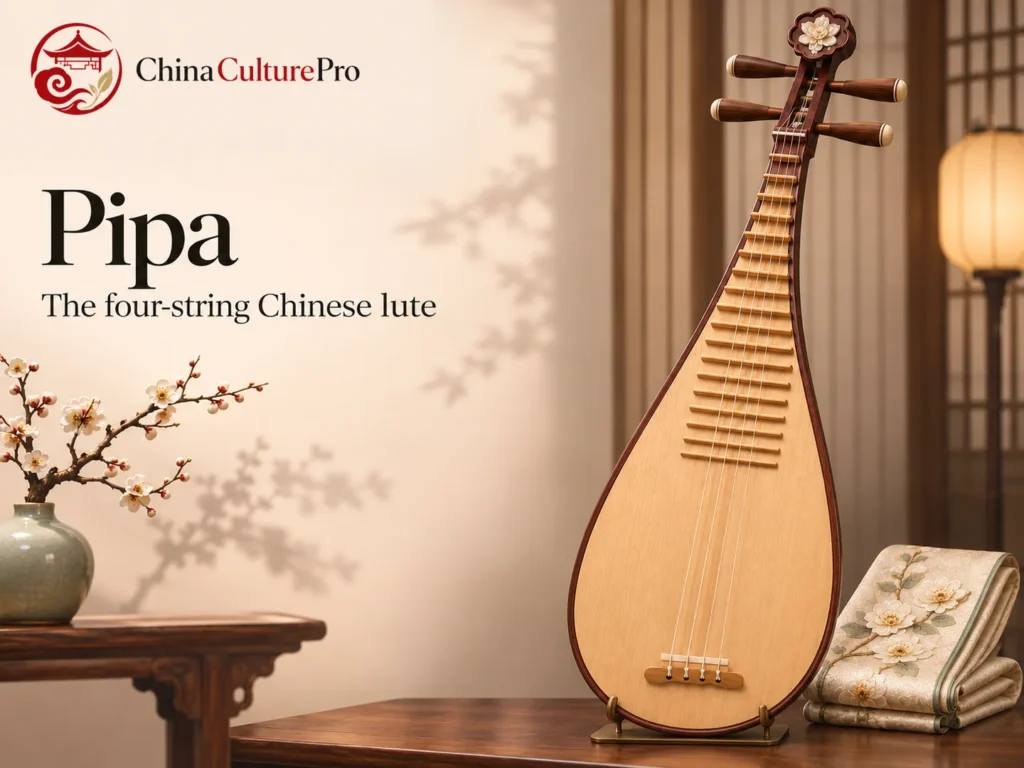
A pipa (琵琶, pípá) is a Chinese four-string lute with a pear-shaped body and raised frets. In modern performance, the player usually sits with the instrument upright or slightly angled against the body.
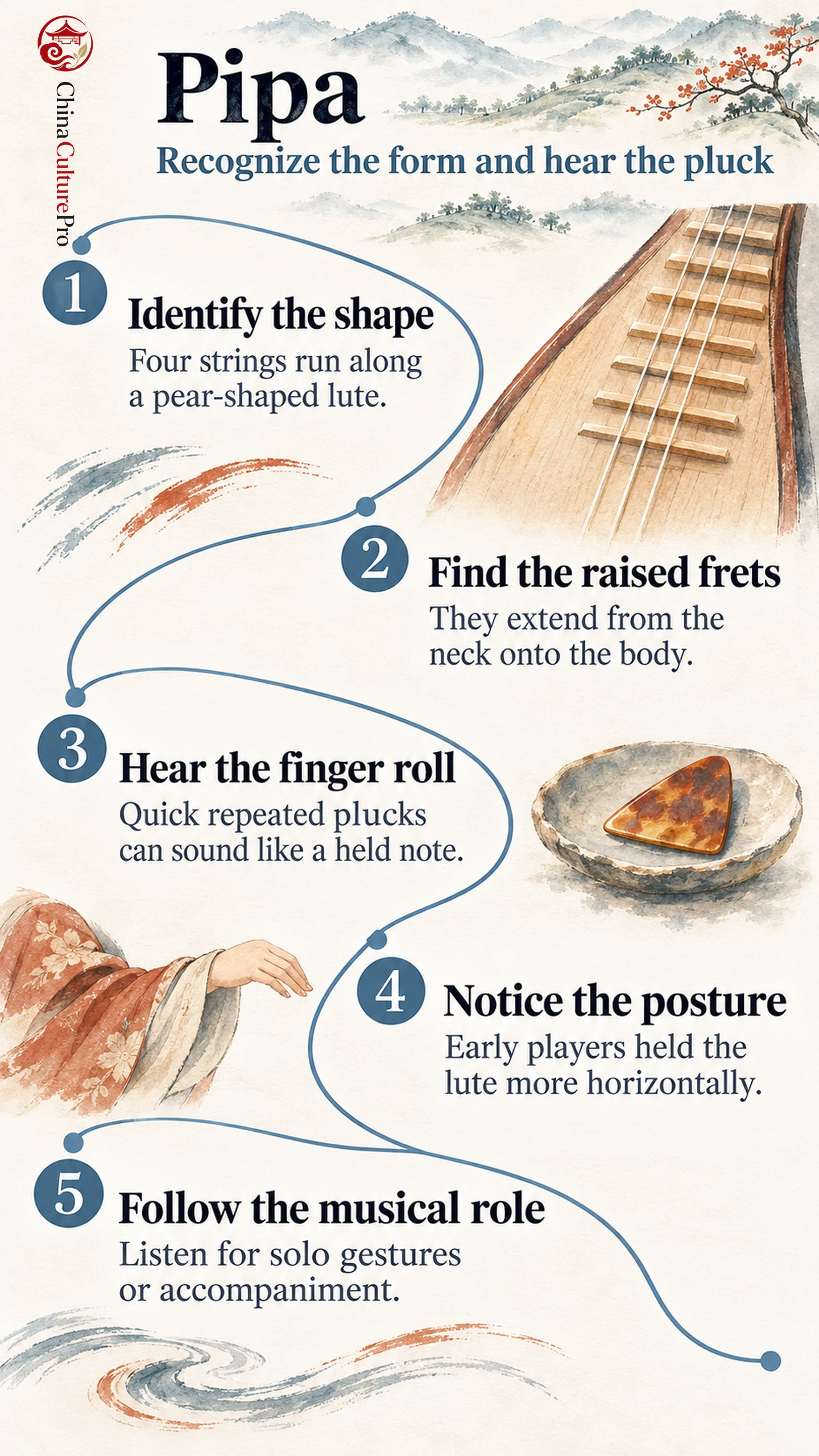
- Look at the face: Frets continue from the neck onto the upper part of the body.
- Listen to the attack: Plucks and strums can be sharply articulated, and rapidly repeated plucks can make a note seem sustained.
- Watch both hands: The right hand starts the notes and the left hand stops the strings at the frets.
The pipa can carry a virtuosic solo or accompany a singer or storyteller. [1][2][3][5]
In one moment a pipa can sound like a single singing line. In the next, a strum can produce several pitches with a short, forceful attack. Those contrasts come from what the right hand does with the strings and what the left hand does at the frets. [1][3]
What a Pipa Looks Like
Among Chinese musical instruments, the pipa belongs to the plucked lutes. Its broad wooden body tapers into a short neck. The strings travel from the lower part of the soundboard up to the tuning pegs. An example documented with four strings, two of them broken, also has frets on the neck and the belly. That arrangement is a useful clue even when a photograph does not show the strings clearly. [1][2]
A guzheng makes a useful comparison. Its long strings run along a horizontal zither body over individual bridges. The pipa instead has a shorter group of strings over a fretted face.
What the Two Hands Do
The left hand stops strings at the frets to change their vibrating length. The player can also push a stopped string sideways to bend the pitch. The right hand can pluck a string, sweep through several or repeat strokes with a succession of fingers. This last technique, called lunzhi (轮指, lúnzhǐ), can create a tremolo. [3]
A rolled note and a strummed chord have different outlines. In the roll, listen for a fine pulse underneath what seems like one held pitch. In the chord, the attack spreads across several strings. A performer can use both effects in the same short passage. [3]
From Horizontal Pick to Upright Finger Playing
The pear-shaped pipa has predecessors in West and Central Asia. A late seventh-century clay group depicts seated musicians holding lutes more horizontally. In early practice a plectrum could pluck silk strings. During the Tang period, players gradually adopted more finger and nail techniques and a more upright position. The clay figures show one historical posture. Changes in fingering and holding position took place over time. [1]
Hear the Pipa in a Solo and a Story
In *Ambush from Ten Sides* (十面埋伏, shí miàn mái fú), sharp chords and repeated gestures can suggest a battle. Li Tingsong’s recorded performance provides an example. Listen for where attacks bunch together and where a brief pause interrupts the movement. [3][4]
In the sung narrative form of Suzhou tanci, a pipa can share accompaniment with a three-stringed lute. The instruments help shape the rhythm around the singer’s words. The guides to Chinese performing arts and Chinese traditional music explain how listening for that role differs from following a solo. [5]
FAQs About Pipa
How Many Strings Does a Pipa Have?
The standard Chinese pipa has four strings. The raised frets run from the neck onto the face of the body. [1][2]
Is a Pipa a Zither?
It is a lute. Its strings run over a neck and pear-shaped body, and the left hand stops them at frets. [1][2]
Can a Pipa Sustain a Note?
A single pluck fades, but a rapid sequence of plucks on one string can give the impression of a continuous note. [3]
Sources
[1] J. Kenneth Moore. The Pipa
[2] Auckland Museum. Pipa, accession 1998.60.88
[3] Lei Gao. The Influence of Chinese Instruments on the Violin
[4] Smithsonian Folkways. China
[5] Suzhou Municipal Government. Suzhou Pingtan