


Quick Answer: What Is Nanyin?
Nanyin(南音,nányīn)is a musical tradition rooted in the Minnan(闽南,Mǐnnán)communities of southern Fujian, especially around Quanzhou, and practiced in communities overseas. It combines instrumental pieces with sung repertories. A small ensemble can accompany a singer using the local speech of Quanzhou.
A lute held horizontally, an end-blown bamboo flute and wooden clappers are characteristic sights and sounds. The repertory has several forms, and community groups pass it on through teaching, scores and performance.
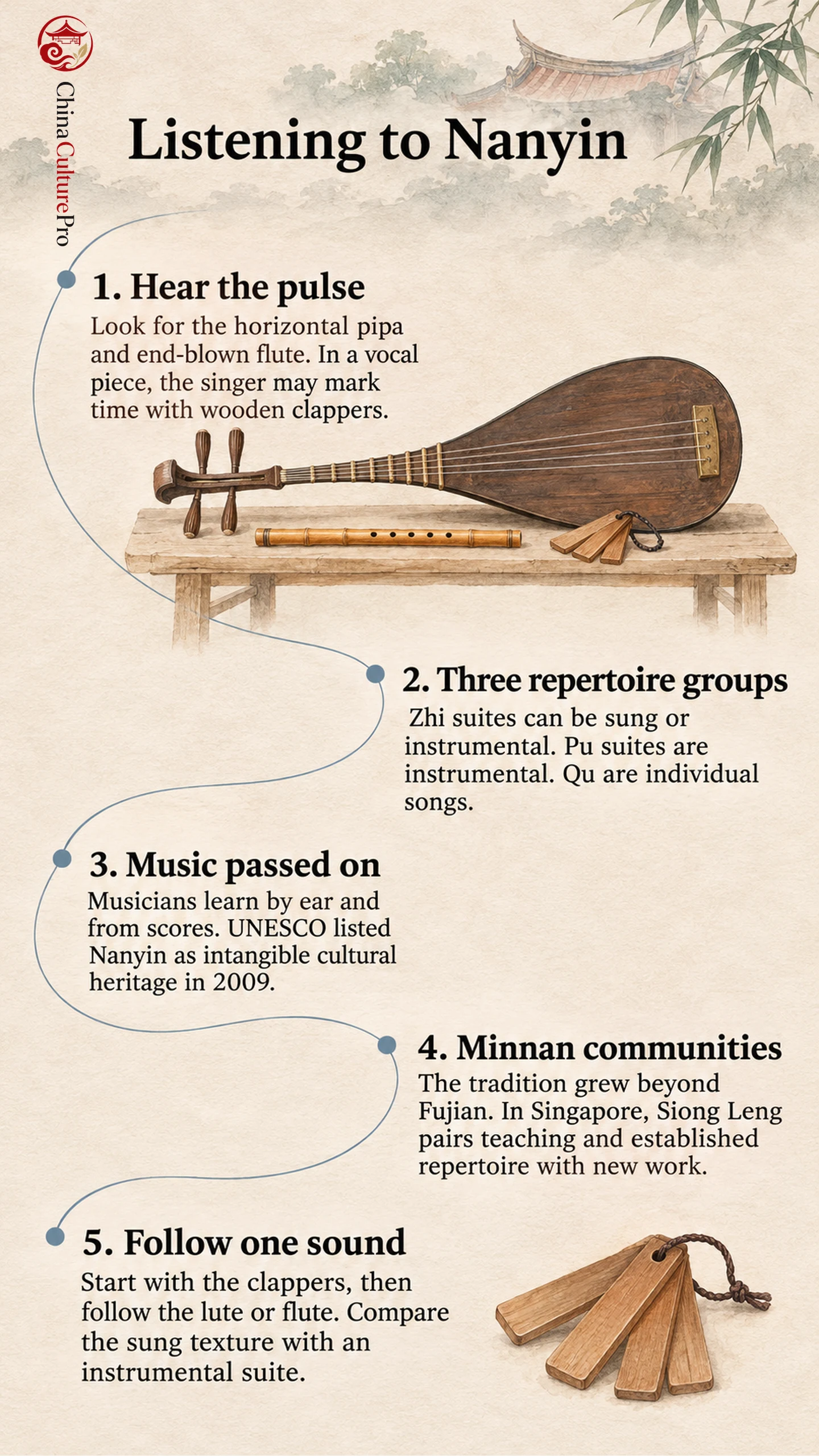
In a sung performance, the clappers can give a listener a way to follow time while the melody moves at an unhurried pace. The instruments have room to articulate individual notes, and the singer’s words can stretch over them. These relationships help explain how Nanyin works as both music and a shared practice.[1]
Instruments, Voice and Clappers
The horizontally held pipa (琵琶,pípa)is one of the clearest visual clues. In this tradition, the player holds the bent-neck lute across the body and plucks its strings. The orientation is a visual cue specific to the performance style. The dongxiao(洞箫,dòngxiāo), an end-blown flute, gives a breath-shaped line beside the lute. A sanxian(三弦,sānxián)adds another plucked sound, while an erxian(二弦,èrxián)adds a bowed line.
In a common vocal setup, the singer marks time using paiban(拍板,pāibǎn), or wooden clappers. The singer can therefore shape the words and mark the pulse at the same time. Listen for the separate clapper strokes, then hear how the flute and lute move around them. The National Heritage Board’s Singapore gallery documents instruments used by a local association and preserves photographs of musicians from 1947.[2]
Zhi, Pu and Qu in the Repertoire
A performance may move between music centered on instruments and pieces centered on the voice. The categories below describe groups within the repertory. A suite can contain several sections, while an individual song gives the singer one text and tune to bring forward.[3]
| Repertoire group | What it contains | What to follow |
|---|---|---|
| Zhi(指,zhǐ) | Suites that can be played instrumentally or presented with sung narrative and accompaniment. | Connections between sections as the suite unfolds. |
| Pu(谱,pǔ) | Instrumental suites. | The way the plucked, bowed and blown sounds combine without a singer. |
| Qu(曲,qǔ) | Individual songs with a featured voice. | The shape of the sung line and the relationship between words and accompaniment. |
In a concert program, the name of the group helps you anticipate what to listen for. You can then check whether the particular suite or song is presented with voice or as an instrumental performance.
Quanzhou and the Transmission of Nanyin
Quanzhou’s municipal account describes teaching by ear alongside the transmission of handwritten scores. Scores can record pitch signs and lute fingering. Learning with another musician also gives a player a way to hear pacing, tone and how parts fit together. Hearing those details in rehearsal helps a musician interpret what the notation records.[4]
Singing in the Quanzhou variety of Southern Min ties the words and their sound to a specific language tradition. Performance settings have included ceremonies, weddings, funerals and community festivities. In 2009, UNESCO inscribed Nanyin on the Representative List of the Intangible Cultural Heritage of Humanity. The decision recognizes the transmission and recreation of the practice by communities.[1]
Nanyin in Singapore and Other Minnan Communities
The tradition traveled with Minnan communities and developed in places beyond Fujian. In Taiwan it is often called Nanguan(南管,nánguǎn). The name helps readers recognize related repertories in different locations, while styles and local institutions can differ.[3]
Singapore’s Siong Leng Musical Association, founded in 1941, gives a documented example. Its account of Teng Mah Seng describes a 1977 Nanyin conference in Singapore that invited groups from across Asia. Teng also wrote new lyrics on contemporary subjects and recruited young musicians for training.[5] The association paired new lyrics and training with performances of its established repertory.
Fujian Nanyin and Cantonese Naam-yam are documented as distinct traditions in Singapore. The Cantonese form has its own sung storytelling, repertory and accompanying instruments. For a program that uses the English spelling Nanyin, check whether it describes Quanzhou or Cantonese singing.[2]
Listening to a Nanyin Performance
Begin with a performance that shows the singer and ensemble together. The Esplanade’s Routes of Asian Music feature offers a documented starting point. Follow the clappers for a short passage, then switch your attention to the horizontal lute and flute. Notice how each can keep its own attack and tone while moving with the others.[3]
Then try an instrumental suite and listen for who seems to carry the phrase when the voice is absent. Comparing those two settings makes the roles easier to recognize than listening for one instrument alone. A brief synopsis of the sung text can also help you follow a story when the language is unfamiliar. For a broader comparison of ensemble sizes and roles, see the guide to the Chinese orchestra.
FAQs About Nanyin
Is Nanyin always sung?
Its repertoire includes songs and instrumental music. Pu consists of instrumental suites, while qu features a singer.
Are Nanyin and Nanguan related names?
Yes. Nanguan is a common name in Taiwan for a related tradition, with its own local styles and communities.
Is Fujian Nanyin the same as Cantonese Naam-yam?
The two are distinct. Their languages, repertories and accompanying instruments differ.
Sources
[1] UNESCO Intangible Cultural Heritage. Decision 4.COM 13.20, Nanyin
[2] National Heritage Board, Singapore. Kreta Ayer Heritage Gallery
[3] Esplanade. How Nanyin Music Continues to Thrive
[4] Quanzhou Municipal People’s Government. Quanzhou Nanyin
[5] Siong Leng Musical Association. Teng Mah Seng