

Quick Answer: What Is a Sheng?
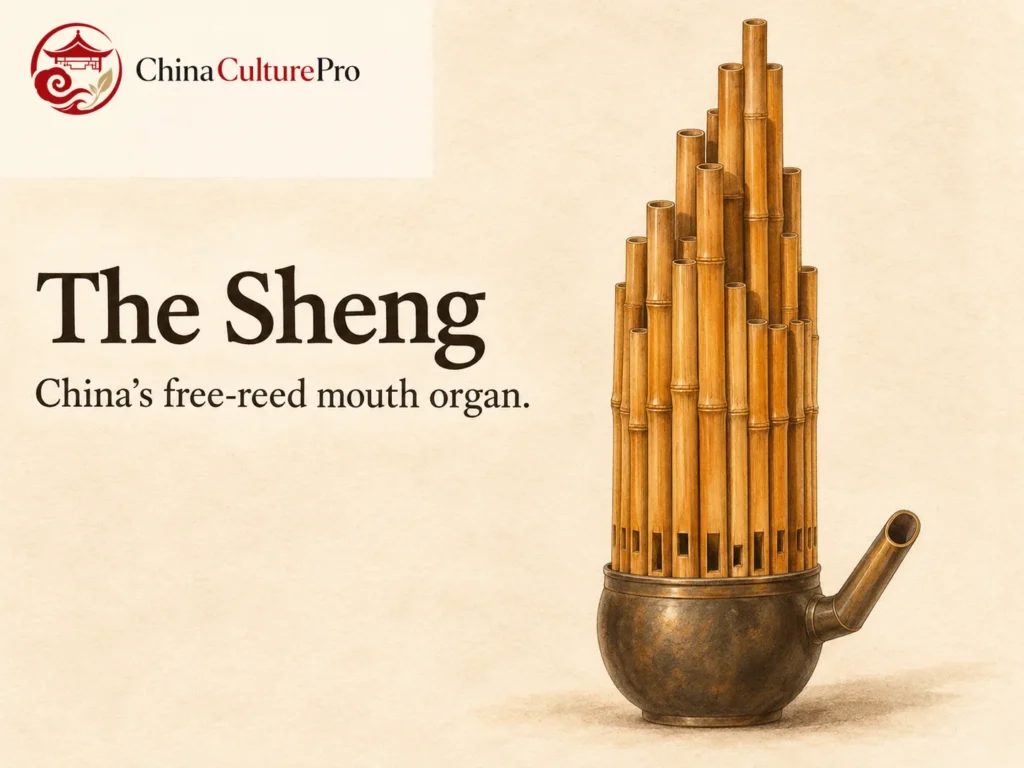
A sheng(笙,shēng)is a Chinese mouth organ. A cluster of upright pipes sits in a shared wind chamber. Air from the player’s breath sets small metal reeds vibrating, and the player selects the notes with finger holes or keys, depending on the model.
The instrument can sustain several pitches together, so one musician can play a melody, add a lower note or support the rest of an ensemble with chords. Compact bamboo instruments and larger orchestral models use the same free-reed principle.
The upright pipes make the sheng easy to spot, but the best listening clue is what happens under the tune. One player can hold a note while another pitch enters or moves. That combination gives the sheng a distinctive place among Chinese musical instruments.
How a Sheng Makes Sound
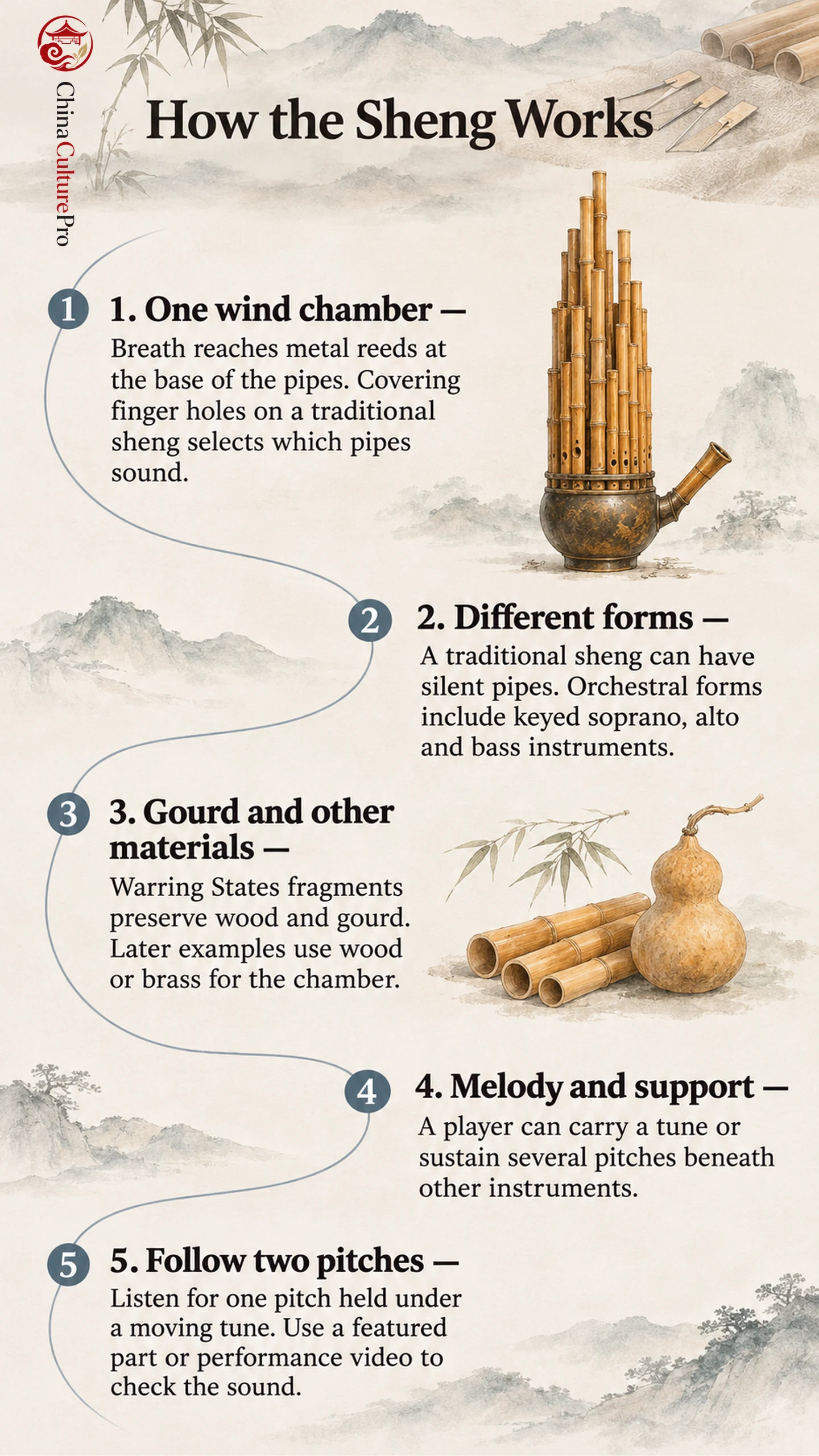
The player breathes through a single mouthpiece attached to the wind chamber at the base. The metal reeds on the sounding pipes sit near their lower ends, inside the chamber. A free reed is a thin tongue that swings through a close-fitting opening. Air moves the tongue, and the pipe and reed work together to produce a pitched tone.[1]
On a traditional sheng, covering a selected finger hole enables that pipe to sound. The player can use airflow in either direction, blowing out or drawing in through the mouthpiece. Covering more than one hole can produce several pitches on the same breath. Fourths, fifths and octaves are examples of intervals heard in traditional playing.[2]
The wind chamber is the quickest visual distinction from a row of panpipes, where the player blows across individual openings. An end-blown xiao (箫,xiāo)or a transverse dizi (笛子,dízi)uses an air jet at a blowing edge. A sheng instead relies on the movement of its reeds.
Traditional and Orchestral Sheng Compared
The number of visible tubes gives only part of the picture. A mid-twentieth-century instrument in Yale’s collection has seventeen bamboo pipes of five lengths, three of which have no reeds and are mute. It has a brass wind chamber and brass reeds. The visible count includes those three silent pipes.[3]
| Form | What to look for | What the form offers |
|---|---|---|
| Traditional round sheng | Upright bamboo pipes clustered around a small wind chamber. | Finger holes select pipes for a tune or several pitches together. |
| Keyed soprano sheng | A compact upper-register instrument with keywork. | A distinct soprano part in a modern wind section. |
| Alto and bass orchestral sheng | Larger instruments built for lower registers, including the alto paisheng and bass baosheng. | Sustained tones below the high winds and a fuller middle or bass layer. |
The keyed soprano, alto and bass examples reflect documented instruments used by the Hong Kong Chinese Orchestra.[4] Construction and available pitches vary between models. A recording marked “sheng” may feature a solo instrument with a very different register from the low part of a Chinese orchestra.
What Historical Shengs Tell Us
The Smithsonian catalogs four wood-and-gourd mouth-organ fragments from China to the Warring States period, 475–221 BCE. The surviving pieces provide physical evidence for an early mouth-organ tradition. They cannot establish a first maker or tell us how every contemporary instrument sounded.[5]
In the historical classification called bayin(八音,bāyīn), the sheng belongs to the gourd group. The category points to an earlier wind-chamber material. The Horniman Museum’s specimen has a wooden chamber, and the Yale specimen shows that brass can serve the same function.[6]
The stepped silhouette also carries an association with a phoenix’s folded wings. The late Qing instrument in the Metropolitan Museum of Art illustrates how an object can hold both a practical arrangement of pipes and a traditional visual association. The chamber and pipes document how the object was built. The phoenix association records how its silhouette has been interpreted.
How the Sheng Works in an Ensemble
The sheng can take the melody or accompany it. A sustained note beneath a moving line can make the tune feel more continuous, while two pitches moving together give it a thicker edge. A pair of notes in parallel fourths or fifths can sound quite different from a sequence of familiar piano chords. Listen for the interval between the parts as much as for the tune itself.
The Met’s account places the instrument in Confucian ceremonial music and also notes uses in folk-song accompaniment and occasional Peking opera performance. These contexts differ in repertory and purpose. In a modern concert ensemble, separate sheng registers let an arranger assign the instrument family both high lines and sustained lower parts.
Listening for the Sheng
Start with a featured sheng part, then listen to it in a larger group. The 2015 concert Sheng Clusters gives a documented example of an entire sheng ensemble. In the orchestral arrangement of Solar Planet, performed in Hong Kong in 2016, the featured sheng plays against the wider ensemble.[7]
In a short passage, follow the clearest pitch first. Then listen for a second pitch that starts and stops with it, or one that holds while the tune changes. Several instruments can produce the same blend in a dense recording, so use the program or a clearly featured passage to confirm which part is the sheng. If video is available, match the sound to the musician breathing through the side mouthpiece and selecting pipes at the base.
FAQs About the Sheng
Is the sheng a flute?
It is a free-reed mouth organ. A metal reed vibrates in each sounding pipe, while a flute uses an air jet at an edge.
Do all shengs have seventeen pipes?
Pipe counts vary across models. Some pipes can be silent, so the number of tubes and the number of sounding notes can differ.
Can a sheng play chords?
Yes. A player can select several sounding pipes together to hold an interval or chord.
Sources
[1] Metropolitan Museum of Art. Sheng, late nineteenth century
[2] Cambridge International Education. Cambridge IGCSE Music Teachers’ Guide to Set Works and the World Focus for Examination in 2025
[3] Yale School of Music. Sheng, 3509.1973
[4] Hong Kong Chinese Orchestra. Wind Instruments
[5] Smithsonian National Museum of Asian Art. Four Pieces of a Mouth Organ
[6] Horniman Museum and Gardens. Sheng, 12.5
[7] Hong Kong Chinese Orchestra. Chen Yi-wei