

Quick Answer: What Does a Spider Mean in Chinese Art?
A spider descending on a thread can represent happiness arriving. A spider’s web at Qixi (七夕, Qīxī) could be read as a sign of skill. A garden painting can also include a spider as part of the small life around its plants.[1][2][3]
- Hanging thread. Its downward movement can carry an auspicious wish.[1]
- Web. Its shape can matter in historical accounts of Qixi.[2][4]
- Garden. Flowers and leaves can give a painter room to observe the animal.[3]
Check which part of the scene the spider’s position or action emphasizes.

A thread can draw the eye downward to a spider on an embroidered textile. A web in a festival account instead asks the viewer to look for order in the strands. Both depend on the spider’s silk, but they use it in different ways.[1][2]
Happiness Descending on a Thread
The name joy spider (喜蛛, xǐzhū) ties the animal to happiness in folk language. In auspicious embroidery, a spider descending on a line can evoke the phrase “happiness descends from heaven” (喜從天降, xǐ cóng tiān jiàng). The movement of the image supplies the idea of arrival.[1]
The small spider can appear on textiles such as hats, garments and curtains. Its legs make the creature readable, while the thread gives the motif a direction. An isolated spider among flowers can call for a different interpretation.[1][3]
What a Spider’s Web Meant at Qixi
On the seventh night of the seventh lunar month, some communities asked for dexterity in needlework. A historical account describes fruit set out in a courtyard. A web spun across it could be taken as a favorable response. A Song account describes a different custom: participants examined a small box the next morning and read a round, orderly web as a sign of attaining skill.[2][4]
Qixi skill competitions also included activities such as threading a needle, where human dexterity was directly on display.[2][5]
Spiders Among Painted Hostas
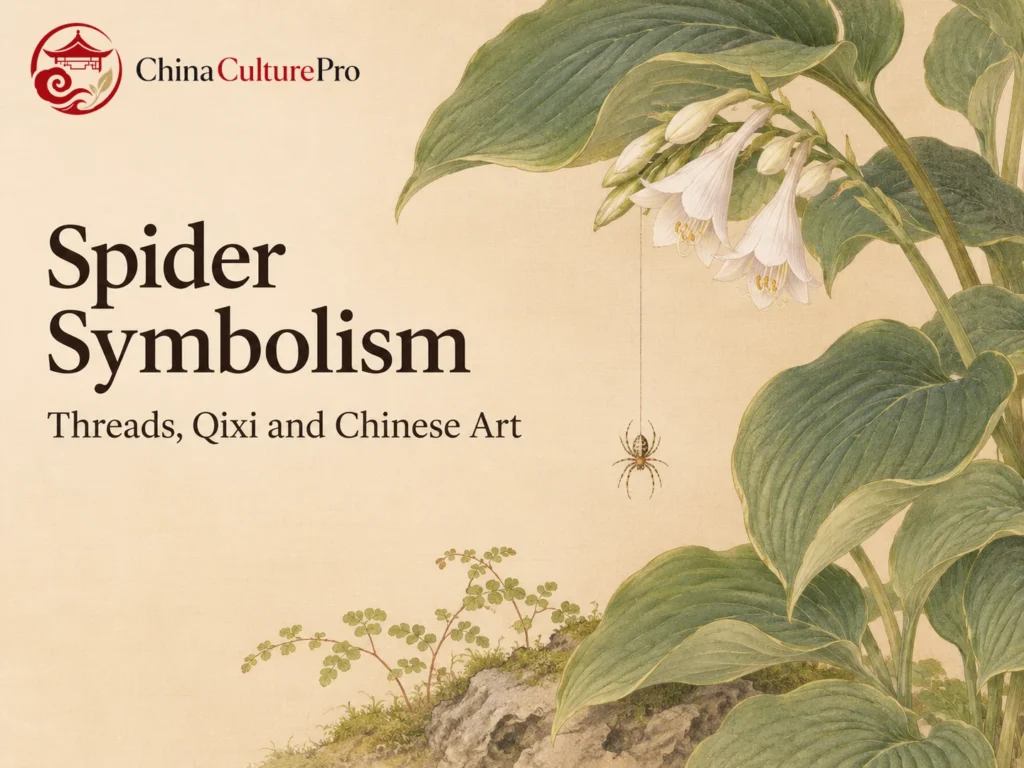
Jiang Tingxi’s Spiders on Blooming Hostas is a leaf dated 1718 in an album that follows Song flower-and-bird models. Its title directs attention to the spiders as well as the hostas. The viewer can move from the broad leaves and flowers to the smaller animals.[3]
The painting gives the spiders a place among plants. A festival account or a pronounced hanging thread gives the silk a more specific symbolic role.[1][2][3]
FAQs About Spider Symbolism in Chinese Art
Is a spider always a good omen in Chinese stories?
No. Journey to the West gives spider spirits an antagonistic role. That meaning belongs to the story, while the embroidered spider can express a wish for happiness.[1][6]
Can a spider be part of a Five Poisons design?
Some descriptions include a spider as a variant. Other sets group a scorpion, centipede, snake, toad and lizard. The companion creatures help identify the festival motif.[7]
Sources
[1] npj Heritage Science. Research on patterns in Qing dynasty embroidery
[2] Chinese Text Project. Shilin Guangji, collected accounts of Qixi
[3] National Palace Museum. Jiang Tingxi, Spiders on Blooming Hostas
[4] Chinese Text Project. Mengliang Lu, volume four
[5] Chinese Museums Association. Suzhou Museum Qixi event and historic customs
[6] Chinese Text Project. Journey to the West, chapter 72
[7] ChinaCulture. Customs of Dragon Boat Festival