


Quick Answer: What Are Qixi Qiqiao Competitions?
Qixi (七夕, Qīxī) falls on day seven of the seventh lunar month. Qiqiao (乞巧, qǐqiǎo) means asking for skill, traditionally associated with the Weaver Girl (织女, Zhīnǚ). Some activities test dexterity, such as threading a needle. Others use a sign to interpret the wish for skill or let participants display what they have made. [1][2][3][4]
- 2027 date: Lunar month seven, day seven corresponds to August 8. [5]
- Hands-on challenge: Threading a needle can show dexterity. [1][4]
- A symbolic reading: In a water-basin custom, people interpreted the shadow cast by a needle. [1][2]
Qiqiao describes a family of customs. The local program determines whether an activity is a contest, a ritual or a display.
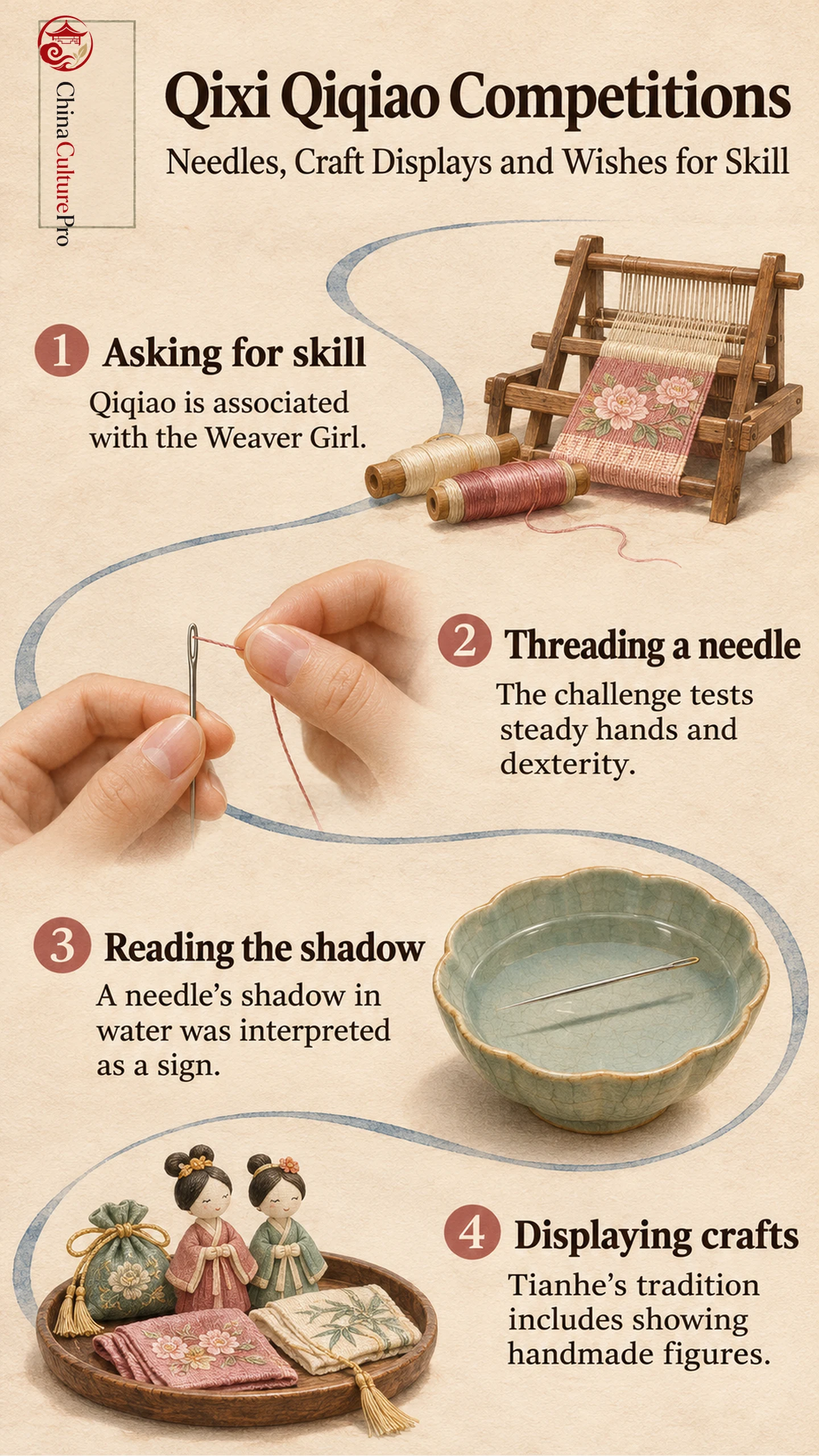
Threading a needle, looking for a shadow in water and setting out a tiny handmade figure all count as ways of engaging with skill at Qixi. Each asks something different of the participant. Threading shows control of the thread and needle. The shadow can be read as an omen, and a display shows the maker’s skill in a finished piece. [1][2][3]
Threading Needles and Reading Shadows
Needle threading for skill (穿针乞巧, chuānzhēn qǐqiǎo) has a long record in Qixi folklore. A Chinese heritage account quotes the Miscellaneous Records of the Western Capital, which describes palace women threading a seven-holed needle on the seventh day of month seven. It also describes later customs of threading by moonlight. Needlework fits the story of the Weaver Girl, whose name ties her to work with thread. [1]
A related custom is testing skill with a floating needle (投针验巧, tóuzhēn yànqiǎo). Participants placed a needle on water and interpreted the shadow it cast. The shadow stood for an answer to a wish for skill. The older practice of reading the shape and the challenge of keeping a needle afloat can be presented together in modern museum activities. [1][2][4][6]
Guangzhou Displays and Gansu’s Longer Observance
In Guangzhou’s Tianhe district, displaying skill (摆巧, bǎiqiǎo) is part of the local celebration. The national heritage entry describes women exhibiting handmade figures, models of plants and miniature objects. It also records needle threading and a ritual honoring the Weaver Girl and her sisters. The figures can depict people from legends or historical stories. Their materials and forms give makers scope to show skill beyond what a needle-threading challenge can measure. [3][7]
In Xihe, Gansu, the heritage entry describes an observance beginning on the last night of the sixth lunar month and ending on the evening of day seven of month seven. Singing and dancing accompany a sequence that includes welcoming, worship, divination and farewell. A field report from Xihe describes a section devoted to group singing and dancing, in which participants show their talents. [8][9]
What a Modern Museum Competition Can Include
In 2024, the Beijing Folklore Museum announced needle threading, the water-basin test and craft displays among its Qixi activities. A 2026 report from the museum described visitors threading colored strands and trying to keep needles on the water. The two tasks give participants different ways to engage with the older Qixi customs. [4][6]
FAQs About Qixi Qiqiao Competitions
Were all qiqiao activities competitions?
Some activities involved comparing dexterity. A shadow reading was a symbolic test, and Guangzhou’s displays gave makers a place to show completed work. [1][2][3]
Do all qiqiao events happen only on the seventh night?
Qixi falls on day seven of the seventh lunar month. Xihe’s documented observance begins at the end of the sixth month and runs through the seventh night. [5][8]
Sources
[1] China Intangible Cultural Heritage Digital Museum. Qixi in Folklore, Opera and New Year Prints
[2] Yuping County People’s Government. Origins and Customs of Qixi
[3] China Intangible Cultural Heritage Digital Museum. Tianhe Qiqiao Customs
[4] Beijing Municipal Government. Beijing Museums’ Qixi Activities
[5] Hong Kong Observatory. 2027 Gregorian–Lunar Calendar Conversion Table
[6] Chaoyang News. Beijing Folklore Museum’s Qixi Program
[7] China Intangible Cultural Heritage Digital Museum. Passing On Qixi Customs
[8] China Intangible Cultural Heritage Digital Museum. Qixi Festival, Xihe Qiqiao
[9] China Intangible Cultural Heritage Digital Museum. A Visit to Xihe’s Qiqiao Festival