


Quick Answer: Why Are Lunar Months 29 or 30 Days?
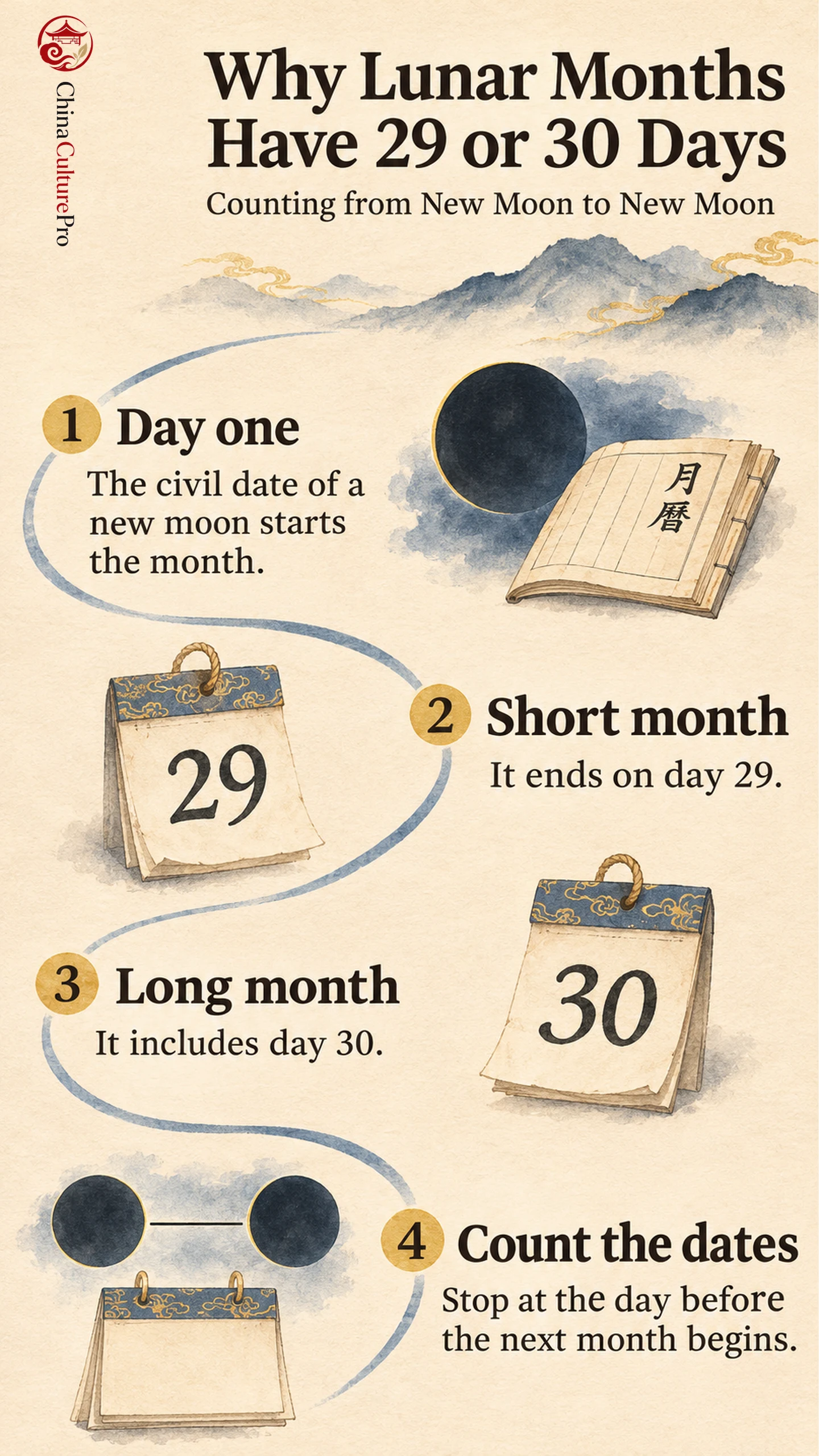
A Chinese lunar month (农历月, nónglì yuè) starts on the civil date of the astronomical new moon (朔, shuò). Successive new moons are about 29.53 days apart on average. Counting whole calendar days from one month’s opening date to the next therefore gives either 29 or 30 days. [1][2][3]
- Short month: A short month (小月, xiǎoyuè) ends on day 29. [1]
- Long month: A long month (大月, dàyuè) includes day 30. [1]
- Calendar rule: The current Chinese calendar uses Beijing time to assign the new moon a civil date. [2][3]
Find the next day one and count up to the day before it. [2][4]
In the Hong Kong Observatory’s 2027 table, August 1 is lunar day 29 and August 2 begins month seven. There is no day 30 in month six. August 31, on the other hand, is lunar day 30 in month seven. Both rows follow the same rule for the next month’s opening date. [4]
A New Moon Sets the Date of Day One
Astronomers determine the new moon from the apparent positions of the Sun and Moon. Under the Chinese calendar standard, the instant is assigned to a date in Beijing time. If a new moon occurs in the evening, day one still starts at midnight at the beginning of that date. Almanacs can publish the opening date in advance by calculating that astronomical instant. [1][2][3][5]
The time from one new moon to the next averages about 29.53 days, and actual intervals vary. Calendar months use whole civil days. Depending on the dates on which the new moons occur, their month starts are 29 or 30 calendar days apart. The numbered months can therefore have different lengths in different years. [1][2][5]
How to Count a 29-Day and a 30-Day Month
The Hong Kong Observatory’s 2027 conversion table shows how to count two consecutive months. The date under the next month heading belongs to the next month, so the count ends on the previous civil day. [4]
| Lunar month | Day one | Last day | Next month begins | Length |
|---|---|---|---|---|
| Month six | July 4 | August 1 | August 2 | 29 days |
| Month seven | August 2 | August 31 | September 1 | 30 days |
Subtract the opening date from the next opening date. There are 29 days from July 4 to August 2 and 30 days from August 2 to September 1. The Gregorian and lunar date rows label the same civil days in two ways. [4]
What Short Months Mean for Festival Dates
A festival on day 15 has a date in either kind of month. An observance on the last day has to follow that month’s actual length. Lunar New Year’s Eve (除夕, Chúxī) falls on the final day of the year, whether that day is lunar 29 or 30. The eve is February 16 in 2026, the 29th day of the last month, and February 5 in 2027, also day 29. In the 2024 calendar it was February 9, day 30. [4][6][7][8][9]
A leap month adds a whole month when the rules call for it. Its day count still comes from the dates of the successive new moons. A leap month can therefore be either 29 or 30 days long. [1][2][3]
FAQs About Chinese Lunar Month Length
Do short and long lunar months always alternate?
The lengths follow the dates of the new moons. Consecutive months can have the same length. In 2027, lunar months nine and ten each have 30 days. [1][4]
Does the full moon decide the length of the month?
The dates of the two new moons set the month’s boundaries. The full moon occurs within the month. [2][3][5]
Sources
[1] Purple Mountain Observatory. Basic Almanac Terminology
[2] Purple Mountain Observatory. Explanation of the Chinese Calendar Standard
[3] Standardization Administration of China. GB/T 33661-2017, Calculation and Promulgation of the Chinese Calendar
[4] Hong Kong Observatory. 2027 Gregorian–Lunar Conversion Table
[5] Hong Kong Observatory. The Chinese Agricultural Calendar
[6] Hong Kong Observatory. 2026 Gregorian–Lunar Conversion Table
[7] Hong Kong Observatory. 2024 Gregorian–Lunar Conversion Table
[8] Shanghai Municipal Government. Chinese New Year’s Eve
[9] Capital Education. Why Some Years Have No Day 30 in the Last Month