
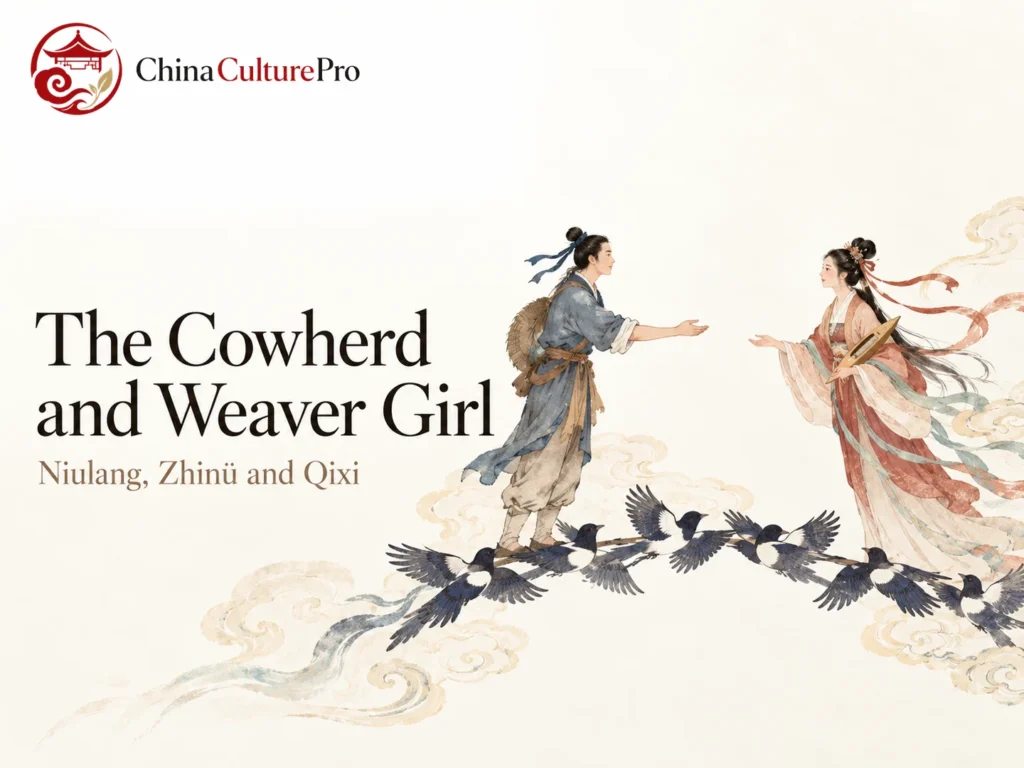

Quick Answer: Who Are the Cowherd and Weaver Girl?
Niulang(牛郎,Niúláng), the Cowherd, and Zhinü(织女,Zhīnǚ), the Weaver Girl, are lovers separated by a heavenly river in Chinese folklore. Their reunion is associated with Qixi(七夕,Qīxī), the seventh night of the seventh lunar month.
- The story: A human–heavenly marriage is broken apart, but the lovers gain a brief reunion.
- The sky: Altair represents the Cowherd and Vega the Weaver Girl, with the Milky Way as their separating river.
- The festival: The romance connects with traditions of seeking skill as well as love.
The familiar magpie-bridge tale developed through multiple traditions; an early mention of the stars is not automatically the complete later story.
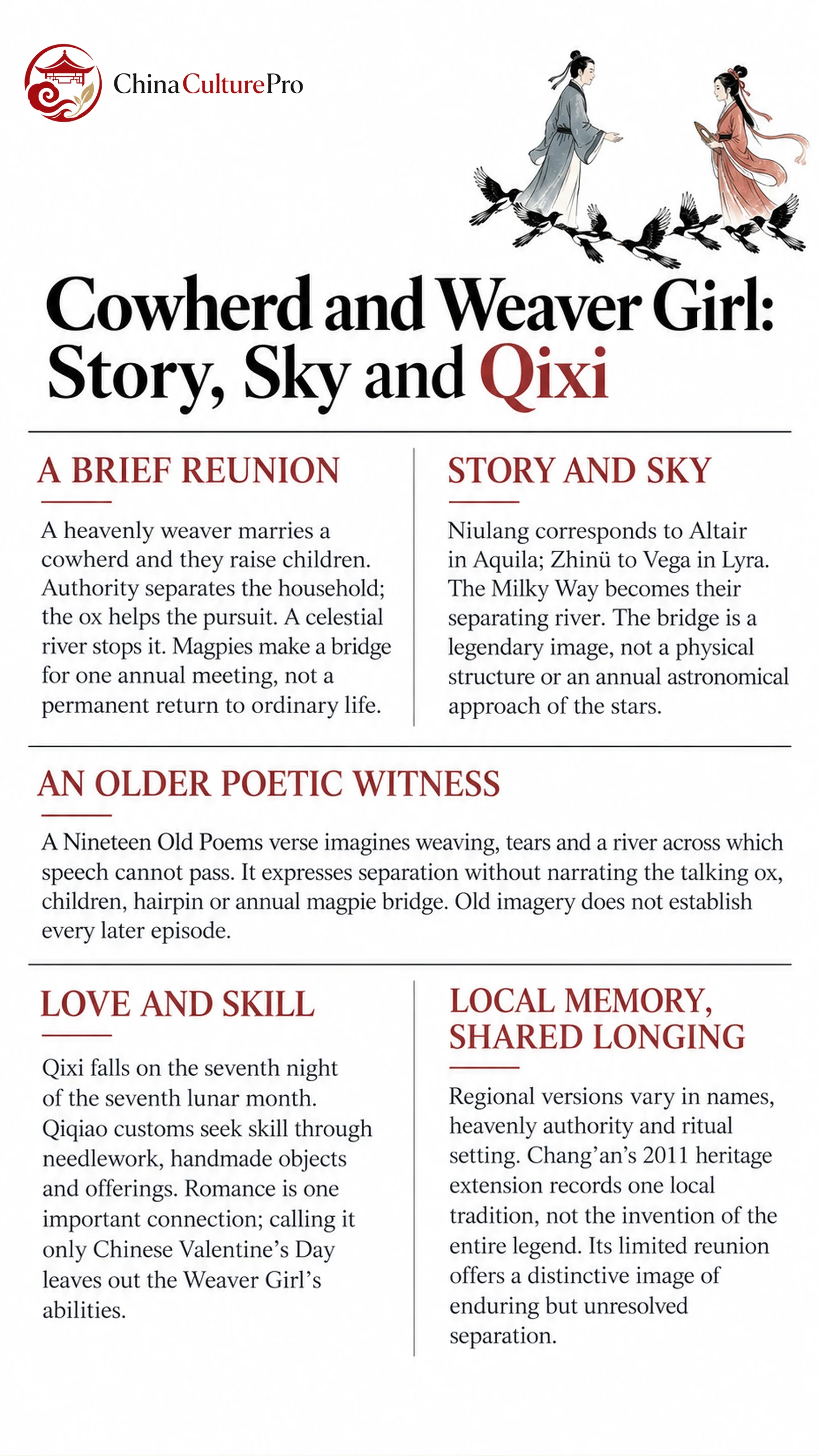
Across a river of stars, a family waits for one night together. The Cowherd and Weaver Girl gives separation a visible setting in the sky, then imagines a bridge across it. Its appeal reaches beyond a simple love-at-first-sight romance: work, family life, heavenly authority and the hope of reunion all matter to the telling.
The Story: Marriage, Separation and the Magpie Bridge
In a familiar version, Niulang lives on earth with an extraordinary ox. He encounters the heavenly weaving maiden Zhinü; they marry, work and raise two children. Some tellings introduce the meeting through a bathing scene in which he takes her clothing. That motif complicates a reading of the encounter as simple mutual attraction, and not every summary includes it. [1]
A heavenly authority brings Zhinü back. The reason may be the forbidden human–heavenly marriage or her abandoned weaving duties. With the ox’s magical help, Niulang pursues her, carrying their children. A hairpin draws a river across the sky, preventing him from reaching her. The animal’s assistance, the family’s children and the sudden barrier turn the separation into a domestic loss on a cosmic scale. [1]
The story allows a limited repair. Magpies form a bridge, and the pair meets on the seventh night of the seventh lunar month. They do not receive an ordinary life together again; the reunion is precious because it must end. This is the familiar explanation linking the lovers to Qixi. [2]
Details change between tellings, including when the ox dies, how its hide enables flight and who permits the meeting. The central movement remains recognizable: a household is formed, divided and briefly reunited.
Altair, Vega and the Milky Way
The story is attached to real features of the night sky. Altair lies in Aquila; Vega is in Lyra. Both belong to the Summer Triangle, a pattern that also includes Deneb; the Milky Way supplies the band imagined as a celestial river. These associations let a listener connect named characters with something visible rather than an entirely inaccessible setting. [1][3]
| Story element | Familiar sky association |
|---|---|
| Niulang, the Cowherd | Altair in Aquila. |
| Zhinü, the Weaver Girl | Vega in Lyra. |
| The heavenly river | The Milky Way, imagined as the barrier between the lovers. |
The magpie bridge belongs to the legend. It is not a bridge that forms physically, and Qixi does not mean that the two stars approach each other for one night. An illustration may place the lovers on opposite banks, but it should not be mistaken for a scaled astronomical map.
Older Poetry Is Not the Whole Later Plot
One of the Nineteen Old Poems(古诗十九首,Gǔshī Shíjiǔ Shǒu)begins with the distant Cowherd star and the bright woman of the celestial river. It describes weaving interrupted by tears and a seemingly narrow stretch of water across which speech cannot pass. The emotional center is separation: visible closeness does not produce communication. [4]
That poem does not narrate the talking ox, the two children, the hairpin or an annual magpie bridge. It offers an important poetic witness to the pair’s association with longing, rather than a complete synopsis of today’s folktale. [4]
This distinction is useful whenever a retelling calls the legend ancient. The imagery has a long history, but a long history does not mean that every familiar episode appeared together at the beginning.
Why the Story Belongs to Qixi
Zhinü is a weaver, and that work is central to the festival connection. Qixi is associated with qiqiao(乞巧,qǐqiǎo), seeking or praying for skill. Recorded customs include needle-threading, displaying handmade objects and setting out fruit. Their forms differ locally, but dexterity and creative accomplishment give them a shared focus. [2]
The romance supplies another emotional register: waiting, commitment and a rare opportunity to meet. Calling Qixi “Chinese Valentine’s Day” introduces that aspect quickly, yet leaves out the craft and skill traditions. A fuller understanding keeps both the lovers and the Weaver Girl’s abilities in view.
For more on observance, explore Qixi Festival traditions. This story page explains the narrative connection; the festival includes more than reenacting a celestial couple’s meeting. Its lunar date also means that the Gregorian calendar date changes, rather than always falling on July 7.
Regional Versions and Lasting Meanings
Local traditions can give the lovers names, monuments and ritual settings beyond the widely shared plot. The official heritage entry for the Chang’an tradition records a 2011 extension under project I-36 and describes local temple observances and named figures. This is a particular community’s transmission history, rather than the date when the whole legend was invented. [5]
The story can be read as a conflict between intimate life and an authority that separates it. Its brief reunion combines endurance with an unresolved loss. That combination distinguishes it from the permanent butterfly transformation in the Butterfly Lovers and from the varied release endings of the White Snake legend.
These are related Chinese folk tales, with different answers to a common narrative problem: what can a story imagine when people cannot live together in the ordinary world?
FAQs About the Cowherd and Weaver Girl
When do Niulang and Zhinü meet?
In the familiar legend, they meet on the seventh night of the seventh lunar month, associated with Qixi. This is not a fixed Gregorian July 7.
Which stars are the Cowherd and Weaver Girl?
Altair represents Niulang and Vega represents Zhinü. The Milky Way becomes their separating river in the story.
Is Qixi only a festival for couples?
No. Love is an important association, alongside traditions of needlework, craft and seeking skill connected with the Weaver Girl.
Are all versions of the story the same?
No. The meeting, ox’s role, heavenly authority and local details vary. The recognizable core is marriage, separation and a limited reunion.
Sources
[1] China Culture. The Cowherd and the Weaver Girl
[2] Ministry of Culture and Tourism. Qixi and skill-seeking customs
[3] NASA Night Sky Network. Summer Triangle: Altair
[4] Nineteen Old Poems. The distant Cowherd star
[5] China Intangible Cultural Heritage. Cowherd and Weaver Girl, Chang’an extension