


Quick Answer: What Is the White Snake Legend?
The White Snake legend(白蛇传,Báishé Zhuàn)is a Chinese folk tale about Bai Suzhen(白素贞,Bái Sùzhēn), a snake spirit who becomes a woman, and Xu Xian(许仙,Xǔ Xiān), the human she marries.
- The romance: A meeting beside West Lake leads to marriage and a shared human life.
- The conflict: A monk challenges the union between a human and a transformed snake.
- The changing story: Revelation, rescue, a flood and confinement beneath a pagoda receive different treatments across versions.
The familiar sympathetic heroine is part of a long storytelling tradition; neither her moral character nor the ending is identical in every text or production.
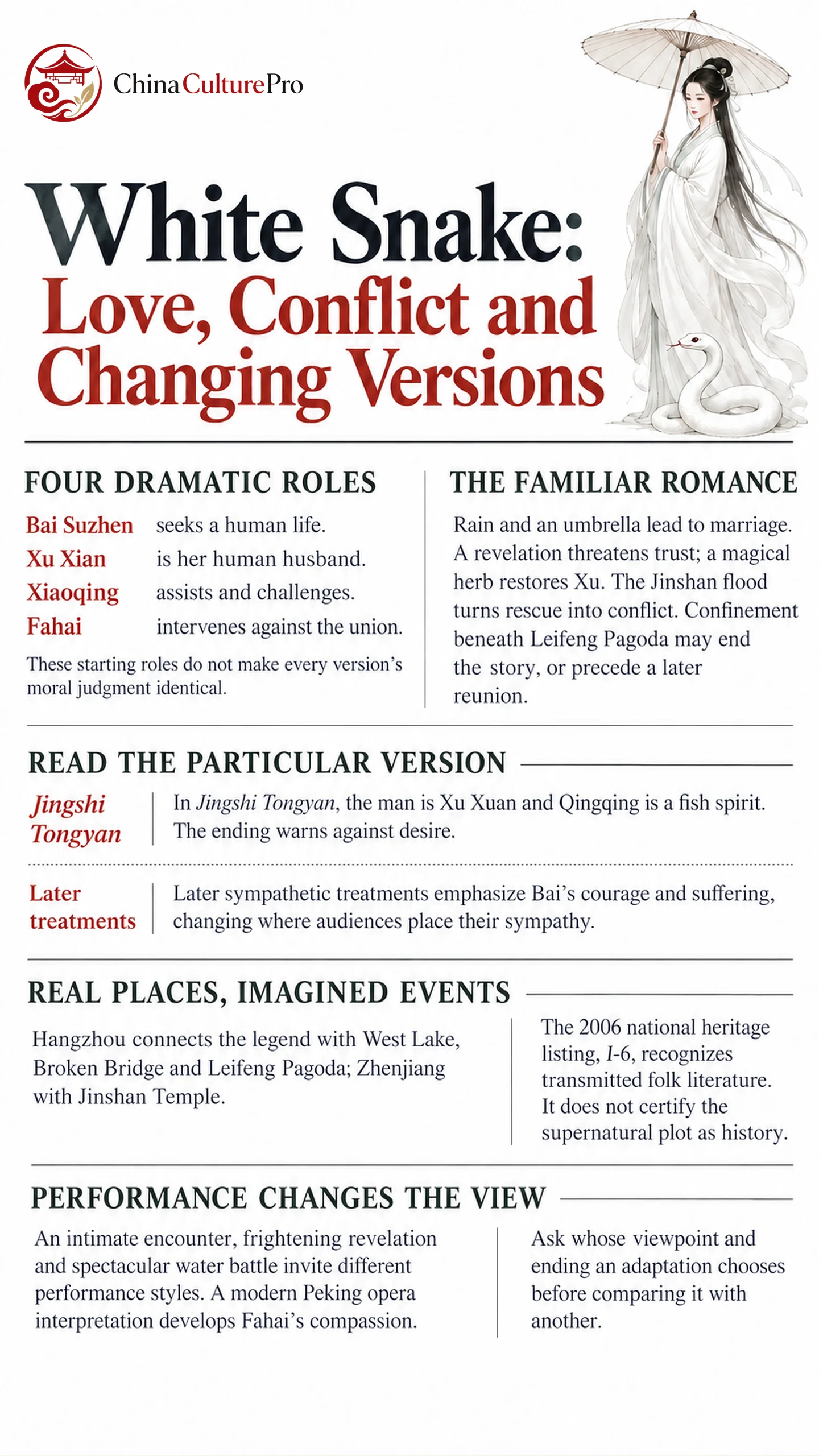
A borrowed umbrella begins an intimacy that a magical battle cannot easily protect. The White Snake story moves between the ordinary and the extraordinary: a rainy encounter, a medicine shop, a concealed identity and a struggle over whether love can cross the boundary between human and nonhuman. Its changing versions make that question newly urgent for different audiences.
Bai Suzhen, Xu Xian, Xiaoqing and Fahai
In familiar later tellings, Bai Suzhen’s supernatural origin coexists with her wish for domestic life. Xu Xian works in the world of medicine and becomes her husband without initially recognizing her true nature. Xiaoqing(小青,Xiǎoqīng), the Green Snake, assists Bai and can act as companion, maid or sister-like ally. Fahai(法海,Fǎhǎi)recognizes the hidden identity and intervenes against the marriage. [1]
| Character | Role in the familiar romance |
|---|---|
| Bai Suzhen | A transformed white snake seeking love and a human life. |
| Xu Xian | Her human husband, caught between trust, fear and outside intervention. |
| Xiaoqing | Bai’s forceful companion and helper. |
| Fahai | A Buddhist monk who challenges the human–snake union. |
These are starting points for understanding the drama. Bai can be protective and dangerous; Xu can be loving and easily frightened. Xiaoqing’s loyalty makes her more than a decorative attendant. Fahai’s judgment creates a conflict, but different storytellers ask audiences to judge that intervention differently.
From the Borrowed Umbrella to Leifeng Pagoda
A familiar account brings Bai and Xiaoqing to West Lake in Hangzhou. Rain leads to an encounter with Xu Xian and the loan of an umbrella. Returning it gives the couple another reason to meet. Marriage follows, and they establish a medicine shop. The supernatural story has acquired a recognizable domestic center. [1]
That security breaks when Bai’s snake form is revealed. In a familiar Dragon Boat Festival episode, realgar wine exposes her identity and Xu dies from fright. Bai obtains a magical herb to restore him to life. The rescue shows her devotion, but it does not end the problem of trust or Fahai’s opposition. [2]
When Xu is at Jinshan Temple, Bai and her companion try to recover him; their confrontation with Fahai becomes the spectacular flooding episode. Later tellings take the couple back toward reconciliation, childbirth and renewed separation. A familiar ending confines Bai beneath Leifeng Pagoda. Other versions continue until her son helps bring about release and family reunion. [2]
The wine and herb are narrative devices in a supernatural tale. They are not instructions for identifying spirits, treating illness or reviving someone. The plot’s real dramatic pressure lies in its changing relationships: concealment, disclosure, attempted rescue and the price of intervention.
How the Story Changed Across Versions
A clear earlier comparison is chapter 28 of Jingshi Tongyan(警世通言,Jǐngshì Tōngyán), the collection compiled by Feng Menglong. Its title promises the White Lady’s lasting confinement beneath Leifeng Pagoda. The human partner is called Xu Xuan, and the companion Qingqing is revealed as a fish spirit, not the Green Snake familiar from many later adaptations. [3]
The ending gives Fahai a rescuing role and closes with a warning against desire. Bai pleads that she has not killed anyone, yet also threatens catastrophic violence elsewhere in the account. This is a more uneasy figure than a uniformly innocent romantic heroine. The early text should be read in its own terms, rather than treated as an incomplete script for today’s favorite version. [3]
Later sympathetic treatments shift attention toward Bai’s loyalty, courage and suffering. The changed portrayal reshapes the moral question as well as the ending. It alters whose fears count, whose actions seem justified and where the audience places its sympathy.
This is why asking for “the original author of White Snake” can mislead. A named compiler or playwright is responsible for a particular text, while the wider legend grows through oral telling and repeated artistic adaptation.
Hangzhou, Zhenjiang and the Legend’s Cultural Landscape
The story joins real places to imagined events. West Lake’s Broken Bridge and Leifeng Pagoda connect it closely with Hangzhou; Jinshan Temple belongs to the Zhenjiang strand. These locations give separate episodes a memorable geography, but a place’s existence cannot verify the supernatural action attached to it.
The official heritage record recognizes the White Snake legend as folk literature in the first national list of 2006, project I-6, with Hangzhou and Zhenjiang entries. It also describes the interaction of oral tradition with storytelling, opera and other forms. The recognized heritage is a transmitted cultural tradition, not certification that a snake woman once lived there. [4]
Placed alongside the Butterfly Lovers and other Chinese folk tales, White Snake shows how a landscape can become familiar through stories even to people who have never visited it.
White Snake on Stage and Screen
The legend offers performers sharply different kinds of scenes: the umbrella encounter can be intimate, the revelation frightening, the rescue athletic and the water battle spectacular. These contrasts help explain its continuing life in Chinese opera.
A recent Peking opera production provides a concrete example of reinterpretation. Its own description gives Fahai a developing capacity for compassion, rather than leaving him a fixed obstacle. It combines traditional performance with multimedia while retaining the human–spirit relationship at the center. That choice demonstrates what an adaptation can change without ceasing to engage the legend. [5]
Film and television can make similar choices through viewpoint and expanded characters. Before comparing endings, establish which production you are watching. Ask whether its interest lies in a threatening transformation, a loyal wife, Xiaoqing’s perspective or the boundaries enforced by Fahai. These questions reveal more than assuming that one version speaks for all Chinese religious traditions.
FAQs About the White Snake Legend
Is Bai Suzhen evil?
Her portrayal varies. Earlier cautionary treatments are more threatening, while many later romances emphasize her loyalty and suffering. Judge the particular version.
Is Xiaoqing always a green snake?
No. The familiar later companion is the Green Snake; Feng Menglong’s chapter identifies Qingqing as a fish spirit.
Does the White Snake legend have a happy ending?
Some versions end in confinement; others continue to release and reunion. A production’s chosen ending changes its emotional meaning.
Is the White Snake legend a true story?
It is a folk and literary tradition attached to real places. Those places and its heritage status do not establish the supernatural plot as history.
Sources
[1] David K. Jordan, University of California San Diego. Tale of the White Snake
[2] CGTN, via Zhejiang government. Legend of the White Snake
[3] Feng Menglong, compiler. Jingshi Tongyan, chapter 28
[4] China Intangible Cultural Heritage. White Snake legend, project I-6
[5] National Centre for the Performing Arts. The Legend of the White Snake production