


Quick Answer: What Are Chinese Ghost Stories?
Chinese ghost stories form a varied field of supernatural storytelling, rather than one uniform horror genre. The word gui(鬼,guǐ), often translated as “ghost,” appears within traditions whose categories do not always match modern English ones.
- Forms: Short records, crafted literary tales, spoken retellings and adaptations preserve different kinds of encounters.
- Emotions: A story may provoke fear, laughter, sympathy, desire or indignation.
- Cultural setting: Ideas about death, family obligations and justice can shape a plot without making it a record of actual events.
A ghost story is evidence of storytelling and imagination. It does not establish supernatural activity or describe what every Chinese person believes.
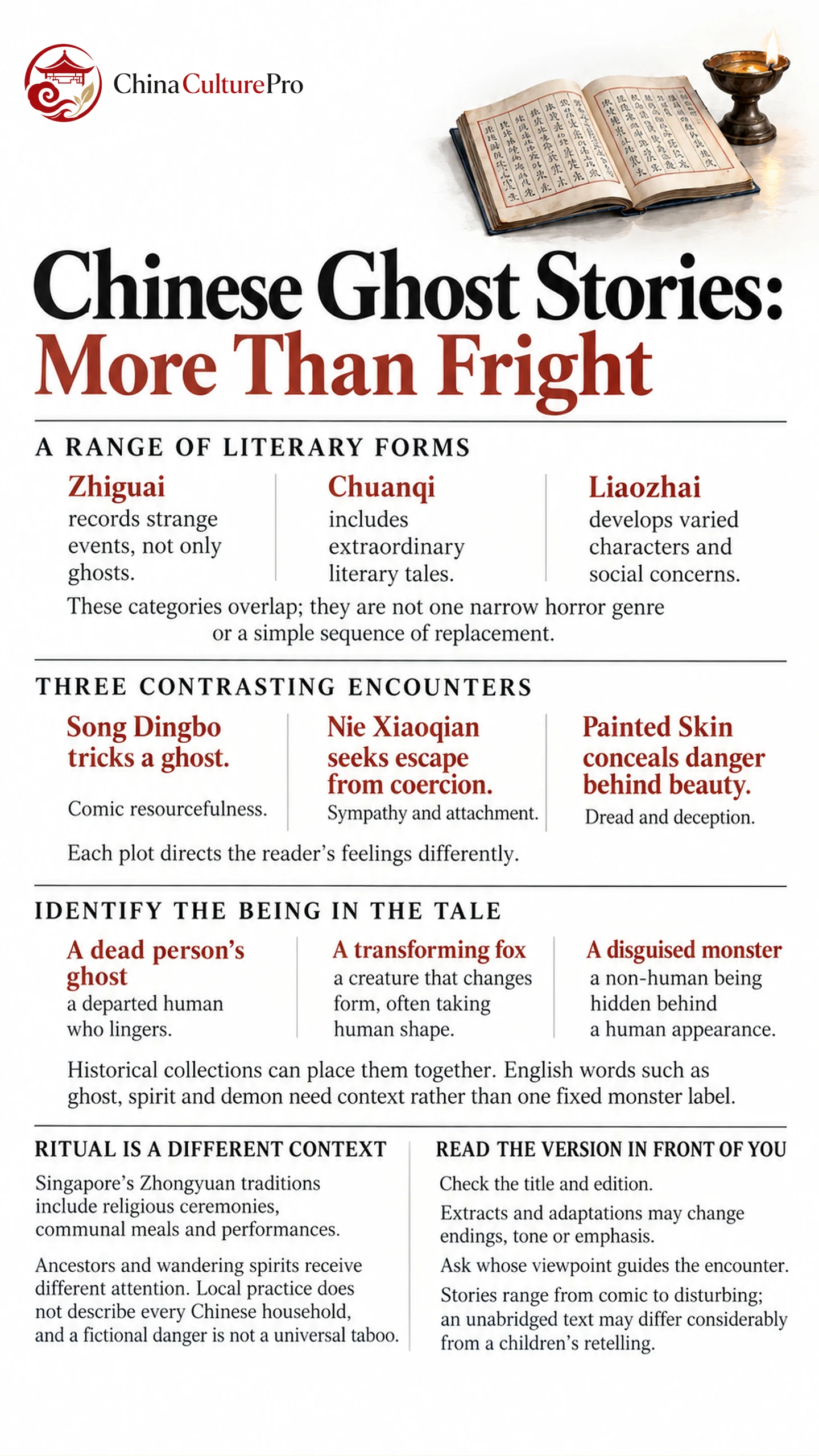
A traveler shares the road with a ghost; a young woman asks for help escaping a monster; a beautiful stranger conceals a dangerous identity. Such encounters can lead to comedy, compassion or terror. This range makes Chinese literature a richer starting point than a single list of frightening creatures or taboos.
From Records of the Strange to Literary Tales
Zhiguai(志怪,zhìguài), commonly translated as “records of the strange” or “accounts of anomalies,” includes much more than dead people returning. Marvels, transformations, unusual animals and extraordinary encounters can share the same collection. Concise notices often locate something improbable within an otherwise recognizable world.
Chuanqi(传奇,chuánqí), “accounts of the extraordinary,” is another important term in discussions of classical tales, particularly those associated with Tang literature. It should not be treated as a synonym for ghost fiction. An anthology of early supernatural and fantastic writing can contain both forms and many different subjects. [1]
Later, Pu Songling(蒲松龄,Pú Sōnglíng)created Liaozhai Zhiyi(聊斋志异,Liáozhāi Zhìyì), often translated as Strange Tales from a Chinese Studio. Its supernatural figures support stories of love, examinations, corrupt authority and human conduct as well as frightening encounters. The Library of Congress emphasizes that many of its so-called ghost stories work through emotion and relationships rather than simply trying to scare the reader. [2]
| Form or setting | What to look for | Reading caution |
|---|---|---|
| Zhiguai record | A brief encounter or anomaly presented in a recognizable setting | The category includes more than ghosts |
| Literary tale | Developed characters, plot and a narrator’s choices | A crafted story is not a transparent transcript of belief |
| Oral retelling | Details selected for a particular audience or occasion | One teller need not preserve every written episode |
| Screen or stage adaptation | A work that reshapes an earlier story for performance | Its ending and supernatural rules may differ from the source |
These are useful reading distinctions, not sealed compartments or a claim that one form simply replaced another.
Three Stories, Three Different Kinds of Encounter
Song Dingbo(宋定伯,Sòng Dìngbó)meets a ghost at night and claims to be a ghost himself. When his weight and noisy passage through water arouse suspicion, he explains that he is newly dead and has not yet learned how to behave. He eventually tricks and sells the ghost after it changes into a sheep. The encounter reverses the expected fear: the human is the more resourceful deceiver. [3]
Nie Xiaoqian(聂小倩,Niè Xiǎoqiàn)offers a different emotional center. In Pu’s tale, the dead young woman is compelled by a threatening supernatural being to harm travelers. Ning Caichen(宁采臣,Níng Cǎichén)resists temptation, listens to her explanation and helps move her remains to a safer burial. After his first wife’s death, she eventually becomes his wife. The original continues beyond the rescue into family acceptance and another confrontation. [4]
Huapi(画皮,Huàpí), or Painted Skin, takes disguise in a darker direction. A man welcomes an apparently beautiful young woman, but discovers a monstrous being preparing the human appearance it wears. Desire and misplaced trust expose him to danger. This is a disturbing tale, not another version of Nie Xiaoqian’s appeal for release. [5]
Taken together, the three show why “Chinese ghost story” cannot predict a single mood. Cleverness, sympathy and dread arise from different choices about who threatens whom and whether the stranger deserves help.
Ghosts, Foxes and Other Strange Beings
Modern English encourages tidy distinctions between a dead person’s ghost, a living animal that changes form and a monster concealing its identity. Historical Chinese collections do not always organize their contents into those same categories. Scholarship on early zhiguai notes a much wider range of strange presences under its supernatural vocabulary. [6]
A practical approach is to identify the being in the named story. Nie Xiaoqian has died and needs her remains relocated. A Chinese fox spirit belongs to a transformation tradition and is not automatically a dead human. Painted Skin’s dangerous disguise should not turn every attractive supernatural stranger into the same character type.
Names translated as “demon,” “spirit” or “ghost” can therefore require a little explanation. A translator’s convenient English word may cover distinctions that become clear only through the plot. Reading the encounter usually tells more than assigning it a monster label in advance.
Popular Beliefs, Ancestors and the Ghost Festival
Literary stories overlap with ideas about burial, remembrance and obligations between the living and the dead. Yet ancestor worship and stories about wandering or threatening spirits are not interchangeable activities.
Zhongyuan(中元,Zhōngyuán)traditions provide a useful example. A scholarly account of the festival in Singapore distinguishes several religious and institutional strands and describes ceremonies, offerings, communal meals, auctions and performances. In that local setting, care for the departed also organizes relationships among the living. [7]
This is a specific cultural history, not a checklist binding every Chinese household. Buddhist, Daoist, family and community settings give the festival different emphases. Entertainment can coexist with ritual, while participants may understand their involvement in different ways.
The broader Chinese ghost month context deserves its own explanation. It should not be reduced to a season in which all ghost fiction is set, nor should a novel’s supernatural danger become a universal rule about ordinary behavior. Describing an offering records a practice; it does not verify the presence of the being addressed.
Reading Retellings and Translations
Start with a story title and the edition or adaptation in front of you. A short extract may stop after an escape, whereas the source continues into marriage or family life. A retelling can choose suspense over the source’s longer attention to obligations and character.
Then notice whose account guides the reader. Does the supernatural figure speak for itself? Is the narrator sympathetic, amused or suspicious? Does a human institution seem fairer than its supernatural counterpart, or just as corrupt? These questions preserve the stories’ social detail instead of treating them as interchangeable scares.
For a first selection, compare the three encounters above rather than assuming that one famous title represents the whole tradition. Tone and intensity vary considerably. An edition intended for children may reshape material that an unabridged literary text presents much more disturbingly.
FAQs About Chinese Ghost Stories
Are Chinese ghost stories always frightening?
No. They may be comic, romantic, compassionate or critical of society as well as frightening.
Is Liaozhai only a collection of ghost stories?
No. It includes foxes, extraordinary people and other strange events alongside ghosts.
Are fox spirits and ghosts the same?
Not automatically. A transforming fox and the spirit of a dead person are distinct ideas, though collections may include both.
Do these stories show what all Chinese people believe?
No. Stories and local practices reflect particular contexts; people’s beliefs and interpretations differ.
Sources
[1] Karl Kao, editor. Classical Chinese Tales of the Supernatural and the Fantastic
[2] Library of Congress. The Strange Tales from Liaozhai
[3] Hong Kong Education Bureau, reference text. Song Dingbo Catches a Ghost
[4] Pu Songling. Nie Xiaoqian
[5] Pu Songling. Liaozhai Zhiyi, Painted Skin
[6] Academy of Chinese Studies. Ghostly Tales in the Wei and Jin Dynasties
[7] Choi Chi-cheung, Singapore Chinese Cultural Centre. Zhong Yuan Festival