

Quick Answer: What Are Chinese Creation Myths?
Chinese creation myths are multiple traditions about the beginnings of the cosmos, humanity and cultural life. They do not form one universally fixed narrative.
- Cosmic formation: Pangu (盘古, Pángǔ) is associated with the separation of heaven and earth.
- Human life and repair: Nüwa (女娲, Nǚwā) shapes people in one account and repairs a damaged sky in another.
- Other beginnings: Culture-hero stories, regional flood traditions and philosophical accounts address different origin questions.
A combined modern retelling can connect these episodes, but it should not be mistaken for a single ancient text shared by every community.

A giant separates heaven from earth, a goddess shapes people, and survivors rebuild life after a flood. All can belong in a guide to Chinese mythology, yet they explain different beginnings. Distinguishing their questions makes the stories easier to follow without forcing them into one continuous timeline.
Four Questions About Beginnings
“Creation” can mean more than making everything from nothing. A story may begin with existing material, an already damaged world or people who need ways to live together. Those differences are part of its meaning.[7]
| Origin question | What the story explains | What not to assume |
|---|---|---|
| How does a cosmos take shape? | Separation or transformation produces an ordered world. | Every account requires the same named creator. |
| Where do people come from? | Human beings are fashioned, born or descended from ancestors. | Human creation must also explain the origin of the sky and earth. |
| How does life survive catastrophe? | Repair or renewal restores a world that already exists. | A rescue episode is automatically the first act of cosmic creation. |
| How does cultural life begin? | Techniques, signs or institutions become available to humans. | A culture hero is a documented inventor with an established biography. |
This is a reading aid, not an ancient official classification. A single figure can appear in more than one kind of story.
Pangu and the Separation of Heaven and Earth
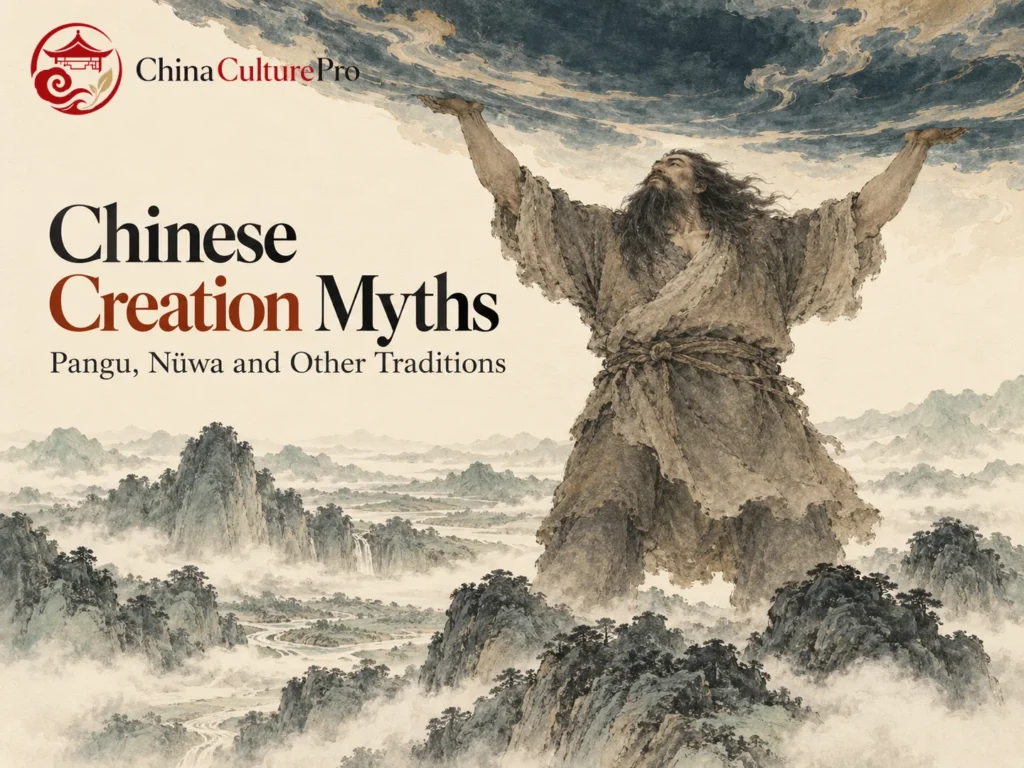
An excerpt preserved in the Taiping Yulan (太平御览, Tàipíng Yùlǎn), attributed to the Sanwu Liji (三五历纪, Sānwǔ Lìjì), begins with heaven and earth in an egg-like, undifferentiated condition. Pangu is within it. The clear and light becomes heaven; the turbid becomes earth.[1]
Pangu grows as heaven rises and earth thickens. The story imagines differentiation and increasing distance, using 18,000-year spans as its mythic timescale. Those numbers belong to mythic narration, not a scientific chronology of the planet.[1]
The source’s question is how a structured cosmos emerges from an undivided condition. It is not necessary to add Nüwa’s human-making episode to make that particular account intelligible. Later retellings may connect the two, but the connection should remain visible as a choice of narration.
Nüwa: Making People and Repairing Heaven
Nüwa has two especially familiar roles, preserved through different textual accounts.
An excerpt attributed to the Fengsu Tongyi (风俗通义, Fēngsú Tōngyì), quoted in the Taiping Yulan, describes a world in which heaven and earth already exist but people do not. Nüwa fashions humans from yellow earth. When the work becomes too demanding, a cord drawn through mud supplies another means of producing them.[2]
This is a human-origin account. The material she uses, and the world into which people appear, are already present. It should not be summarized as a claim that she makes the entire universe from nothing.
The Huainanzi (淮南子, Huáinánzǐ) gives her a different task. Cosmic supports have failed, fire and water threaten the world, and people face danger. She repairs heaven with five-colored stones, restores its supports and checks the flood.[3]
Here, the crucial action is rescue. People are already present and need protection. Human creation and sky repair can both be associated with Nüwa without being the same episode or requiring one fixed sequence in every telling.
Fuxi, Cultural Origins and Regional Flood Stories
Fuxi (伏羲, Fúxī) introduces another kind of beginning. The I Ching (易经, Yìjīng), or Book of Changes, associates him with observing patterns in the world. Its Appended Statements (系辞, Xìcí) credits him with forming the bagua (八卦, bāguà), the eight trigrams, and with making nets for hunting and fishing.[4]
The emphasis is on signs and techniques that organize human life. This is a culture-hero account, not archaeological evidence that one identifiable individual invented every attributed practice.
Human ancestry also appears in regional flood traditions. Archival material from ethnographic work in western Hunan during the 1930s records a story, told among Miao communities, in which a brother-and-sister pair survive a flood and become human ancestors. Researchers compared these motifs with Fuxi–Nüwa traditions.[5]
The comparison is historically and locally specific. It does not make every Miao account identical, nor does it establish that every image of Fuxi and Nüwa tells a flood-survivor story. A named community, recorded version and source matter as much as a familiar pair of names.
Cosmic Process Without a Giant Creator
A personal divine craftsman is not the only way Chinese texts discuss origins. Chapter 42 of the Tao Te Ching (道德经, Dàodéjīng) describes the Dao (道, dào), or Way, generating one, then two, then three, and finally the multiplicity of beings.[6]
This is a condensed account of generation rather than an adventure featuring Pangu or a goddess shaping clay. It does not name those figures as the identities of “one,” “two” or “three.” Inserting such a cast into the passage would require an additional interpretation.
The passage belongs in a broader exploration of Daoist thought. It expands the range of origin questions without replacing the other stories or proving that Chinese traditions never imagined creator beings. Narrative myths and philosophical accounts can coexist in the same cultural landscape.[7]
Why the Stories Do Not Form One Fixed Timeline
These materials survive in different forms: excerpts quoted by later compilers, philosophical passages, attributed cultural inventions and locally recorded oral traditions. The sources answer different questions; placing every figure in one family tree does not resolve those differences.
Nor does the absence of one universally authoritative account mean an absence of creation traditions. Requiring every culture to reproduce the same model of creation can obscure the evidence rather than clarify it.[7]
For a combined retelling, the useful distinction is between what a particular source states and what a later storyteller adds to connect episodes. A smooth sequence can be enjoyable while still being identified as a synthesis.
FAQs About Chinese Creation Myths
Who created the world in Chinese mythology?
Pangu is a familiar answer in stories of cosmic separation. Other traditions address origins differently, so his account should not be treated as the only Chinese explanation.
Did Nüwa create the world or human beings?
The yellow-earth account concerns making people in an existing world. The sky-repair account concerns rescuing a damaged one. They are distinct narrative tasks.
Are Fuxi and Nüwa always the same kind of pair?
Their roles and relationship depend on the tradition. A regional ancestor story, a cultural-origin account and an image of the pair need not convey an identical narrative.
Does China have only one creation myth?
No. Textual, philosophical and regional traditions preserve multiple accounts. A modern book can combine them, but that does not make the combination one ancient, universally shared canon.
Sources
[1] Taiping Yulan, Chinese text via Wikisource. Volume 2: An Excerpt from Sanwu Liji
[2] Taiping Yulan, Chinese text via Wikisource. Volume 78: Nüwa
[3] Huainanzi, Chinese text via Wikisource. Lanming Xun
[4] Book of Changes, Chinese text via Wikisource. Appended Statements, Part Two
[5] Academia Sinica, Institute of History and Philology. Flood Myths and the Legend of Fuxi
[6] Laozi, Chinese text via Wikisource. Daodejing, Chapter 42, Wang Bi Text
[7] Paul R. Goldin, Monumenta Serica. The Myth That China Has No Creation Myth