


Quick Answer: Who Is Fuxi?
Fuxi(伏羲,Fúxī), also spelled Fu Xi or Fu Hsi, is a culture hero and ancestral sovereign in Chinese tradition. Stories credit him with knowledge and practices that make organized human life possible.
- Patterns: His best-known attribution is the creation of the eight trigrams.
- Cultural arts: Texts associate him with nets, hunting, fishing and the ordering of social life.
- Images and ritual: He appears in paired serpentine imagery and in traditions of ancestral remembrance.
These are traditional attributions from different settings. They do not establish one historically verified ruler who personally invented every art later credited to him.
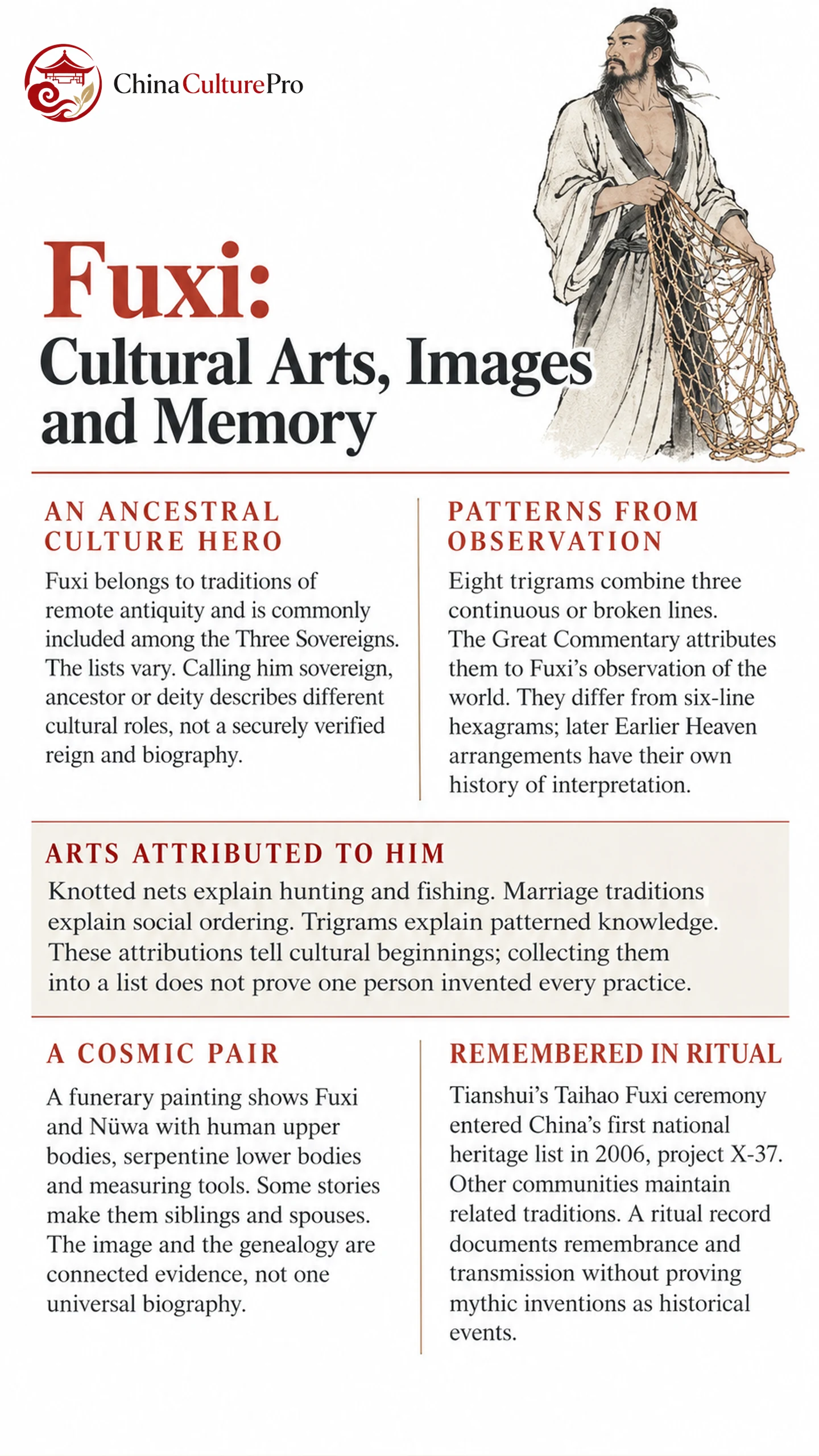
A net, a set of lines and an intertwined pair of figures can all point toward Fuxi. The objects seem unlike one another, yet each concerns a way of ordering life: catching food, recognizing patterns or imagining human origins. That range makes him a useful introduction to the culture heroes of Chinese mythology.
A Culture Hero Rather Than a Securely Dated Ruler
Fuxi belongs to accounts of remote antiquity, before the securely documented rulers familiar from later Chinese history. He is commonly included among the Three Sovereigns(三皇,Sānhuáng), though traditional arrangements of these earliest figures are not uniform. Classical compilations preserve differing names, genealogies and successions rather than a single contemporary record. [1]
“Culture hero” explains his role especially well. The term describes a figure through whom a tradition tells the origins of useful knowledge or institutions. It explains cultural beginnings without requiring all those practices to have one historical inventor.
Calling Fuxi an emperor, ancestor or deity therefore answers different questions. A traditional chronology can place him as a sovereign; an image can give him a cosmic role; a community can honor him ritually. None of those uses supplies a reliable birth certificate or archaeological proof of his full biography.
Fuxi and the Eight Trigrams
The bagua(八卦,bāguà), or eight trigrams, are central to Fuxi’s reputation. Each consists of three lines, with each line either continuous or broken. The eight possible forms become a compact vocabulary for patterns and relationships. In the Book of Changes(易经,Yìjīng)tradition, they carry associations including heaven, earth, thunder, wind, water, fire, mountain and lake or marsh. [1][2]
The Great Commentary gives the attribution a particular logic. Fuxi looks upward at heaven, downward at earth, and toward animals and the human body before making the trigrams. In this account, symbols arise through observing relationships in the world. The story concerns the origin of patterned knowledge, not merely a miraculous diagram appearing without a setting. [1]
The trigrams should also be distinguished from the sixty-four six-line hexagrams and from later circular arrangements. Research on the “Fuxi” or Earlier Heaven diagram traces important interpretations to Song-period thinkers such as Shao Yong. A diagram’s traditional name does not prove that its surviving arrangement was drawn by a prehistoric Fuxi. [3]
For the individual forms and their relationships, see the eight trigrams and the I Ching. The attribution to Fuxi is one part of that larger textual history.
Nets, Marriage and the Origins of Cultural Order
The Great Commentary also credits Fuxi with knotted cords made into nets for hunting and fishing. It connects the invention with a trigram, making tools and symbolic knowledge part of the same account of cultural development. Other transmitted descriptions associate him with marriage rites and musical instruments. [1]
The useful question is not simply how many inventions can be added to his list. Ask what a particular attribution explains: obtaining food, organizing relationships or recognizing patterns. Different cultural arts can gather around a revered founding figure without amounting to a documented technical patent history.
| Attribution | What the evidence establishes |
|---|---|
| Trigrams and knotted nets | A classical text credits the culture hero with these arts. |
| The Earlier Heaven arrangement | Later thinkers interpret and organize diagrams under Fuxi’s name. |
| Marriage and social order | Transmitted traditions portray him as a founder of human institutions. |
Other figures carry related but distinct traditions, including Shennong and agriculture. Such accounts distribute the beginnings of civilization among several culture heroes.
Fuxi and Nüwa in Images and Stories
Nüwa(女娲,Nǚwā)is Fuxi’s famous visual partner. In a painting from the Astana graves cataloged by the National Museum of Korea, the figures have human upper bodies and serpentine lower bodies. A compass and a ruler, together with surrounding sun, moon and constellation imagery, place the pair within a representation of cosmic order. The object belongs to a funerary setting. [4]
This paired imagery can be read alongside human-origin stories, including versions that make the two siblings and spouses. The museum’s explanation itself presents a sibling pair linked to repopulating the world after a flood. That is one interpretive tradition, not a genealogy that every text about either figure must repeat. [4]
Nor does a serpentine body turn the pair into ordinary zoological snakes. It is an artistic means of presenting extraordinary beings. Compare the Nüwa stories to see how human creation and heaven repair have their own textual settings beyond the paired image.
Ritual Traditions in Tianshui and Beyond
Fuxi is also honored through regional ceremonies. The official entry for the Taihao Fuxi ceremony in Tianshui, Gansu, records inclusion in the first national intangible heritage list in 2006, project X-37. It describes temple-based remembrance and the ways ceremonial forms have changed over time. Related traditions are maintained in other places, including Huaiyang in Henan. [5]
These practices show how an ancestral figure remains part of community life. Their importance does not depend on proving that each mythic invention happened literally. For the reader, three kinds of evidence remain especially useful: what a text attributes, what an image depicts and what a community does to remember. Keeping those questions distinct makes Fuxi’s many roles easier to understand.
FAQs About Fuxi
Did Fuxi write the I Ching?
Tradition credits him with the trigrams, not authorship of the entire received book and all its commentaries. The textual tradition developed through multiple layers.
Are Fuxi and Nüwa siblings or spouses?
Some traditions identify them as both. Their relationship varies, so a paired image should not impose one biography on every text.
Was Fuxi a real emperor?
He is a legendary sovereign and culture hero. His full biography and precise reign are not established as the life of a securely documented historical ruler.
Are Fuxi’s trigrams the yin–yang symbol?
No. Trigrams are three-line forms. A modern circular image may combine several elements, but those components have different identities and histories.
Sources
[1] Taiping Yulan, volume 78. Classical extracts concerning Fuxi
[2] Book of Changes. Received Chinese text and commentaries
[3] Shandong University, Center for Zhouyi and Ancient Chinese Philosophy. Research on trigram ordering and directions
[4] National Museum of Korea. Painting of Fuxi and Nüwa
[5] China Intangible Cultural Heritage. Taihao Fuxi ceremony, Tianshui