

Quick Answer: What Is a Jiangshi?
A jiangshi (僵尸, jiāngshī) is a corpse associated with Chinese tales of the dangerous returning dead. The name means “stiff corpse”; “Chinese hopping vampire” is the familiar English screen label.
- Folklore: Older supernatural stories describe bodies that move and threaten the living.
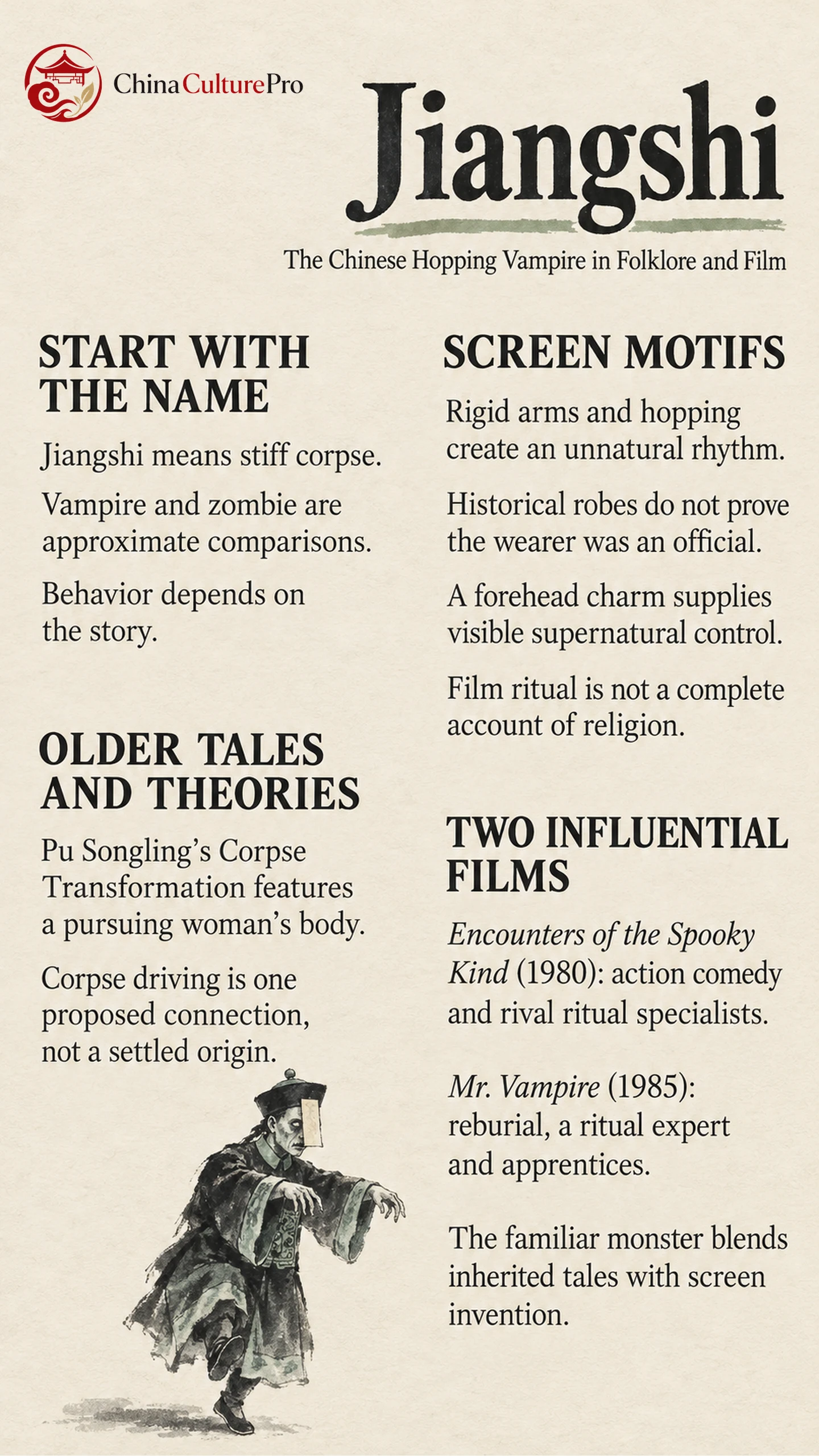
- Screen image: Stiff arms, hopping movement, historical robes and a forehead charm form a recognizable cinematic combination.
- Film history: Hong Kong filmmakers developed that image through horror, comedy, martial arts and ritual spectacle.
The creature has no single rulebook. A particular story or film determines its movement, behavior and vulnerabilities.
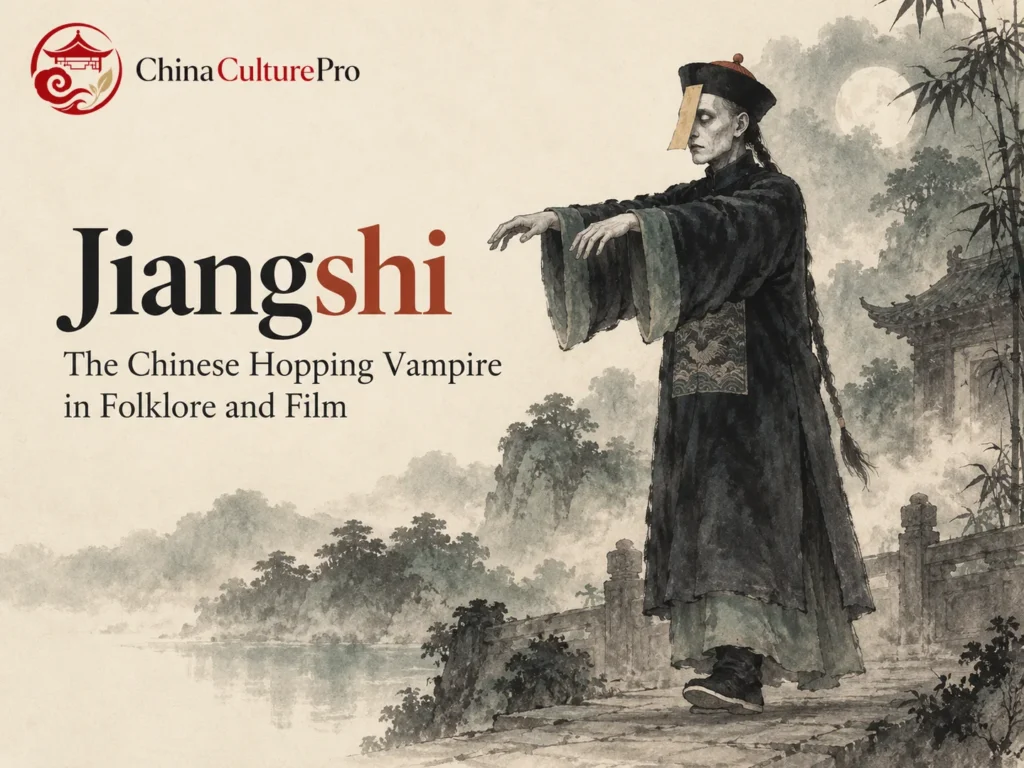
A rigid figure advances with both arms out, a paper charm hanging from its forehead. The image can be frightening and funny at once. Understanding jiangshi means following the path from Chinese ghost stories to film, while keeping older corpse fiction separate from the conventions of a familiar movie monster.
What the Name Means—and What “Vampire” Adds
The word’s literal sense concerns a dead body. A traditional dictionary definition also records the belief that some preserved corpses could become harmful supernatural beings. Recording such a belief is different from establishing that a corpse can return to life.[1]
“Vampire” helps an English-speaking viewer recognize a predatory undead creature, but it brings additional expectations. Blood drinking, aristocratic manners and European religious symbols do not automatically belong to every jiangshi story. Some accounts emphasize taking qi (气, qì), or vital energy; others involve biting or blood. These features vary.[2]
“Zombie” is another comparison rather than an exact translation. The useful starting point is a material corpse that moves, followed by the rules of the particular narrative. It is less useful to assume that every Chinese ghost, every reanimated body and every screen vampire is the same creature.
Older Corpse Stories and Proposed Origins
The Qing writer Pu Songling (蒲松龄, Pú Sōnglíng) offers a concrete example of corpse horror in Strange Tales from a Chinese Studio (聊斋志异, Liáozhāi Zhìyì). In “Corpse Transformation” (尸变, Shībiàn), travelers sleep near a recently deceased woman. Her body rises during the night. One man survives her initial approach by keeping still and holding his breath, then flees when she pursues him.[3]
The body is a woman’s, and the pursuit is not presented as a uniform, two-footed movie hop. The story belongs to the wider literature of returning corpses; it is not a description of every feature later associated with the male, robed screen jiangshi.[3]
Another proposed connection is corpse driving (赶尸, gǎnshī), tales of specialists guiding the dead back toward their home region for burial. Explanations of the hopping image sometimes invoke bodies transported on poles or concealed carriers. These are proposed explanations, not a securely established account of one moment when the monster was invented.[2]
The connection with home burial makes Chinese funeral traditions relevant context. A supernatural tale can express anxiety about the treatment of the dead without documenting a literal reanimation practice.
The Familiar Screen Image
The recognizable costume-and-movement combination is useful for identifying a film tradition. It is not a checklist that every earlier tale must satisfy.
| Screen motif | What the viewer recognizes | Boundary to retain |
|---|---|---|
| Rigid arms and hopping | An unnatural bodily rhythm, used for both pursuit and physical comedy. | Older corpse stories describe other kinds of movement. |
| Historical robe and cap | A visual link with older styles of dress. | Costume does not establish the creature’s identity as a real historical official. |
| Paper charm on the forehead | A visible device of supernatural control. | Its function belongs to the particular story or film. |
| A ritual specialist confronting the corpse | An encounter combining religious imagery with action and suspense. | A screen performance is not a complete account of living religious practice. |
The robe and cap draw on Chinese clothing history. The broader image also borrows from beliefs and ritual imagery associated with Daoism (道教, Dàojiào). These visual references helped the films develop a distinctive monster rather than simply reproducing a European vampire.[2]
A recognizably older costume does not even guarantee a Qing-dynasty setting: Mr. Vampire (僵尸先生, Jiāngshī Xiānsheng) is set in Republican-era China.[6]
Two Films That Shaped the Genre
Encounters of the Spooky Kind (鬼打鬼, Guǐ dǎ Guǐ), released in 1980, combines action comedy with supernatural threats. Its central character becomes the target of an attack arranged through a ritual specialist, while another specialist intervenes to help him. Rival magical performances and physical action drive the story.[4]
The film’s importance lies in that mixture. Its supernatural world can be dangerous, while tricks, timing and bodily performance create comedy. Treating the genre as pure solemn horror would miss much of how it works.[4]
Mr. Vampire, released in 1985, places a ritual expert and his apprentices at the center of a reburial gone wrong. Lam Ching-ying plays the expert confronting the threatening dead. A scene in which characters hold their breath to avoid detection turns danger into tightly timed comedy.[5]
The film blends Hunan walking-corpse folklore with Western vampire and zombie imagery. Its success helped generate a wave of related films and establish the ritual expert as a recognizable screen persona.[6] The familiar monster is therefore the product of adaptation as well as inheritance.
These films are useful starting points for seeing how Chinese mythological and folkloric material changes in performance. Their charms, escape tactics and monster rules can change with the narrative.
FAQs About Jiangshi
Why do jiangshi hop?
Stiff movement is central to the familiar screen image. Proposed links with corpse-driving traditions help explain the association, but they do not establish one certain origin for every version.
Do jiangshi always drink blood?
No single feeding rule covers the tradition. Stories and films can emphasize vital energy, biting or blood, while the name itself means a stiff corpse.
Does holding your breath stop a jiangshi?
It works within particular narratives, including a comic scene in Mr. Vampire. An older corpse story also uses breath holding. Those rules need not apply in another retelling.
Are jiangshi ghosts or zombies?
English labels overlap imperfectly. Begin with the reanimated material body and the specific narrative, rather than assuming that Chinese corpse tales follow the rules of another monster tradition.
Sources
[1] Taiwan Ministry of Education. Revised Mandarin Chinese Dictionary: Jiangshi
[2] Emily Zarka, PBS Monstrum. The Ancient Terror of the Chinese Hopping Corpse, Jiangshi
[3] Pu Songling, Chinese text via Wikisource. Strange Tales from a Chinese Studio, Volume 1: Corpse Transformation
[4] Hong Kong Film Archive. Encounter of the Spooky Kind
[5] Hong Kong Film Archive. Mr. Vampire: Fantasies in Reality
[6] Hong Kong Film Archive. Mr. Vampire: Andrew Lau Programme