

Quick Answer: What Are Chinese Fox Spirits?
Chinese fox spirits, often called huli jing(狐狸精,húli jīng), are foxes imagined as capable of extraordinary transformation and interaction with human beings. They belong to a broad tradition rather than one story with a single cast.
- Abilities: Taking human form is a recurring motif, with details that vary by text.
- Roles: A fox may become a lover, companion, trickster, threat or object of worship.
- Context: Literary characters, local religious practices and everyday language use the fox differently.
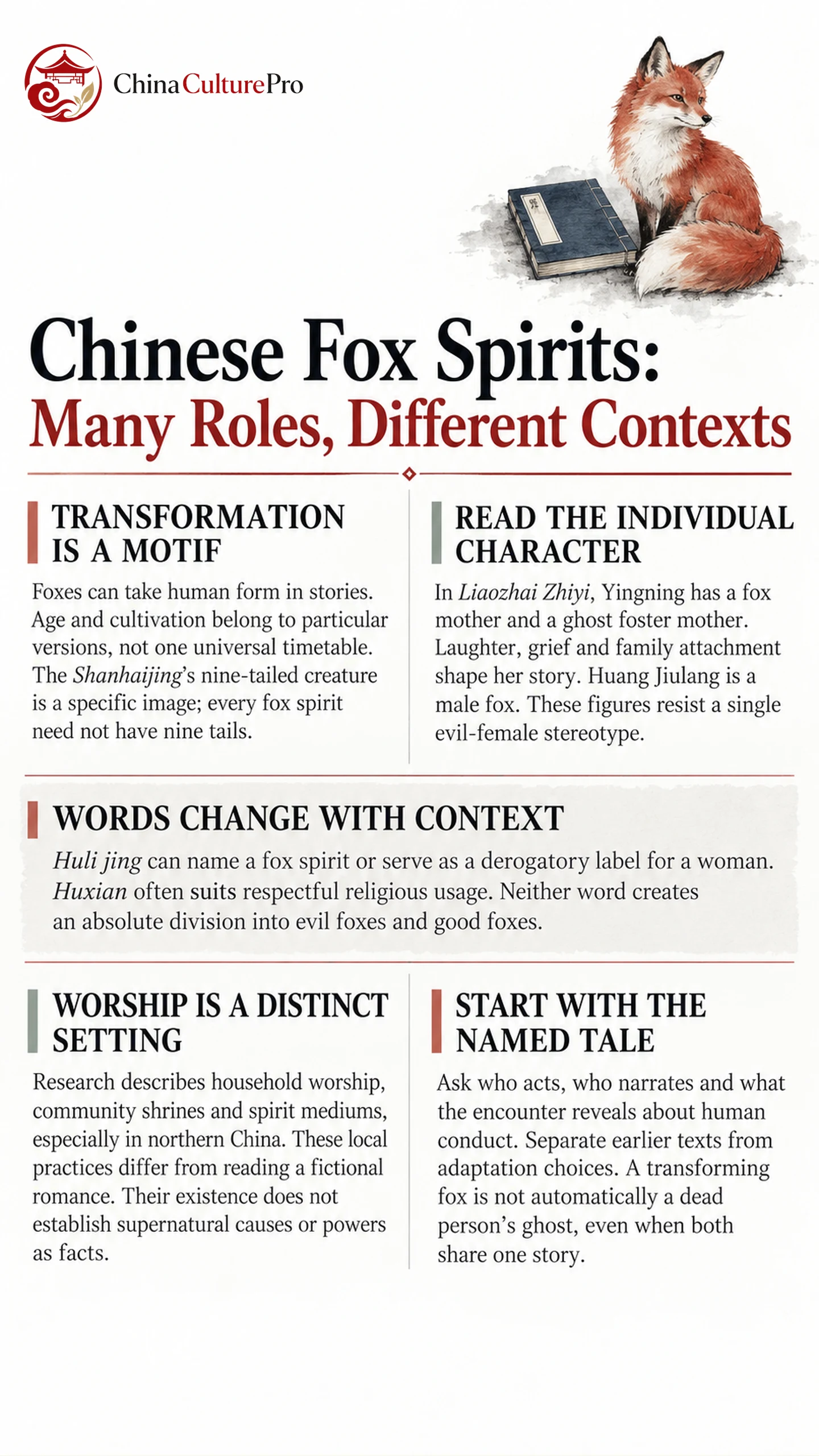
Not every fox spirit is female, evil or nine-tailed. Their supernatural powers are features of stories and beliefs, not established facts about animals.
A stranger arrives at a scholar’s house and seems entirely human—until an unexpected detail changes the encounter. Chinese fox stories repeatedly play with that uncertainty. Within Chinese mythology, foxes are especially flexible figures, carrying affection, danger, wit and social criticism across boundaries that ordinary people are expected to respect.
Shapeshifting, Age and the Nine-Tailed Fox
Transformation lets a fox enter human life as something more complicated than a wild animal. In different narratives it can speak, dress, form relationships and conceal its identity. Accounts that connect age or cultivation with increased powers should be read within their own narrative worlds; they do not add up to one universal timetable.
The nine-tailed fox, jiuweihu(九尾狐,jiǔwěihú), is a related but more specific image. The Shanhaijing(山海经,Shānhǎijīng), or Classic of Mountains and Seas, describes a foxlike creature at Qingqiu with nine tails and a cry like an infant’s. It can eat people. That short description is not already the full plot of a beautiful fox woman marrying a scholar. [1]
A useful distinction is between a particular creature’s description and the wider repertoire of fox transformation. Nine tails make an image immediately striking, but their presence does not tell the viewer every detail of the character’s morality, identity or story. Nor must a fox in human disguise display a visible tail at all times.
Fox Characters in Chinese Literature
Pu Songling(蒲松龄,Pú Sōnglíng)gives fox-related characters considerable emotional variety in Liaozhai Zhiyi(聊斋志异,Liáozhāi Zhìyì), often translated as Strange Tales from a Chinese Studio. Its stories should be read as crafted literary works, even when they draw on circulating tales and beliefs.
Yingning(婴宁,Yīngníng)is remembered for her irrepressible laughter and love of flowers. Her background crosses more than one boundary: she is born to a fox mother and raised by a ghost foster mother. The story moves from courtship and apparent innocence toward household expectations, disturbing consequences and grief. Her later wish to arrange a proper burial for her foster mother gives her an attachment that a simple “seductress” label cannot explain. [2]
Huang Jiulang(黄九郎,Huáng Jiǔláng), in another story, is a young male fox appearing in human form. His involvement in human friendship, desire and political entanglements directly challenges the assumption that fox characters are always women. [3]
These examples do not turn every fox into an ideal companion. They show why the individual story matters. A nonhuman character may expose human cruelty or hypocrisy while also behaving ambiguously. Attraction, kindness and danger need not sort themselves into separate species.
Huli Jing, Huxian and the Insulting Everyday Meaning
The same vocabulary does different work depending on who is speaking. Huxian(狐仙,húxiān), often rendered “fox immortal,” commonly suits a religious or respectful context. Huli jing can name the supernatural being, but it also has a derogatory figurative sense directed at a woman accused of seductive or disruptive behavior. The dictionary records both the folkloric and insulting uses. [4]
| Term or description | Context and meaning | What to avoid assuming |
|---|---|---|
| Huli jing | A fox spirit; also a disparaging label in human social speech | That it is a harmless compliment |
| Huxian | A fox immortal, often in respectful or religious usage | That this creates an absolute good-fox category |
| Nine-tailed fox | A particular bodily motif with its own textual and artistic histories | That every transforming fox has nine tails |
| Fox character in a named story | An individual shaped by that plot and its narrator | That all fox characters share the same gender or motives |
Calling a real person a fox spirit imports an accusation, rather than neutrally describing a traditional animal. Explaining that use does not endorse it. Equally, the two supernatural terms should not become a rigid system in which one always means evil and the other always means good.
Fox Worship and Local Religious Life
Foxes also appear in Chinese folk religion. Xiaofei Kang’s study of the fox cult examines domestic worship, spirit mediums, community shrines and tensions with officials, particularly in northern China. The publisher’s account emphasizes a tradition that crossed social classes and persisted despite official opposition. [5]
This setting differs from reading a romantic tale. A household shrine concerns relationships between worshippers and a locally understood presence; a literary story concerns a narrator, characters and an audience. The two can draw on related ideas without becoming identical evidence.
Regional and household traditions also make broad statements about what “Chinese people believe” unreliable. Some people participate in such practices; others know foxes through literature, family stories or entertainment. A historical study of worship does not establish that a supernatural being caused an illness or that an attributed power produces real results.
The religious context is therefore worth preserving in its own right. Reducing it to a costume for a fictional villain loses part of the fox tradition, just as treating every fox story as a record of worship loses its literary humor and invention.
Reading Fox Stories Without One Fixed Rulebook
Begin with the named work and the character’s actions. Is the encounter presented as a warning, a joke, an intimate relationship or a test of someone’s conduct? Is the narrator asking us to distrust an outsider, or making the supposedly civilized human look worse?
Then distinguish what the text says from what a later adaptation adds. A later retelling may choose a visible tail or a repeated magical effect to make a fox immediately recognizable. Those choices do not have to become rules for every earlier tale. The same caution applies to a neat chart of ages and powers.
Fox stories and Chinese ghost stories often share collections and supernatural settings, but a transforming fox is not automatically the surviving spirit of a dead person. Yingning’s fox mother and ghost foster mother make that distinction particularly clear. [2]
Read this way, the fox remains a character with choices and relationships, rather than a checklist of supernatural features. Affectionate and disturbing stories can then retain their differences.
FAQs About Chinese Fox Spirits
Are all Chinese fox spirits evil?
No. Their roles range from harmful or deceptive figures to affectionate companions and respected religious presences.
Are fox spirits always female?
No. Male fox characters also appear in Chinese literature, including Huang Jiulang in Liaozhai Zhiyi.
Does every fox spirit have nine tails?
No. Nine tails are a particular motif, rather than a requirement for every fox spirit.
Are huli jing the same as ghosts?
Usually not. Fox transformation and the return of a dead person are distinct ideas, though both can appear in the same tale.
Sources
[1] Classic of Mountains and Seas. Southern Mountains Classic
[2] Pu Songling. Liaozhai Zhiyi, Volume Two, Yingning
[3] Pu Songling. Liaozhai Zhiyi, Volume Three, Huang Jiulang
[4] Ministry of Education, Taiwan. Revised Mandarin Chinese Dictionary: Huli Jing
[5] Xiaofei Kang. The Cult of the Fox: Publisher’s Description and Contents