

Quick Answer: Who Is Yu the Great?
Yu the Great(大禹,Dà Yǔ)is a flood-controlling culture hero and the traditional founding ruler of the Xia(夏,Xià)dynasty in Chinese accounts of the ancient past.
- Central achievement: He makes an inundated world habitable by directing its waters.
- Character: His exhausting public service becomes an example of diligence and responsibility.
- Historical position: Later histories connect his success with legitimate rule and the Xia royal line.
These are transmitted traditions, rather than a securely documented personal biography. Early texts, later retellings, archaeological cultures and ceremonies preserve different kinds of evidence; none should be treated as interchangeable.
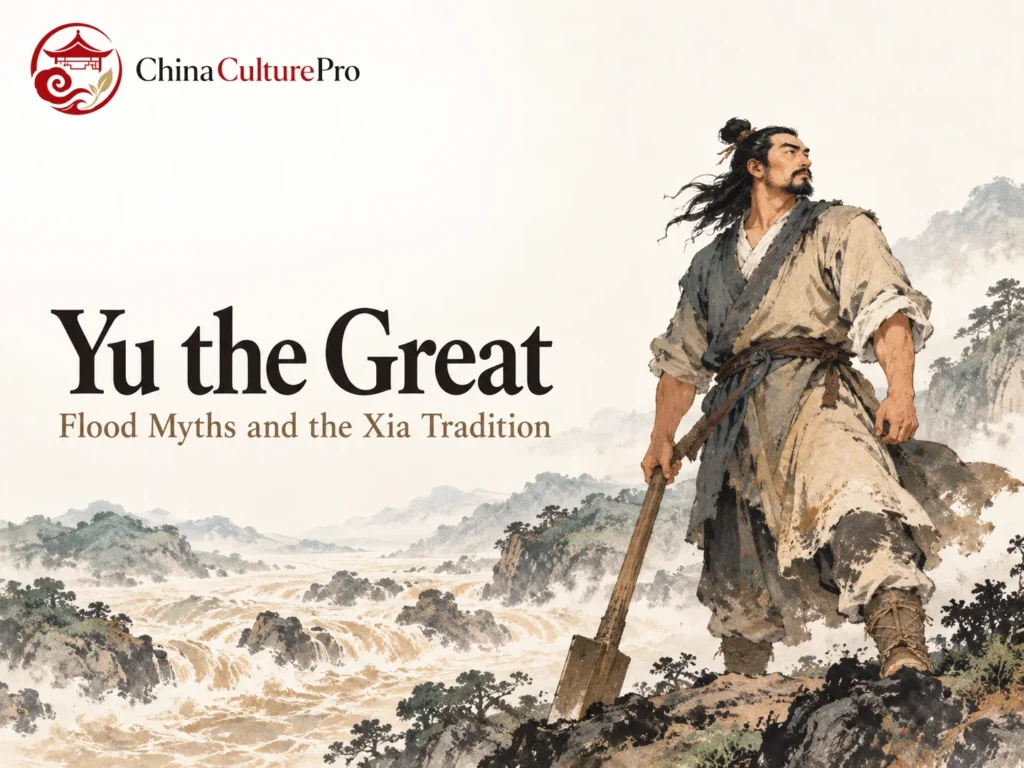
A flooded landscape becomes habitable through the labor of a figure who keeps traveling instead of returning home. Yu’s story joins environmental disorder, personal sacrifice and political authority. Within Chinese mythology, its importance lies both in the compelling flood narrative and in the questions it raises about how the ancient past was remembered.
The Flood Story: Gun’s Failure and Yu’s Work
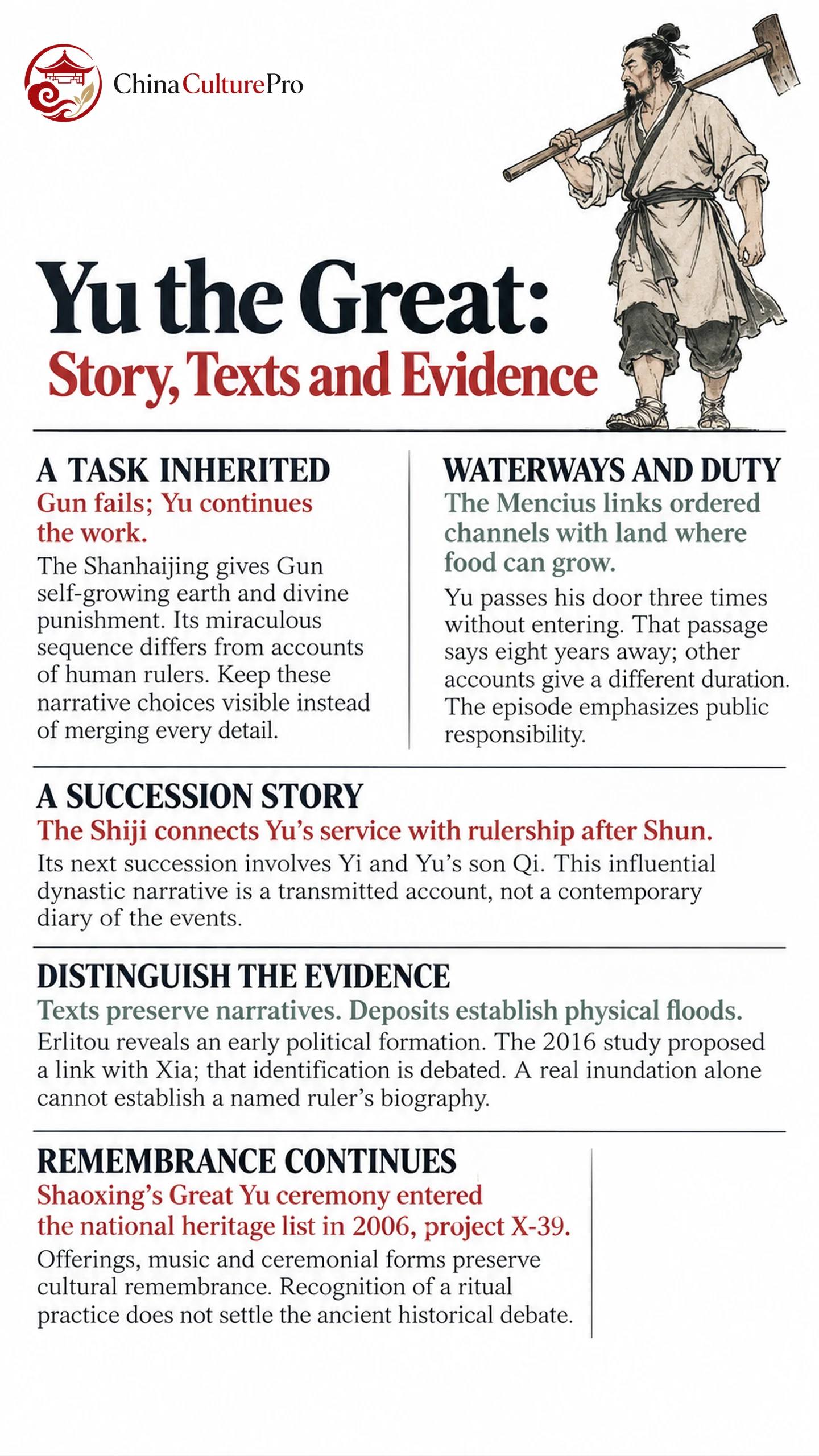
A familiar account begins with waters overwhelming the land and preventing ordinary life. Gun(鲧,Gǔn), Yu’s father, undertakes the task first but fails. Yu continues the work, changing the emphasis from holding water back to giving it channels through which to flow. The result is land where people can settle and cultivate crops.
The supernatural version in the Shanhaijing(山海经,Shānhǎijīng), or Classic of Mountains and Seas, has a different texture. Gun takes the deity’s self-growing earth without permission to stop the flood. The deity orders his death; Yu is subsequently born from Gun, and receives the task of arranging the land and its regions. Miraculous material and birth belong to this account’s mythic world. [1]
That passage does not supply every detail of the familiar engineering comparison. Keeping its divine sequence distinct from later human-ruler narratives allows Gun to remain more than a convenient example of a foolish technique. The story changes when the failed predecessor is also a punished figure whose work his son inherits.
Channels, Cultivation and Passing His Own Door
The Mencius(孟子,Mèngzǐ)presents Yu’s work within an argument about the duties of sage rulers and their ministers. It describes cleared waterways and outlets leading toward the sea; with the waters ordered, growing food becomes possible. This is a vision of making human society viable, not a surviving construction specification. [2]
In the same passage, Yu spends eight years away and passes his own door three times without entering. The point is the burden of public service: the speaker asks how someone carrying such responsibilities could also personally farm. A popular retelling’s thirteen-year absence should not be silently substituted into that particular passage.
The image is powerful because home remains within reach. Yu’s refusal to stop makes the cost of his task visible, rather than merely announcing that he worked hard. Readers can admire that dedication while recognizing it as an ethical example fashioned within a text, not a universal instruction to neglect family life. Other flood and restoration stories, including Nüwa’s repairing of heaven, organize the recovery of a damaged world differently.
From Flood Hero to the Xia Tradition
The Shiji(史记,Shǐjì), or Records of the Grand Historian, gives Yu a place in a succession of rulers. After his service, Shun(舜,Shùn)recommends him; the narrative describes the leading lords turning toward Yu rather than Shun’s son. Yu becomes ruler, and the account associates his rule with Xia. [3]
Succession after Yu is more complicated than “he simply handed the throne to his son.” The same chapter says authority was entrusted to Yi(益,Yì), but that the lords ultimately favored Yu’s son Qi(启,Qǐ). This supplies a narrative explanation for the emergence of the hereditary line associated with the Xia dynasty.
The chapter also gives thirteen years for Yu’s absence. The difference from the Mencius shows why combining several accounts into one biography requires care. The Shiji preserves an influential historical tradition; it was not a contemporary diary of the events it describes.
What Texts, Flood Deposits and Archaeology Can Show
A 2016 study reconstructed a very large landslide-dam outburst flood on the Yellow River around 1920 BCE. Its authors proposed a connection with the Great Flood tradition and suggested implications for the beginning of Xia and the archaeological Erlitou(二里头,Èrlǐtóu)culture. The wording matters: the physical reconstruction and the identification with a transmitted story are separate claims. [4]
Sarah Allan’s published response disputes that identification. She reads early Yu narratives as accounts of ordering a habitable world, rather than reports of one Yellow River disaster. Erlitou’s importance as an early state-level Bronze Age society does not itself establish that its rulers were the Xia kings named in later texts. [5]
| Evidence | What it can support | What does not follow automatically |
|---|---|---|
| Early textual passages | Particular ways Yu’s work and character were described | A complete contemporary biography |
| Flood deposits and dating | A physical inundation in a particular region and period | Identification of its controller as Yu |
| Erlitou material culture | An important early political and cultural formation | Every ruler and succession episode in the Xia tradition |
| Later histories and ritual records | How Yu was placed in political memory and commemoration | Independent confirmation of all ancient events |
Research continues: a 2025 geographical study still frames the historicity of Xia and its flood associations as an unresolved issue. The responsible conclusion is neither that one discovery proves the whole narrative nor that physical evidence has nothing to contribute. Different questions require different evidence. [6]
Remembering Yu in Ritual and Culture
Yu also has a life in commemoration. The national intangible cultural heritage record lists the Great Yu sacrificial ceremony in Shaoxing, Zhejiang, in the first batch of 2006, under project number X-39 and the category of folk customs. Its ritual tradition includes offerings, music and ceremonial forms. [7]
This is evidence for a recognized cultural practice, distinct from evidence establishing an ancient ruler’s exact lifetime. The listing’s protection of remembrance does not settle the archaeological debate. Chinese intangible cultural heritage concerns transmitted practices as well as the stories attached to them.
Across these settings, Yu can be read as a figure of sustained responsibility: the land becomes livable because difficult work continues beyond personal convenience. That interpretation explains his cultural force without requiring every miraculous episode or dynastic detail to become verified history.
FAQs About Yu the Great
Was Yu the Great a real person?
His personal historicity remains uncertain. Later textual traditions and archaeological hypotheses do not provide a securely documented contemporary biography.
How did Yu control the flood in the story?
The familiar account emphasizes opening channels and directing water away so that land becomes habitable, rather than relying only on barriers.
Why did Yu pass his home without entering?
The episode presents dedication to public work. Its duration and surrounding details depend on the textual version.
Did the 2016 flood study prove the Xia dynasty?
No. It proposed a connection between a reconstructed flood and the tradition; that historical identification remains debated.
Sources
[1] Classic of Mountains and Seas. Hai Nei Jing
[2] Mencius. Teng Wen Gong I
[3] Sima Qian. Shiji, Basic Annals of Xia
[4] Qinglong Wu and colleagues. Outburst Flood at 1920 BCE Supports Historicity of China’s Great Flood and the Xia Dynasty
[5] Sarah Allan. The Jishi Outburst Flood and the Great Flood Legend: Preliminary Reflections, pages 23–34
[6] Hantao Ni and colleagues. Authenticity of the Great Flood During the Late Longshan Era
[7] China Intangible Cultural Heritage. Great Yu Sacrificial Ceremony