
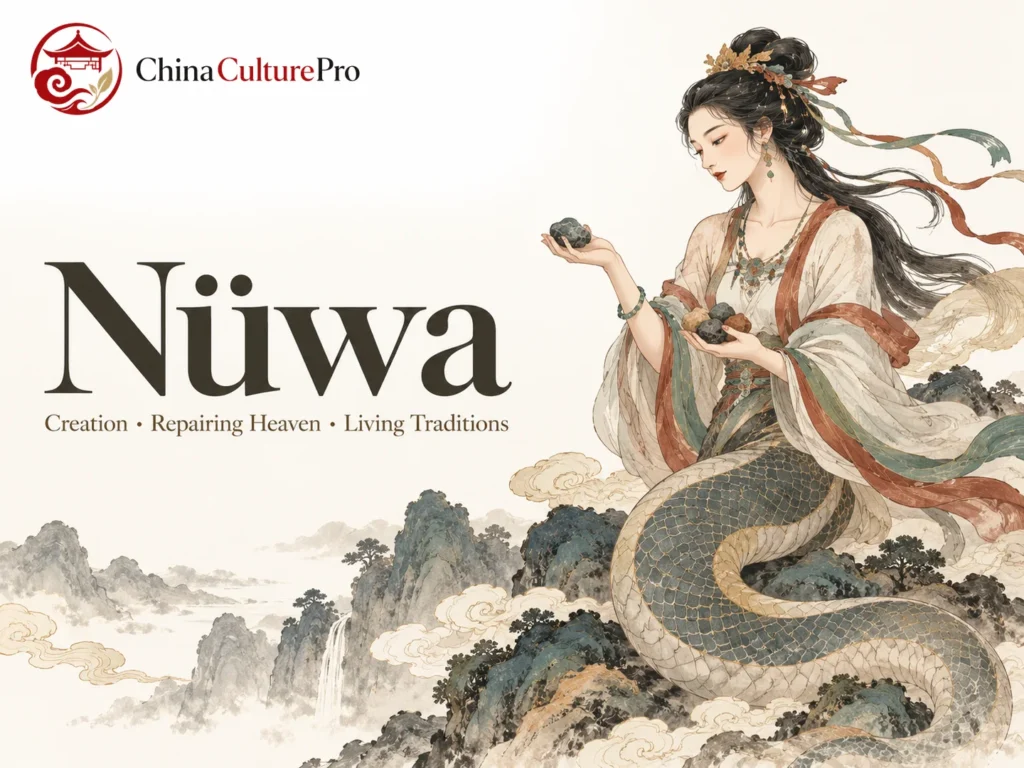

Quick Answer: Who Is Nüwa?
Nüwa(女娲,Nǚwā), also written Nuwa in English, is a creator and restorer in Chinese mythology. Her best-known stories explain the making of people and the repair of a damaged world.
- Creating humanity: She shapes people from earth in a tradition preserved through a later quotation.
- Repairing heaven: She uses stones of five colors and other extraordinary materials to restore cosmic order.
- Art and worship: Serpentine images, paired divine figures and local ritual traditions give her roles beyond a single story.
These traditions have different textual and cultural settings; they do not supply one universally fixed biography.

A handful of earth becomes a person; colored stones mend a broken sky. These two images make Nüwa one of the most recognizable figures in Chinese mythology. Reading the stories alongside their sources reveals a figure concerned with both bringing human life into the world and making that world livable.
Creating People from Earth
In the earth-creation story, the newly opened world has no people. Nüwa molds yellow earth into human forms. Making them individually becomes exhausting, so she draws a cord through mud and lifts it to produce more people. The change from careful handwork to a quicker method gives the story its memorable contrast of scales: one person, then a populated world.
The passage is attributed to Fengsu Tongyi(风俗通义,Fēngsú Tōngyì)and preserved as a quotation in Taiping Yulan(太平御览,Tàipíng Yùlǎn), volume 78. That surviving route matters: the familiar account is not simply a paragraph available in every complete modern edition of the earlier work. [1]
Its ending also explains social rank: wealthy people are associated with individually molded figures, while poor people come from the cord method. This is an explanation of inequality within the tale, rather than evidence that people have different natural worth. Modern retellings may retain the lively mud-making episode while omitting this hierarchical conclusion. Recognizing both elements helps distinguish the older recorded passage from a children’s adaptation. [1]
Repairing Heaven and Restoring a Habitable World
The repair story begins with catastrophe. In Huainanzi(淮南子,Huáinánzǐ), the supports of the world fail, the land splits, fires persist and floods spread. Dangerous animals threaten vulnerable people. The crisis is larger than a hole in the sky: the conditions that allow people to survive have broken down. [2]
Nüwa responds through several different acts. She refines stones of five colors to mend heaven, uses the legs of a great turtle as supports, kills a black dragon and gathers reed ashes to check the floodwaters. These actions address the damaged sky, failed supports, dangerous creature and uncontrolled water respectively. The account ends with order restored and people able to live again. [2]
The colored stones are the most portable image, but the other actions give the episode its full shape. This is a restoration story, rather than another account of making humanity from nothing. “Stones of five colors” also need not mean that every telling specifies exactly five individual stones or the same painted palette. [2]
One way to read the story is as an imaginative account of care expressed through practical repair: Nüwa finds a different response to each danger. That is an interpretation of the narrative, not a single creed shared by everyone who knows it.
Why the Stories Do Not Form One Fixed Chronology
The received Liezi(列子,Lièzǐ)provides a useful surprise. Its Tangwen chapter mentions Nüwa repairing heaven and establishing the supports, then places Gonggong(共工,Gònggōng)striking the mountain afterward. This differs from the familiar sequence in which his collision first causes the disaster that she repairs. The Huainanzi repair passage itself does not name him as its cause. [2][3]
| Tradition | What its textual witness helps establish |
|---|---|
| Earth creation | The Fengsu Tongyi quotation in Taiping Yulan preserves molding people, the cord method and a social-rank explanation. |
| Cosmic repair | Huainanzi presents several restoring actions within a broader disaster. |
| A different sequence | Liezi places the repair before Gonggong’s collision, rather than supplying the familiar combined plot. |
These differences do not make a modern retelling worthless. They show how storytellers can join episodes into a more continuous plot. When comparing the Gonggong and Zhurong traditions, ask which text or retelling is being used before expecting every opponent, event and consequence to match.
Nüwa and Fuxi in Art
Nüwa is often pictured with a human upper body and a long serpentine lower body. Paired images place her alongside Fuxi(伏羲,Fúxī), with their lower bodies intertwined. A silk painting cataloged by the National Museum of Korea preserves this pairing in a funerary setting, showing that the figures also belonged to a visual world concerned with cosmic order and the dead. [4]
Such an image is not an illustration of the clay episode alone. It presents a relationship through paired bodies and composition. It is therefore useful to separate three questions: what an object depicts, which story explains it, and how a particular tradition describes the figures’ kinship.
The museum describes the pair as brother and sister, associated with humanity’s origin. Other retellings develop their relationship as a primordial marriage; that plot should not be imposed on every passage about Nüwa. [4] The Fuxi traditions have their own range of cultural-hero roles. Their visual partnership is an important connection, rather than a reason to flatten all accounts into one family tree.
Ritual Traditions and Cultural Meanings
Nüwa is also remembered through ritual practice. The official national heritage entry for the Nüwa ceremony in Shexian, Hebei, records its inclusion in the first national list in 2006, under project X-38. It locates the tradition around the Wahuang Palace complex. This gives a concrete example of local observance beyond books and paintings. [5]
The distinction is important: a heritage listing documents a transmitted cultural practice. It does not establish that the creation or heaven-repair episodes happened as historical events. Nor does one listed community define how all Chinese people understand the figure. Chinese intangible cultural heritage includes the practices through which communities preserve and reinterpret stories.
Across the examples here, Nüwa can be approached as maker of people, rescuer of a threatened world, partner in an image or focus of local reverence. The creation and repair stories make resourcefulness and the protection of life especially fruitful themes to explore. A retelling is easier to understand when its source, setting and particular choices remain visible.
FAQs About Nüwa
Is Nüwa the creator of the whole universe?
Her best-known accounts concern creating people and repairing an existing world. They do not require her to be the sole creator of everything in every Chinese tradition.
Are Nüwa and Fuxi siblings or spouses?
Some traditions make them both siblings and spouses. Paired images are widespread, but their relationship varies with the source and should not be assumed in every Nüwa story.
Did Gonggong cause the disaster Nüwa repaired?
That is a familiar combined retelling. The cited Huainanzi passage leaves the cause unnamed, while the received Liezi places his collision after her repair.
Is Nüwa still worshipped?
Yes, local ritual traditions survive. The nationally listed Shexian ceremony is one documented example; it does not imply universal observance throughout China.
Sources
[1] Taiping Yulan, volume 78. Quotation attributed to Fengsu Tongyi
[2] Huainanzi. Lanming chapter
[3] Liezi. Tangwen chapter
[4] National Museum of Korea. Painting of Fuxi and Nüwa
[5] China Intangible Cultural Heritage. Nüwa ceremony, Shexian