


Quick Answer: Who Is Kuafu?
Kuafu(夸父,Kuāfù), also written Kua Fu in English, is the giant of a Chinese sun-chasing myth. His pursuit ends in overwhelming thirst, while his abandoned staff becomes a lasting feature of the landscape.
- Central action: He races after the sun and seeks water beyond what great rivers can supply.
- Familiar ending: He dies before reaching another source of water; his staff becomes a forest.
- Interpretation: The story can evoke extraordinary ambition, bodily limits and what remains after an unfinished effort.
Different texts give the figure different emphases. This is a transmitted myth, not a verified biography or an explanation of the sun’s physical movement.
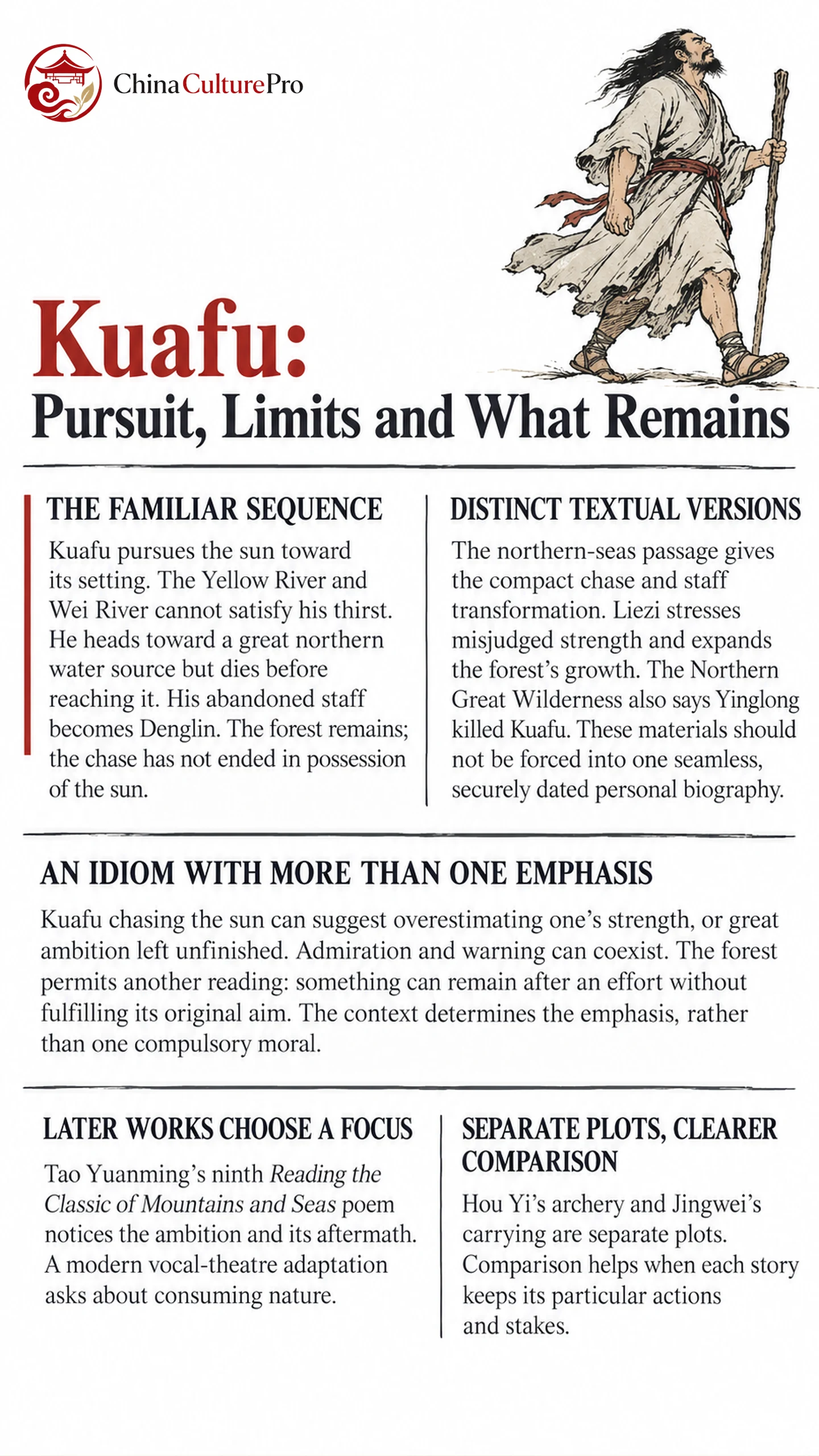
A giant runs after the sun until the largest rivers cannot satisfy his thirst. Then the story changes scale: the runner falls, but a forest remains. Within Chinese mythology, Kuafu’s memorable image combines immense energy with a limit that strength alone cannot remove.
The Chase, the Thirst and the Staff
The familiar account comes from the Shanhaijing(山海经,Shānhǎijīng), or Classic of Mountains and Seas, in its section on regions beyond the northern seas. Kuafu pursues the sun toward its setting. Thirst drives him to drink from the Yellow River and the Wei River, but their water is insufficient. [1]
He heads north toward a great marsh or lake. Before reaching it, he dies of thirst. His discarded staff transforms into Denglin(邓林,Dènglín), the forest named in the passage; this is the story’s miraculous aftermath. Many familiar explanations describe it as a peach forest; the short original ending itself names Denglin rather than spelling out every later detail of its shade and fruit.
This sequence does not end with Kuafu taking possession of the sun or changing the ordinary alternation of day and night. Its movement is pursuit, thirst, death and transformation. The forest provides an aftermath without undoing the failed journey.
The account’s vast scale belongs to mythic storytelling. Drinking beyond the capacity of great rivers gives physical form to an impossible demand, rather than reporting a feat that should be reconstructed as ordinary human endurance.
Different Texts Give Different Emphases
The received Liezi(列子,Lièzǐ), in the Tang Wen chapter, opens with the judgment that Kuafu misjudged his strength. It also develops the forest’s growth through the relation between the discarded staff and his dead body. That framing makes the cost of pursuit particularly explicit. [2]
Another Shanhaijing passage, in the Classic of the Northern Great Wilderness, includes both the thirsty pursuit and a statement that Yinglong(应龙,Yìnglóng), a dragon, killed Kuafu. These are difficult materials to flatten into one literal sequence. [3]
| Textual setting | Distinctive emphasis | Reading consequence |
|---|---|---|
| Regions beyond the northern seas | Pursuit, river drinking, thirst and a transformed staff | Supplies the compact familiar plot |
| Liezi, Tang Wen | Misjudged strength and an expanded account of forest growth | Makes overreaching a visible interpretation |
| Northern Great Wilderness | Genealogical imagery and a separate killing by Yinglong | Preserves material that does not fit a seamless biography |
A retelling may select one account or combine elements. It should make that choice visible instead of presenting every version as a chapter in the same securely dated life.
Ambition, Limits and the Kuafu Idiom
Kuafu zhu ri(夸父逐日,Kuāfù zhú rì), “Kuafu chases the sun,” survives as an idiom. The Ministry of Education’s dictionary explains its figurative uses as either overestimating one’s ability or possessing great ambition without completing the undertaking. [4]
That range matters. In one context Kuafu is a cautionary figure: determination cannot abolish every limit. In another, the grandeur of an unfinished goal deserves attention even without success. The forest ending permits a further reading—an effort can leave something behind that differs from its original aim.
These readings do not need to become a single compulsory moral. The short pursuit is memorable partly because admiration and unease can coexist. Kuafu’s scale is extraordinary, yet thirst remains decisive.
Poetry, Performance and Related Myths
Tao Yuanming(陶渊明,Táo Yuānmíng)returns to Kuafu in the ninth poem of his Reading the Classic of Mountains and Seas sequence. He emphasizes the great intention of the chase and the forest that remains afterward. A poetic response can therefore shift attention from the unsuccessful finish toward the meaning of what survives. [5]
Modern performance can ask different questions. Huang Ruo’s vocal-theatre work Book of Mountains and Seas gives Kuafu curiosity about where the sun goes at night and reads his pursuit through the consequences of endlessly consuming nature. That is a particular adaptation’s interpretation, not an unstated motive that must be inserted into every ancient passage. [6]
Hou Yi’s sun story concerns an archer responding to multiple suns, rather than this exhausting chase. Jingwei’s sea-filling task offers another comparison between a vast goal and limited means, but begins with a different loss and transformation.
When encountering Kuafu again, notice whether the work emphasizes pursuit, warning, persistence or the forest left behind. Recognizing that choice preserves the story’s tension.
FAQs About Kuafu Chasing the Sun
Does Kuafu catch the sun?
He does not capture or keep it. The familiar account ends with his death during the search for enough water.
Why does Kuafu chase the sun?
The short familiar passage does not explain a detailed motive. Later tellings supply different reasons.
What happens to Kuafu’s staff?
It becomes Denglin, commonly explained as a peach forest. The details vary between accounts.
Does the story praise ambition or warn against it?
Both readings occur. The wording of a particular text or the context of the idiom determines the emphasis.
Sources
[1] Classic of Mountains and Seas. Regions Beyond the Northern Seas, Kuafu Passage
[2] Liezi. Tang Wen
[3] Classic of Mountains and Seas. Northern Great Wilderness
[4] Ministry of Education, Taiwan. Dictionary of Chinese Idioms: Kuafu Zhu Ri
[5] Tao Yuanming. Reading the Classic of Mountains and Seas, Poem Nine
[6] Huang Ruo and production team. Book of Mountains and Seas Programme