


Quick Answer: Who Are Gonggong and Zhurong?
Gonggong(共工,Gònggōng)and Zhurong(祝融,Zhùróng)are figures commonly associated with water and fire in Chinese myth. A familiar version brings them into conflict and connects the outcome with damage to the world’s supports.
- Conflict: Their confrontation gives elemental powers a dramatic personal form.
- Catastrophe: Gonggong’s collision with a cosmic mountain becomes an explanation for an uneven world.
- Variation: Other texts give Gonggong a different opponent or organize the restoration story differently.
The water-versus-fire version is a real strand of the tradition, but it is not the wording of every early source. Neither figure has one securely verified biography underlying all the accounts.
A defeated figure strikes a mountain, and a quarrel becomes a disaster for heaven and earth. The familiar scene is easy to remember, but its parts come from different textual settings. Reading it within Chinese mythology means following both the dramatic conflict and the choices made when its episodes are joined.
Water, Fire and More Than One Identity
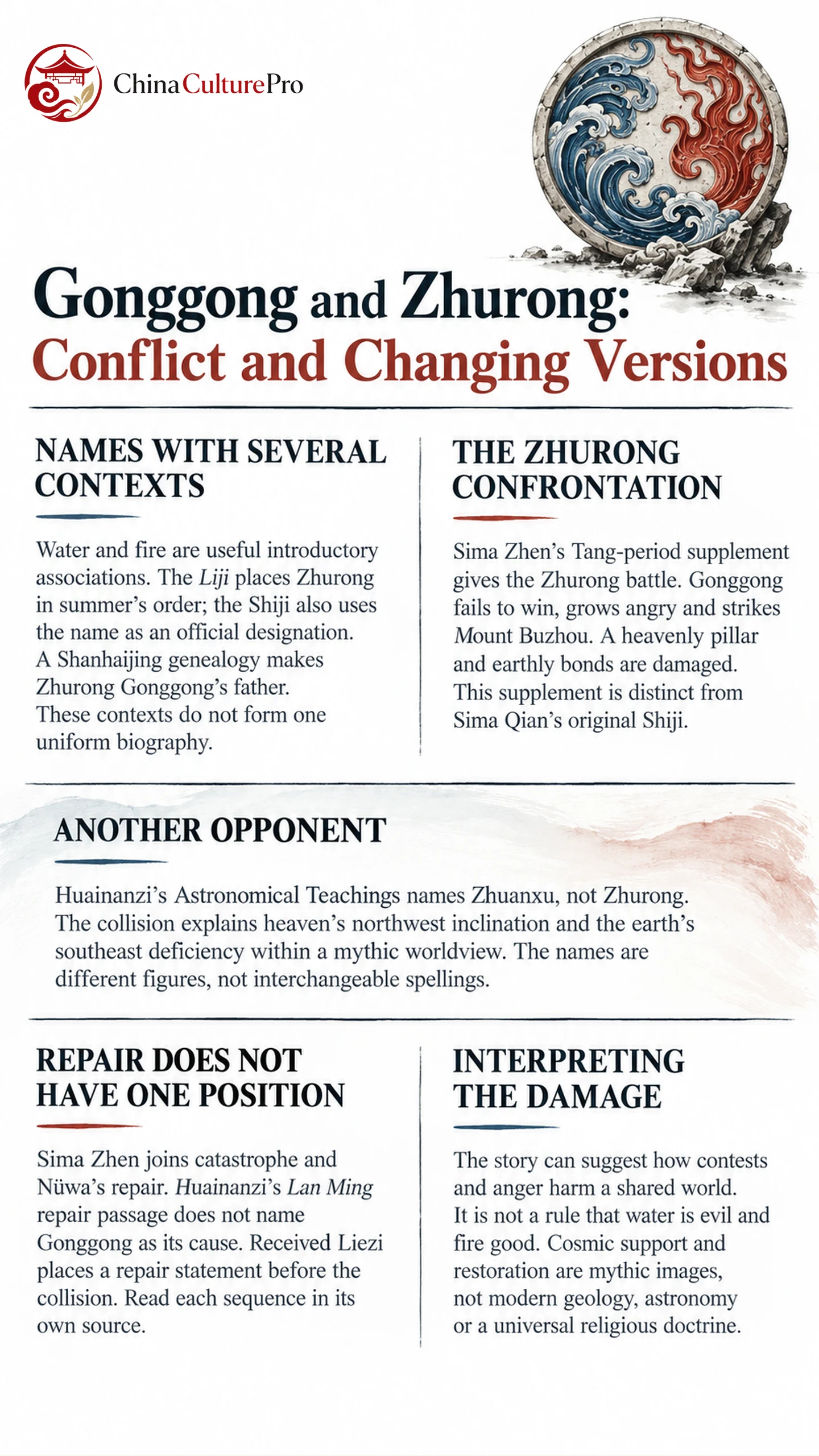
“Water god” and “fire god” are useful introductory labels, especially for the paired conflict. They do not exhaust the ways the names appear. Zhurong, for example, belongs to the summer associations in the Liji(礼记,Lǐjì), or Book of Rites, placing the name in a wider seasonal order. [1]
The Shiji(史记,Shǐjì), or Records of the Grand Historian, describes Zhurong as a designation associated with a fire official and passed to another holder. That account should not be collapsed into a modern character biography with one uncontested identity and lifetime. [2]
The Shanhaijing(山海经,Shānhǎijīng), or Classic of Mountains and Seas, gives a genealogical sequence in which Zhurong fathers Gonggong. That relationship differs markedly from simply introducing two unrelated elemental rivals. Genealogy and combat belong to different ways of arranging the mythic material. [3]
These variations help explain why a single family tree or a single list of divine offices cannot make every account agree. The important question is what a particular text is doing with the name.
The Battle and the Breaking of Mount Buzhou
A clear source for the Zhurong confrontation is the supplementary Annals of the Three Sovereigns by Sima Zhen(司马贞,Sīmǎ Zhēn). This Tang-period supplement is associated with the Shiji tradition, but it is not part of Sima Qian(司马迁,Sīmǎ Qiān)’s original composition. [4]
In its account, Gonggong is a powerful contender who fights Zhurong and fails to win. Anger drives him to strike Mount Buzhou(不周山,Bùzhōu Shān)with his head. The mountain collapses, a heavenly pillar breaks and the bonds of the earth are damaged.
The movement from defeat to collision gives the version its force. The consequences exceed the combatants: a struggle over power breaks the structure on which ordinary life depends. It is a mythic catastrophe, not a report of a historically observed mountain impact.
A modern retelling can expand the combat with armies, flames and surging water. Those additions may make a vivid scene, but the compact supplementary account does not require one fixed inventory of weapons, monsters or battle speeches.
Why Some Texts Name Zhuanxu Instead
Zhuanxu(颛顼,Zhuānxū), rather than Zhurong, is Gonggong’s opponent in the Astronomical Teachings chapter of the Huainanzi(淮南子,Huáinánzǐ). The passage describes a contest for rulership, Gonggong’s anger and the blow against Buzhou. It then explains heaven’s inclination northwest and the earth’s deficiency southeast. [5]
Sun, moon and stars move toward the inclined side of heaven in this account; waters and sediment gather toward the lower part of the earth. This is the text’s mythic explanation for directional patterns, not modern astronomy or a claim that every river flows in one compass direction.
| Textual setting | Named opponent | What distinguishes this version |
|---|---|---|
| Huainanzi, Astronomical Teachings | Zhuanxu | Contest, collision and the directional imbalance of heaven and earth |
| Sima Zhen’s supplementary annals | Zhurong | Defeat in combat and a narrative leading into restoration |
| Received Liezi(列子,Lièzǐ), Tang Wen | Zhuanxu | The collision is placed after a statement about an earlier repair |
Zhuanxu and Zhurong are different names, not alternative spellings. Replacing one with the other changes the version being told. Even a familiar plot benefits from naming its source before calling one opponent the universal answer.
How Nüwa’s Repair Fits Different Versions
Nüwa(女娲,Nǚwā)is the restoring figure in the supplementary annals: after the catastrophe she repairs heaven with colored stones, sets up supports and stops the floodwaters. This version explicitly joins conflict, damage and repair. [4]
The Huainanzi’s Lan Ming chapter gives an influential repair account with broken supports, uncontrolled fire and water, dangerous creatures and Nüwa’s restorative acts. It does not name Gonggong as the cause of that crisis. Quoting those acts therefore does not, by itself, establish the whole joined battle narrative. [6]
The received Liezi offers another arrangement. Its Tang Wen chapter mentions Nüwa’s repair first, then says that afterward Gonggong fought Zhuanxu and struck Buzhou. That order cannot simply be reversed while still claiming to reproduce the passage. [7]
The dedicated Nüwa article explores her restoration traditions more fully. Here, the essential distinction is between a connected story in one source and related episodes whose connection a later teller supplies.
Reading Conflict and Cosmic Disorder
Water and fire make a compelling contrast, but the myth is not a general rule that water is evil and fire is good. One compelling reading centers on the damage a contest can bring to a shared world. In the collision, private anger acquires public consequences.
The broken support also turns an abstract loss of order into something imaginable. Heaven leans; the land no longer balances; the consequences remain visible within the story’s world. Restoration answers that damage through acts of making and stabilizing, rather than another victory in combat.
Those are readings of the narrative, not a universal doctrine held by everyone in China. Nor do these texts form a single continuous history of Chinese gods and goddesses. A figure can appear as an official, ancestor, rival or cosmic power in different settings.
Keeping the versions distinct makes the drama clearer. The Zhurong battle can be told on its own terms, while the Zhuanxu passages retain the political and cosmological questions they pose.
FAQs About Gonggong and Zhurong
Does Gonggong always fight Zhurong?
No. Important passages in the Huainanzi and received Liezi name Zhuanxu instead.
Did Gonggong cause Nüwa to repair the sky?
That sequence appears in some accounts, including Sima Zhen’s supplement. Other repair passages do not make the same connection.
Is Zhurong simply one historical person?
No single documented biography accounts for the divine, official and genealogical uses of the name.
Does the tilted-sky story explain real astronomy?
It supplies a mythic explanation within the text’s worldview, rather than a scientific account of celestial motion.
Sources
[1] Book of Rites. Monthly Ordinances
[2] Sima Qian. Shiji, Chu Hereditary House: Fire Officials and the Zhurong Title
[3] Classic of Mountains and Seas. Hai Nei Jing
[4] Sima Zhen. Supplementary Annals of the Three Sovereigns
[5] Huainanzi. Astronomical Teachings, Gonggong Passage
[6] Huainanzi. Lan Ming Chapter
[7] Liezi. Tang Wen