


Quick Answer: Who Are the Chinese Gods and Goddesses?
“Chinese gods and goddesses” is a useful starting phrase for a diverse religious and mythological world. It includes figures whose identities and forms of devotion developed in different settings.
- Religious traditions: Daoist deities, Buddhist figures and popular religious presences can appear in overlapping cultural environments.
- Associated roles: Heavenly government, compassion, maritime protection and household care are different kinds of responsibility.
- Local variation: A widely known name may be shared across regions, while a local divine office can have distinct holders.
There is no complete list or ranking that governs every tradition. A figure’s title, image, temple setting and particular history matter more than a single label.
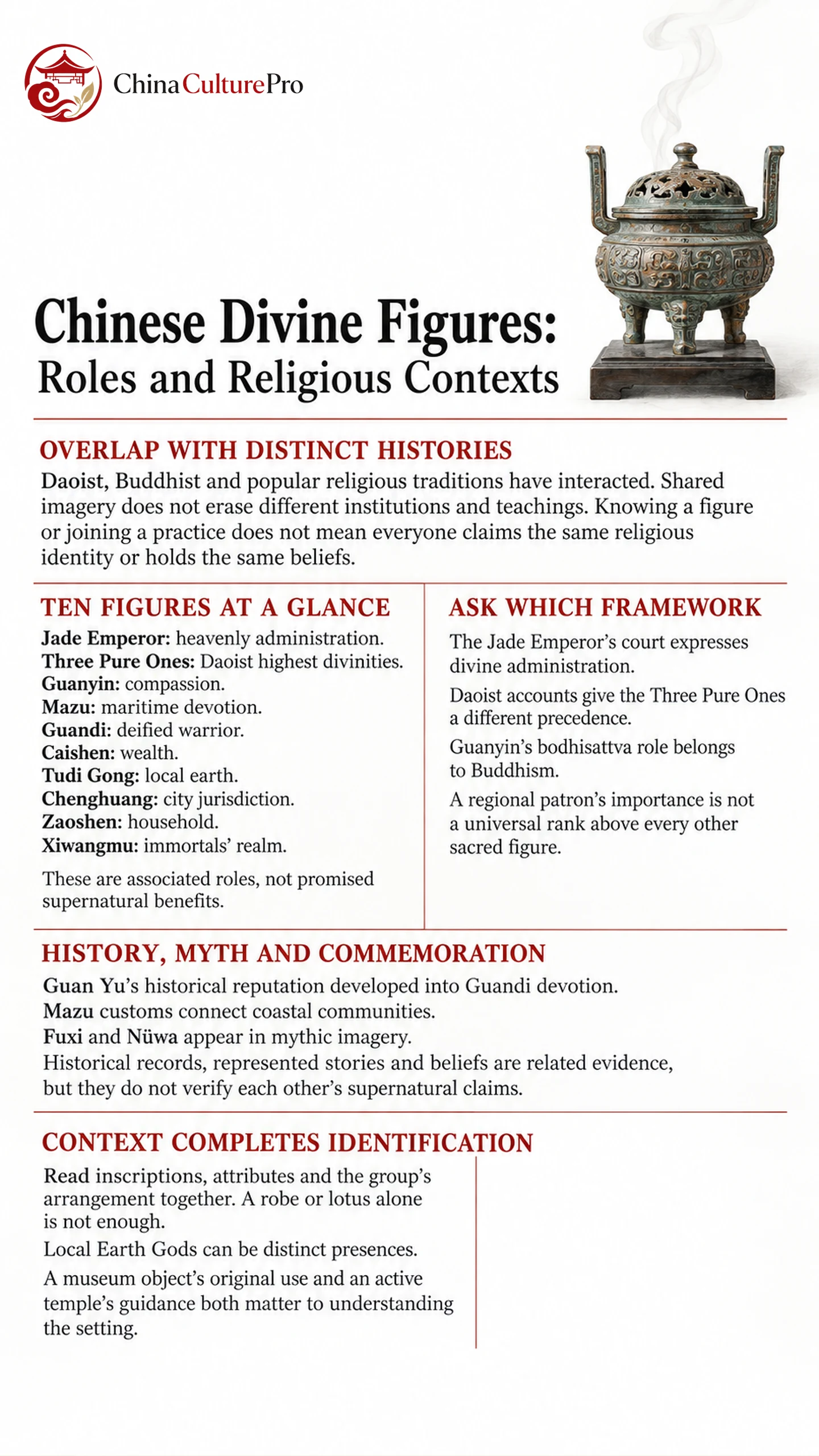
An imperial robe, a lotus and a household print can point to very different sacred presences. Knowing a name helps, but knowing the setting helps more. This guide introduces major figures in religion in China, then explains why their roles cannot be reduced to a single family tree or divine league table.
How Religious Traditions Meet
Religious Daoism, Chinese Buddhism and Chinese folk religion have interacted over long periods. Shared practices and images do not erase their distinct teachings, institutions or histories. Research on religion in China also distinguishes formal religious identification from participation in practices associated with a tradition. [1]
That helps explain why a person might know several divine figures without describing themselves as a member of a single organized religion. It does not mean that every person participates or believes in the same way.
Objects make the variety tangible. A printed household deity, a Daoist ritual image and a Buddhist monastery painting have different settings and uses. Museum research also documents the movement of figures and visual ideas between traditions. An image’s presence in one setting therefore does not always establish a completely separate religious world. [2]
Ask what a particular figure means to a community, in a text, or within a ritual and artistic setting.
Major Figures and Their Different Roles
The following selection is a recognition guide, not an exhaustive pantheon. “Associated role” describes a religious or cultural understanding; it does not promise a supernatural result.
| Figure | Associated role | Context to keep in view |
|---|---|---|
| Jade Emperor (玉皇大帝,Yùhuáng Dàdì) | Heavenly sovereign and administration | Popular religion and Daoist settings. [3] |
| Three Pure Ones(三清,Sānqīng) | Highest divinities in an influential Daoist account | A group, not another name for the Jade Emperor. [4] |
| Guanyin (观音,Guānyīn) | Compassion and response to suffering | The Buddhist bodhisattva Avalokiteshvara. [5] |
| Mazu (妈祖,Māzǔ) | Maritime protection and community devotion | Especially important in coastal traditions. [6] |
| Guandi (关帝,Guāndì) | A deified warrior associated with valor and faithfulness | Historical memory developed into devotion. [7] |
| Caishen (财神,Cáishén) | Wealth and prosperity | A wealth deity in popular religious practice. [1] |
| Tudi Gong(土地公,Tǔdì Gōng) | Protection of a locality | Local Earth Gods need not be one identical being. [8] |
| Chenghuang (城隍,Chénghuáng) | The city and its divine jurisdiction | Different cities have distinct City God traditions. [8] |
| Zaoshen(灶神,Zàoshén), the Stove or Kitchen God | Household guardianship and reporting | A deity closely connected with domestic life. [8] |
| Xiwangmu(西王母,Xīwángmǔ), Queen Mother of the West | The realm of immortals | A prominent figure in early funerary imagery and later traditions. [9] |
A single role rarely contains a figure’s whole identity. Maritime protection does not exhaust Mazu’s significance, and a celestial title does not explain every story about its holder. The dedicated articles follow those histories in greater detail.
Why There Is No Single Universal Ranking
The Jade Emperor’s heavenly court offers a recognizable model of divine government, with offices, reports and jurisdictions. This helps readers understand official robes, audience halls and stories about divine administration. Scholarship also cautions against making bureaucracy the explanation for every deity or every devotional relationship. [3]
Daoist accounts introduce another distinction. The Chinese Taoist Association identifies the Three Pure Ones as the highest gods in its description of the Daoist divine order. Their position cannot be reduced to the idea that whoever resembles a human emperor must outrank every other sacred figure. [4]
Guanyin belongs to a Buddhist framework in which compassion, awakening and the bodhisattva’s activity matter; that role is not simply a lower administrative post at another deity’s court. [5]
Likewise, regional importance is not a cosmic ranking. A community’s patron may be central to its festivals and identity without being described as the universal ruler of every religious tradition. Asking “highest in which framework?” produces a more useful answer than a single numbered list.
Mythic Figures, Historical People and Devotion
Guan Yu(关羽,Guān Yǔ)provides one route from history to divine status. He was a warrior whose reputation developed through later veneration and titles; Guandi identifies the elevated religious figure. The historical person, stories about his loyalty and subsequent worship are related layers rather than interchangeable evidence. [7]
Mazu’s tradition offers another pattern. UNESCO’s account links her commemoration with coastal customs, oral traditions and religious ceremonies; Mazu belief and customs entered its Representative List in 2009. Recognition concerns the transmitted cultural practice, not verification of the miracles devotees attribute to her. [6]
Fuxi (伏羲,Fúxī)and Nüwa (女娲,Nǚwā)illustrate the importance of mythic and ancestral images. A surviving funerary painting pairs them with human upper bodies and intertwined serpent forms. Such an object tells us about representation and the world imagined by its makers, not about a photographed historical couple. [10]
Literature and performance add further layers to divine figures. A dramatic role may emphasize humor, rivalry or an adventure that differs from temple devotion. A familiar story can be an entry point while still leaving the religious history to be understood separately.
Reading Images and Temple Settings
Look first for a name inscription or a reliable object description. Clothing, posture and attributes are clues, but a single lotus, weapon or official robe cannot identify every image on its own. A group’s arrangement and the setting of the work may be equally revealing.
A museum object also has a history of use. The Met’s painting of Guandi, for example, belongs to a set used in Buddhist water-and-land rituals. Its subject’s presence there makes the interaction between traditions visible rather than merely theoretical. [7]
Locality matters as well. In the historical framework described by Columbia’s teaching resource, neighboring Earth Gods can be distinct local presences, whereas Mazu can be honored at many temples as the same goddess. The word “god” alone cannot tell the reader which kind of relationship is intended. [8]
For active religious sites, follow the site’s own signs and guidance; the Chinese temple etiquette guide provides a broader introduction. Respectful observation does not require assuming that every visitor shares the same beliefs or that every temple follows identical arrangements.
FAQs About Chinese Gods and Goddesses
Who is the highest Chinese god?
There is no universal answer. The Jade Emperor is a heavenly sovereign in popular accounts; Daoist frameworks give the Three Pure Ones a different kind of precedence.
Is Guanyin a Chinese goddess?
“Goddess of Mercy” is a familiar English label, but Guanyin is more precisely the Buddhist bodhisattva of compassion, Avalokiteshvara.
Are Chinese gods all Daoist?
No. Buddhist, local, household, ancestral and mythic traditions contribute different figures and forms of devotion.
Are local Earth Gods the same being everywhere?
Not necessarily. Local traditions can distinguish an Earth God or City God associated with one particular jurisdiction.
Sources
[1] Pew Research Center. Confucianism, Taoism and Chinese Folk Religions
[2] Metropolitan Museum of Art. Another World Lies Beyond: Chinese Art and the Divine
[3] Columbia University, Asia for Educators. The Jade Emperor and the Heavenly Domain
[4] Chinese Taoist Association. The Three Pure Ones
[5] Asian Art Museum. The Bodhisattva Avalokiteshvara, Guanyin
[6] UNESCO Intangible Cultural Heritage. Mazu Belief and Customs
[7] Metropolitan Museum of Art. Guan Yu, Painting from a Water-and-Land Ritual Set
[8] Columbia University, Asia for Educators. The Kitchen God and Other Gods of the Earthly Domain
[9] Metropolitan Museum of Art. Tomb Panel with Xiwangmu and Attendants
[10] National Museum of Korea. Painting of Fuxi and Nüwa