
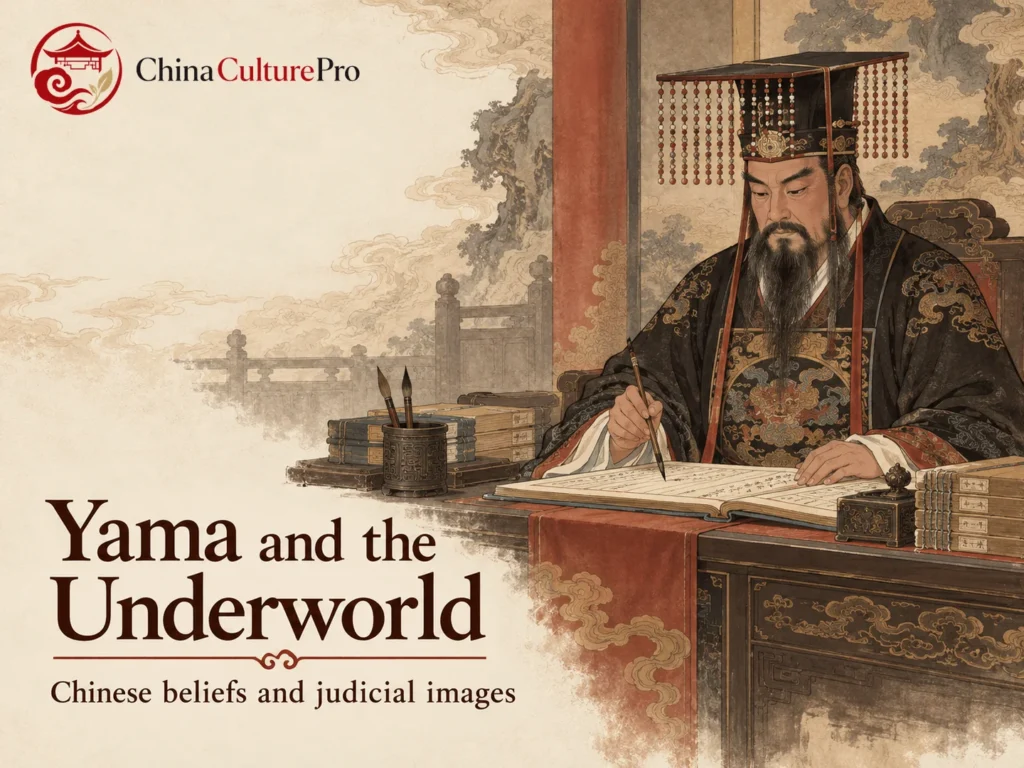

Quick Answer: Who Is Yama in Chinese Belief?
Yama(阎罗王,Yánluó Wáng)is a judge of the dead in Buddhist and Chinese religious traditions. In Chinese usage, Yanluo Wang and the shorter Yan Wang(阎王,Yán Wáng)are familiar names. He commonly appears within an underworld imagined as a system of courts and officials.
- Background: Buddhist texts connect Yama with questioning the dead about their actions. [1]
- Chinese images: He may wear official dress and examine records at a desk. [6]
- Ten Kings: In an important Chinese Ten Kings(十王,Shí Wáng)system, he is the fifth of ten underworld kings. [3]
- Related figures: Other judges, clerks and rescuing bodhisattvas have different roles. [4]
These are beliefs and representations of moral accountability. Yama is neither one securely documented earthly ruler nor an interchangeable name for every figure in a Chinese afterlife scene.
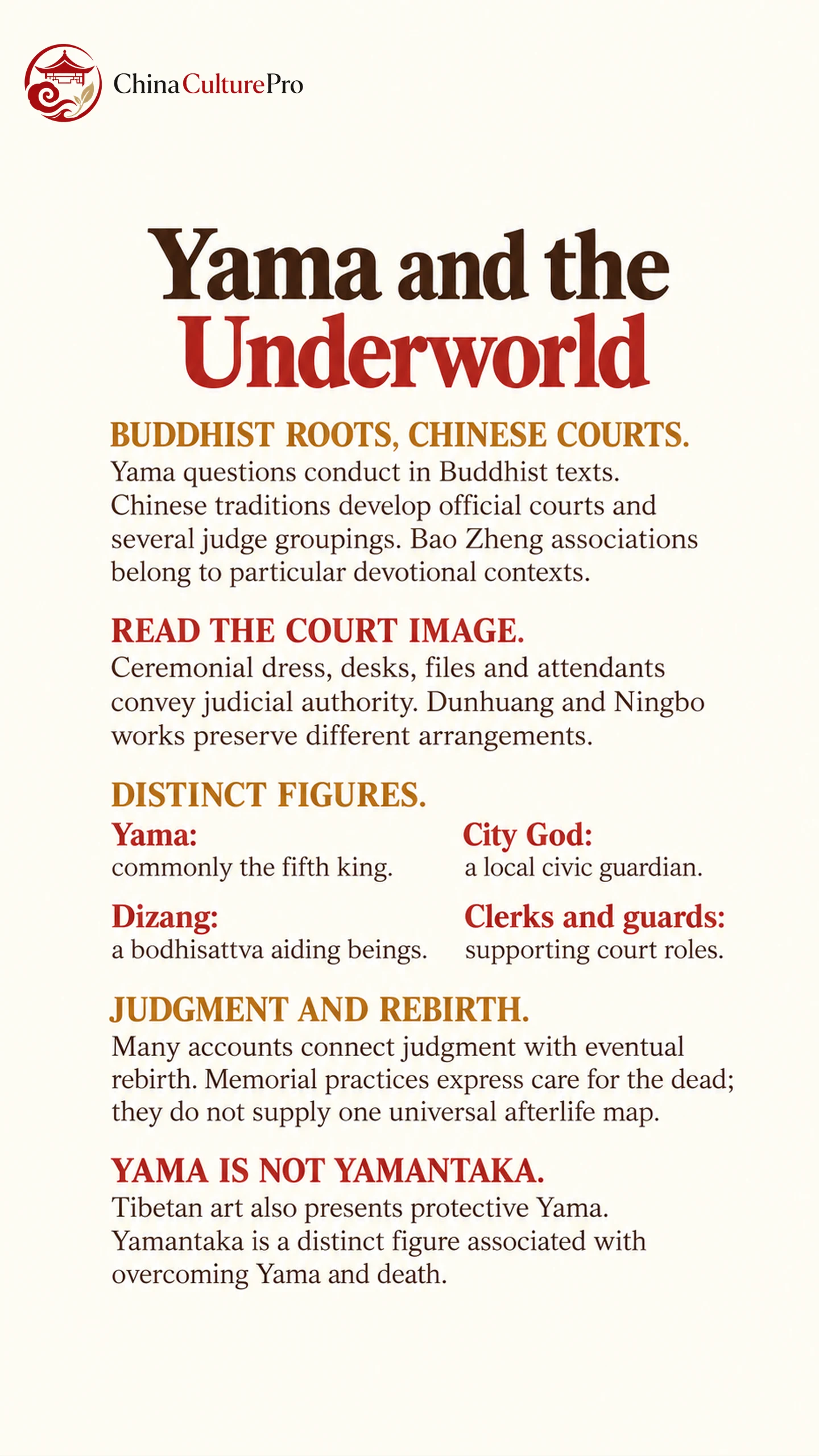
A stern official at a desk can represent judgment after death. To read such an image, distinguish the judge from the surrounding clerks, the wider court system and the compassionate figures who may stand above or beside him.
Yama’s Buddhist Background and Chinese Names
Yama has an Indian Buddhist background; his Chinese name is a rendering of that transmitted divine name. Yan Wang is a shorter Chinese form. The same figure also appears in other Buddhist cultures, but names and visual conventions do not remain identical across regions. [2]
In the Buddhist Devaduta Sutta, Yama questions someone about the warnings encountered during life, including birth, aging, sickness and death. The repeated point is responsibility for one’s own actions, rather than blame assigned to parents or companions. This text supplies a moral setting for the judge without describing the entire later Chinese ten-court system. [1]
As the idea developed within Chinese Buddhism, it entered a world already familiar with officials, registers and territorial administration. A Buddhist judge could therefore be represented in the recognizable visual language of a Chinese magistrate. [2]
From a Judge to a Chinese Underworld Administration
Diyu(地狱,Dìyù), commonly translated as “hell,” encompasses several religious and popular ways of imagining punishment and rebirth. It should not be treated as a single geographical map accepted unchanged by every community. The Ten Kings form one especially influential judicial arrangement. [5]
Earlier Chinese materials also bring together Dizang(地藏菩萨,Dìzàng Púsà), the bodhisattva Ksitigarbha, and groups of three judges, including Yama and figures associated with Mount Tai and the paths of rebirth. This shows that the familiar ten-court system developed among other configurations, rather than arriving as one complete, permanently fixed chart. [2]
Later divine offices could acquire associations with respected human judges. Bao Zheng(包拯,Bāo Zhěng), the Song official remembered for impartial justice, is connected with afterlife judgment in some traditions. One probably late-nineteenth-century Shanghai-region statue has a base naming both him and Yanluo; other settings distinguish them. This is evidence of a particular devotional identification, not proof that Yama’s Buddhist identity began with Bao Zheng. [7]
Reading Yama’s Court in Art
A tenth-century painting from Dunhuang places the Ten Kings in two groups before a bodhisattva. Yama is recognizable there through his ceremonial headgear. The arrangement is evidence of a specific early image, rather than a requirement that every underworld picture give him that exact position or crown. [3]
A related painting presents the kings at individual desks, like officials hearing cases. The central bodhisattva and the judges occupy different visual positions. Read the relationship between central figure, court and record-keeping staff before identifying every impressive-looking person as “King Yama.” [4]
A thirteenth-century Chinese painting of King Yanluo by Lu Xinzhong belongs to a court series made in the Ningbo artistic world and preserved in Japan. Files, attendant officials and landscape screens make the court both recognizable and richly furnished. Its Chinese place of production matters even though its later collection history is Japanese. [6]
Yama, Dizang, City Gods and Court Attendants
Dizang, the bodhisattva Ksitigarbha, appears centrally in important Buddhist underworld images. He is distinct from the judges around him. Chenghuang(城隍,Chénghuáng), the City God, belongs to a local civic office that can be connected with the dead’s journey. [3][10]
The following roles help identify a scene. The complete Ten Kings of Hell tradition has its own collective imagery; it should not be reduced to ten identical portraits of one ruler. [4][6]
| Figure or role | Distinction in the image or tradition |
|---|---|
| Yama / Yanluo Wang | An underworld judge; commonly the fifth king within the ten-court arrangement. [3] |
| Dizang / Ksitigarbha | A bodhisattva associated with aid to beings in the underworld, depicted separately from the kings. [2][3] |
| City God | A local civic guardian connected with the spiritual affairs of a particular district. [10] |
| Court attendants and clerks | Supporting figures who carry records or enforce court business; they are not all kings. [6] |
Judgment, Rebirth and Care for the Dead
Chinese underworld imagery often connects consequences after death with eventual rebirth. Punishment is not necessarily an everlasting final destination for an unchanging soul. This is why the English word “hell” can mislead if it imports a different religion’s complete account of the afterlife. [5]
Mourning, offerings and Buddhist ritual care give the imagery a living social purpose: descendants seek help for the deceased, while moral stories address the conduct of the living. In popular accounts, Meng Po(孟婆,Mèng Pó)offers a drink of forgetfulness before rebirth. The narrative belongs to popular accounts of the transition to another life. [5]
These traditions interact within religion in China. A temple image, a Buddhist scripture and a family’s memorial custom can share themes without supplying one identical set of rules.
Tibetan Protective Images and the Yamantaka Distinction
Yama also appears in Tibetan Buddhist protective imagery. A painting from eastern Tibet dated around 1675–1725 presents him in a fierce, buffalo-headed form with Yami. Its catalogue identifies this as a protector role, a different context from a Chinese magistrate seated behind a desk. [8]
Yamantaka is not simply another spelling of Yama. The name means “Destroyer of Yama,” and the figure is associated with Manjushri’s conquest of death. An early-eighteenth-century Tibetan painting represents that distinct protective theme. Fierce appearance, buffalo associations or flames alone are therefore insufficient for identification: the complete iconographic setting and title matter. [9]
FAQs About Yama and Chinese Underworld Judges
Is Yama an Evil Deity?
His judicial role is not the same as being a source of evil. Buddhist texts use his questioning to emphasize responsibility for actions; Tibetan traditions also give him protective roles. [1][8]
Is Yama One of the Ten Kings of Hell?
In an important Chinese arrangement, Yama is the fifth king. Other accounts use his name more broadly for underworld authority, so read the particular text or image. [3][6]
Is Chinese Hell an Eternal Destination?
Many Chinese Buddhist and popular accounts connect underworld judgment with eventual rebirth. The imagery does not simply reproduce a model of permanent punishment for an unchanged soul. [5]
Is Yamantaka Another Name for Yama?
No. Yamantaka is a distinct figure associated with overcoming Yama and death. Similar fierce imagery does not make the names interchangeable. [9]
Sources
[1] Dhammatalks.org, translation by Thanissaro Bhikkhu. Devaduta Sutta, Majjhima Nikaya 130: Yama and moral responsibility
[2] Religions, original research article. Dizang and the Three Kings: Constructing Buddhist Hell by Imitating the Bureaucratic System in the Tang Dynasty, 2022
[3] British Museum. Dunhuang painting of Ksitigarbha and the Ten Kings, 1919,0101,0.9
[4] British Museum. Ksitigarbha with the Ten Kings at their desks, 1919,0101,0.23
[5] Asia for Educators, Columbia University. The Ten Magistrates of the Underworld Realm
[6] Nara National Museum, National Institutes for Cultural Heritage e-Museum. Lu Xinzhong, King Yanluo, thirteenth-century Chinese painting
[7] Brighton and Hove Museums. Decolonising the Sacred: identifying Yanluo and Bao Zheng, WA505695
[8] Los Angeles County Museum of Art. Yama and Yami, circa 1675–1725, M.71.78
[9] The Metropolitan Museum of Art. Yamantaka, Destroyer of the God of Death, early eighteenth century, 69.71
[10] Asia for Educators, Columbia University. The City God and the earthly domain