
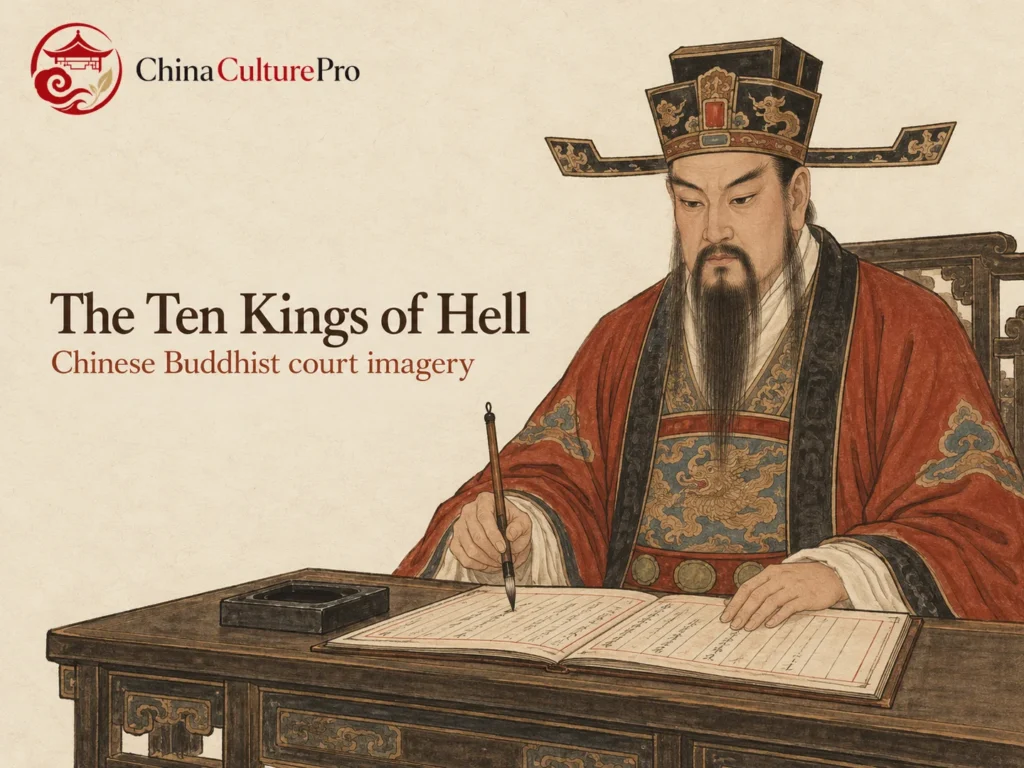

Quick Answer: Who Are the Ten Kings of Hell?
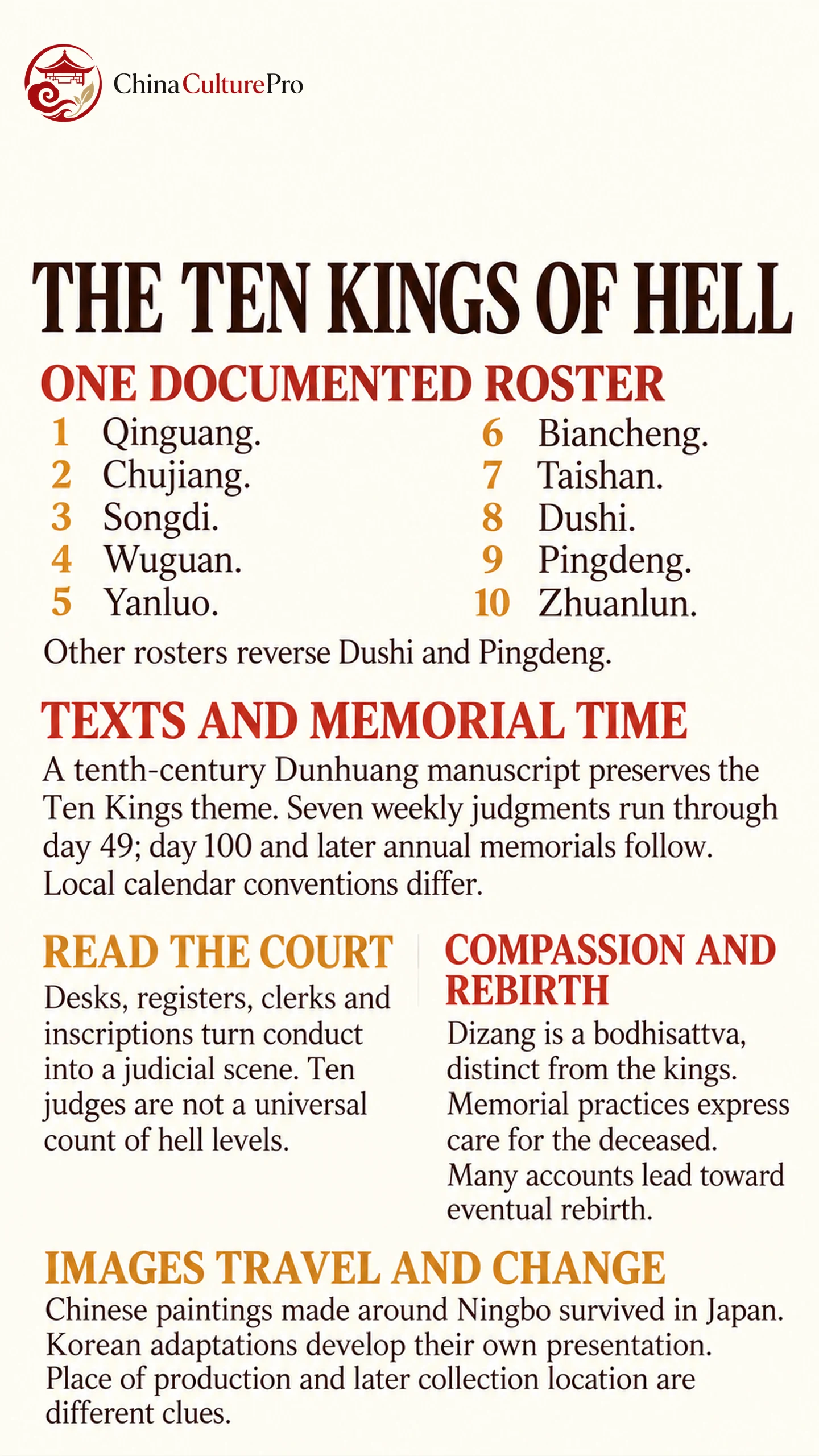
The Ten Kings(十王,Shí Wáng)are judges of the dead in an influential Chinese Buddhist underworld tradition. They appear as officials hearing cases before rebirth. Yanluo Wang(阎罗王,Yánluó Wáng), the Chinese Yama, is commonly the fifth king within this arrangement. [1][4]
- Group: Ten separate courts make moral judgment visible as an administration. [7]
- Time: The sequence is linked with seven weekly observances and later memorial occasions. [4]
- Images: Judges sit at desks with clerks, registers and attendants. [5]
- Purpose: Paintings address moral consequences and care for the deceased, alongside the prospect of rebirth. [6][7]
Names, court order and ritual details vary. Ten judges should not be confused with a universally fixed count of hells, punishment levels or ceremonies performed by every family.
A row of crowned officials can look like an imperial audience. In Ten Kings imagery, however, the cases concern actions during life and the journey after death. The names, sequence and surrounding figures reveal how a judicial picture also became part of mourning and religious care.
The Ten Kings: Names and Changing Court Orders
The following order follows one documented Chinese popular roster. It is a reference for comparison, not a claim that every Buddhist text, temple or painting uses identical names and positions. [1]
Another recorded painting tradition places Pingdeng Wang(平等王,Píngděng Wáng)in the eighth court and Dushi Wang(都市王,Dūshì Wáng)in the ninth, reversing their positions here. It also writes the sixth king’s name with 變成, a variant of the 卞城 form shown below. Such differences make the actual inscription more reliable than a single modern diagram. [2]
| King | Court and recorded variation |
|---|---|
| Qinguang Wang(秦广王,Qínguǎng Wáng) | First court |
| Chujiang Wang(楚江王,Chǔjiāng Wáng) | Second court |
| Songdi Wang(宋帝王,Sòngdì Wáng) | Third court |
| Wuguan Wang(五官王,Wǔguān Wáng) | Fourth court; 五 and 伍 occur in records |
| Yanluo Wang | Fifth court; Yama |
| Biancheng Wang(卞城王,Biànchéng Wáng) | Sixth court; 變成 is another recorded written form |
| Taishan Wang(泰山王,Tàishān Wáng) | Seventh court; 太山 also occurs |
| Dushi Wang | Eighth in this roster; ninth in another documented sequence |
| Pingdeng Wang | Ninth here; eighth in another documented sequence |
| Zhuanlun Wang(转轮王,Zhuǎnlún Wáng) | Tenth court; also given a longer title referring to the five paths |
How the Ten-Court Tradition Developed
The ten-court system combines Buddhist judgment and rebirth with the visual and administrative language of Chinese officials. Its development is associated with the later Tang period, while surviving documents provide more precise evidence for particular formulations. [4]
An illustrated Chinese manuscript of the Sutra of the Ten Kings from Dunhuang is dated to the tenth century. It describes stages encountered after death. The catalogue identifies it as an apocryphal Chinese sutra, a category that distinguishes its textual background without dismissing its religious significance. [3]
The tradition later supplied subjects for sets of hanging scrolls. Paintings from the Mingzhou studio of Jin Chushi were made before 1195, the year the city’s name changed. This inscription-based dating gives a firmer historical anchor than a legend assigning all ten courts to one human founder. [4]
The individual background of Yama and related judges helps explain his prominence within the collective system.
Seven Weeks and Later Memorial Observances
A prominent account links the first seven kings with weekly judgments during the first seven weeks after death. Seven times seven gives forty-nine days. The eighth judgment is associated with the hundredth day, followed by later annual memorial occasions. [4][5]
Calendar descriptions need care. One catalogue describes the ninth judgment after a year and the tenth in the third year; another describes the last occasion at the end of the second year. Year-counting language and ritual conventions should be checked in the particular tradition rather than converted automatically into one anniversary date. [4][5]
The images thus connect a religious account of the dead’s journey with times when descendants remember and assist them. They do not establish that every family must commission ten ceremonies or that all Chinese funerals follow one schedule. Sets of scrolls could be displayed during extended funeral observances. [6]
How to Read a Ten Kings Painting
Start with the judge’s desk, formal dress and surrounding staff. Registers and scribes make the scene an examination of conduct. Attendants can summon, record or enforce; they should not all be counted as additional kings. In a thirteenth-century series by Lu Xinzhong, landscape-painted screens give the official interiors further visual depth. [5]
Next look for inscriptions linking depicted actions with their consequences. Later scrolls use familiar social wrongdoing, including dishonest trade or failures of filial conduct, to make moral arguments recognizable to their viewers. These are didactic images, not neutral illustrations of a demonstrated place. [6]
A fourth-court painting preserved in Taiwan pairs the tribunal with explanatory writing and scenes of conduct and judgment. It shows why the smaller inscriptions and attendant groups matter alongside the central official. The imagery can connect everyday morality with the larger narrative of accountability. [2]
Some City God temple settings also incorporate underworld scenes. A shared judicial appearance does not make the local civic guardian interchangeable with each of the ten judges. [1]
Dizang, Merit and the Possibility of Rebirth
Dizang(地藏菩萨,Dìzàng Púsà), the bodhisattva Ksitigarbha, belongs to the compassionate side of this religious landscape. In important arrangements he is distinguished from the kings who hear cases. Calling him simply “an eleventh judge” loses that difference. [2]
Funerary offerings and other acts undertaken for the deceased express care and the hope of assistance. The court system therefore operates within a setting that includes family responsibility, moral conduct and religious aid, rather than punishment alone. [7]
Many accounts treat the underworld as a transitional domain before rebirth. Its English translation as “hell” should not automatically import the idea of unending punishment for a permanently unchanged soul. Within Chinese Buddhism, judgment belongs to a wider discussion of consequences, compassion and release. [7]
Chinese Images and Their East Asian Adaptations
Chinese Ten Kings paintings circulated through maritime connections. Works made around Ningbo reached Japan, where a number survived in religious collections. Lu Xinzhong’s thirteenth-century series is Chinese in origin even though it is now preserved in Nara. Production history and later location answer different questions. [5]
The subject also developed in Korea. A Korean painting dated 1798 presents the tenth king with attendants and imagery of rebirth. Its warrior-like presentation demonstrates that East Asian adaptations need not repeat the appearance of a Song Chinese magistrate exactly. [8]
The tradition’s wider presence is part of the history of religion in China and its cultural connections. Identify each work through its language, date, place of production and ritual setting before assuming it represents a universal Chinese afterlife chart.
FAQs About the Ten Kings of Hell
Is Yama the Only King of Hell?
Within the ten-court arrangement, he is one of the judges and commonly occupies the fifth court. His prominence does not erase the other nine offices. [1]
Are the Ten Kings the Same as Eighteen Levels of Hell?
No. One counts judges or courts; the other describes a different arrangement of punishments or domains. Religious accounts do not all use one numerical map. [7]
Is Dizang One of the Ten Kings?
He is a bodhisattva associated with aid to beings in the underworld, distinct from the group of judges in important representations. Read the specific image’s arrangement. [2]
Do These Images Describe Eternal Punishment?
Many Chinese Buddhist and popular accounts connect the courts with eventual rebirth. Their moral warnings should not automatically be read through a model of permanent, unending damnation. [7]
Sources
[1] Taiwan Historica. Taiwan Folk Cultural Objects Dictionary: Yanluo Wang and the ten courts
[2] Taiwan Historica, National Cultural Memory Bank. Ten Kings painting: fourth court and variant roster
[3] British Library, International Dunhuang Programme. Illustrated Sutra of the Ten Kings, Or.8210/S.3961, tenth century
[4] The Metropolitan Museum of Art. Jin Chushi, Ten Kings of Hell, before 1195, 30.76.290
[5] Nara National Museum, e-Museum. Lu Xinzhong, King Yanluo and the Ten Kings series, thirteenth century
[6] Reed College, K. E. Brashier. Taizong’s Hell: a study collection of Chinese hell scrolls
[7] Columbia University, Asia for Educators. The Ten Magistrates of the Underworld Realm
[8] The Metropolitan Museum of Art. The Tenth King of Hell, Korea, 1798: object and restitution record