
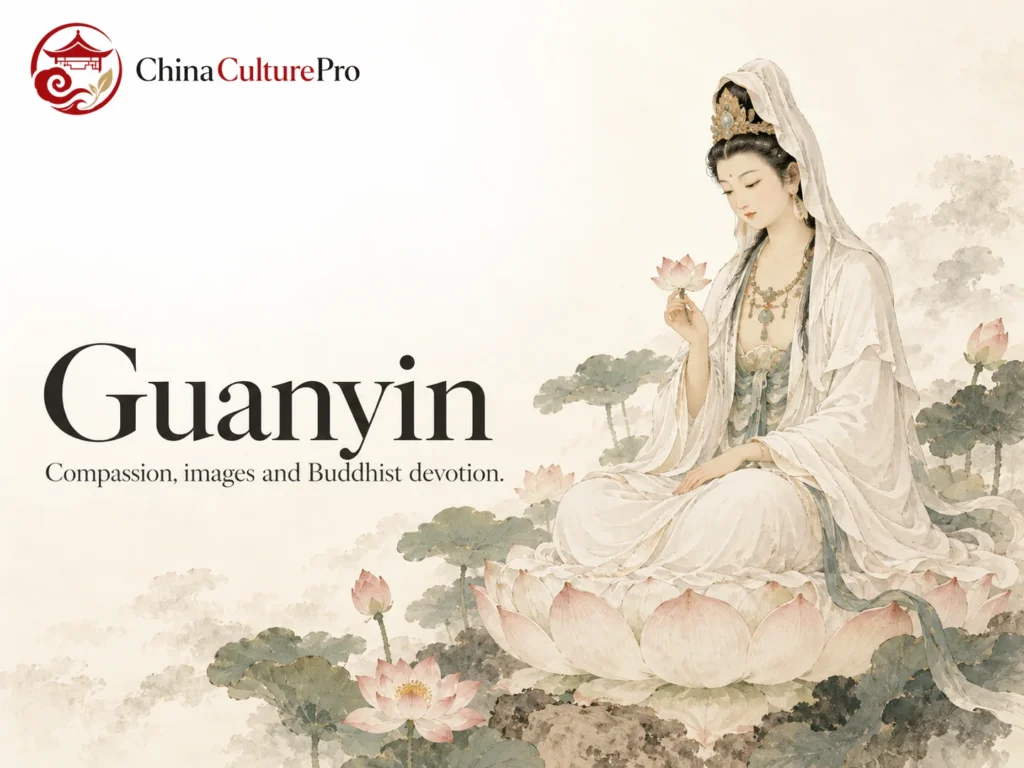

Quick Answer: Who Is Guanyin?
Guanyin(观音,Guānyīn)is the Chinese Buddhist bodhisattva associated with compassion, known in Sanskrit as Avalokiteshvara. Devotees turn to this figure with hopes of relief from suffering. Guanyin also appears in local religious traditions beyond formally Buddhist settings.
- Identity: A bodhisattva whose religious significance centers on helping beings.
- Images: Representations vary in posture, clothing, attributes and gender appearance.
- Devotion: Scriptures, temples, household practices and regional legends contribute different meanings.
The familiar English title “Goddess of Mercy” describes an important popular image, but does not fully explain the figure’s Buddhist identity or the variety of surviving art.
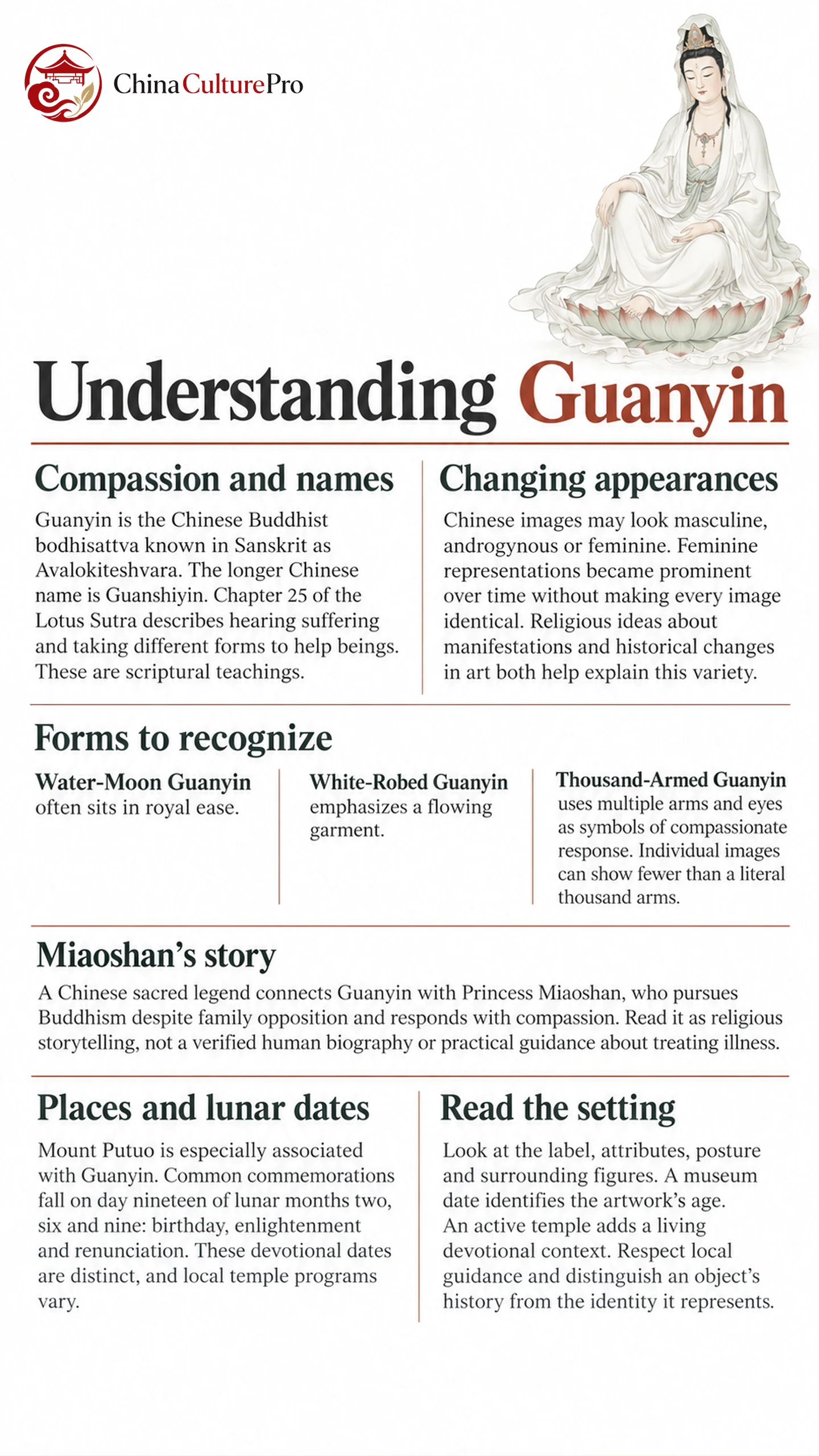
A white robe, a relaxed seated pose or a fan of arms can all belong to an image of Guanyin. These differences are useful clues rather than contradictions. This introduction connects Chinese Buddhism with the figure’s names, visual forms and devotional settings, keeping sacred stories distinct from historical evidence.
Names, Compassion and the Lotus Sutra
Guanshiyin(观世音,Guānshìyīn)is the longer Chinese name behind Guanyin. It is commonly understood in relation to perceiving the world’s sounds, especially the cries of suffering beings. Avalokiteshvara is the corresponding Sanskrit name used in Buddhist art and scholarship. In this context, a museum label using Avalokiteshvara identifies the same bodhisattva, although representations across Buddhist cultures differ.[1]
Chapter 25 of the Lotus Sutra explains this compassionate responsiveness through stories of beings calling upon the bodhisattva amid danger. It also describes taking different forms to teach those who need help.[2] These are scriptural teachings and devotional assurances, not evidence that recitation guarantees rescue from a particular emergency.
Compassion here involves responding to others, rather than merely having a gentle appearance. Understanding that emphasis gives the many images a shared religious focus without requiring every community to tell exactly the same stories.
Why Guanyin Images Can Look Male or Female
Surviving representations do not support a single timeless appearance. Some show princely ornaments and masculine features; others appear androgynous or feminine. Feminine representations became increasingly prominent in Chinese art, while masculine and androgynous forms also remained part of the visual tradition. The Asian Art Museum traces this changing visual language rather than treating every image as a portrait of one human woman.[3]
The Buddhist teaching that a bodhisattva can assume different forms helps explain the religious flexibility of such representations. Historical changes in artistic conventions are another part of the explanation. Neither point requires a story in which one identifiable person physically changed sex at a documented moment.
Pronouns in translations and museum labels may therefore differ. Use the particular image’s context, while keeping the broader distinction between an artistic representation and the bodhisattva’s religious identity in view.
Recognizing Different Forms of Guanyin
Form names draw attention to a pose, garment or symbolic capacity. They do not normally mean separate, unrelated deities.
| Form | Useful visual clue | Interpretive caution |
|---|---|---|
| Water-Moon Guanyin(水月观音,Shuǐyuè Guānyīn) | Often seated in relaxed “royal ease,” associated with contemplation and a waterside setting. | A pose and devotional theme, rather than a historical sitting recorded from life. |
| White-Robed Guanyin(白衣观音,Báiyī Guānyīn) | A flowing robe and often a feminine appearance. | Religious associations vary; a white robe alone does not establish every detail of an image’s meaning. |
| Thousand-Armed Guanyin(千手观音,Qiānshǒu Guānyīn) | Multiple arms, sometimes with eyes in the hands and symbolic objects. | Representations may show fewer than a literal thousand arms. |
The Asian Art Museum’s Song wooden sculpture provides an example of the Water-Moon form. A Qing lacquer sculpture at the Smithsonian exemplifies the White-Robed form and its devotional associations.[4] Another Smithsonian work represents multiple arms and eyes as ways of perceiving suffering and extending help; that particular image has twenty-two pairs of arms.[5]
An iconographic name describes a tradition; an individual object gives it a particular visible form. They also show why identifying Chinese gods and goddesses requires more than counting limbs or recognizing one costume.
Miaoshan: A Chinese Sacred Legend
Miaoshan(妙善,Miàoshàn)is a princess associated with Guanyin in a Chinese sacred legend. In the account discussed by Taiwan’s National Museum of Taiwan History, she pursues Buddhism despite her father’s demand that she marry. The conflict eventually turns toward an extraordinary act of compassion for the father who opposed her.[6]
In this telling, the story explores religious commitment, family authority and mercy extending even to a hostile person. It can be read alongside filial piety, while recognizing that its family conflict has a specifically sacred resolution. It is not a verified biography establishing that all Guanyin traditions began with one historical princess. Nor is its miraculous treatment of illness practical guidance for readers.
Worship, Sacred Places and Lunar Observances
Devotion extends across different settings. Taiwan’s museum account describes both public temples and household images, as well as traditions in which Buddhist and local religious practices overlap. This helps explain Guanyin’s presence in Chinese folk religion without erasing the figure’s Buddhist background.
Mount Putuo(普陀,Pǔtuó), in Zhejiang’s Zhoushan islands, is especially associated with Guanyin as a Buddhist sacred place.[7] Its significance is devotional geography; it is not proof that a legendary life unfolded there exactly as narrated.
The Hong Kong Buddhist Association’s lunar calendar lists three commemorations: the nineteenth day of the second month for the birthday, the nineteenth of the sixth for enlightenment, and the nineteenth of the ninth for renunciation.[8] These are religious observances, not a verified human chronology. Gregorian dates change, and particular temples decide their own programs.
Reading Guanyin in a Temple or Museum
Begin with the label or inscription, then consider posture, attributes, surrounding figures and the object’s setting. A museum date refers to the sculpture or painting. A sacred name refers to the figure represented. This distinction prevents a Song artwork from being mistaken for evidence that worship began in that period.
In an active temple, the image is also an object of devotion. The Hong Kong Buddhist Association explains reverence for Buddhist images through remembering compassion and helping others. Visitors can respect that meaning without adopting a prescribed ritual. Follow local guidance about photography and access, and consult Chinese temple etiquette for the broader context.
FAQs About Guanyin
Is Guanyin a Buddha or a goddess?
Guanyin is principally identified as a bodhisattva in Chinese Buddhism. “Goddess of Mercy” is a familiar popular English title with a narrower emphasis.
Are Guanyin and Avalokiteshvara the same figure?
Yes. The names belong to Chinese and Sanskrit Buddhist contexts, with varied local images and traditions.
Does every Guanyin image have a thousand arms?
No. Multiple arms characterize particular forms, and even those images may use a smaller representative number.
When is Guanyin’s birthday?
It is commonly commemorated on the nineteenth day of the second lunar month. This is distinct from the enlightenment and renunciation observances.
Sources
[1] University of Michigan Museum of Art. Guanyin
[2] Tsugunari Kubo and Akira Yuyama, translators, BDK. The Lotus Sutra, Chapter 25
[3] Asian Art Museum. The Bodhisattva Avalokiteshvara, Guanyin
[4] Smithsonian National Museum of Asian Art. Guanyin Standing on Waves
[5] Smithsonian National Museum of Asian Art. Thousand-Armed Thousand-Eyed Bodhisattva Avalokiteshvara
[6] National Museum of Taiwan History. Guanyin Belief in Taiwan
[7] Information Office of Zhoushan Municipal People’s Government. Putuo Mountain
[8] Hong Kong Buddhist Association. Frequently Asked Questions and Lunar Observance Calendar