
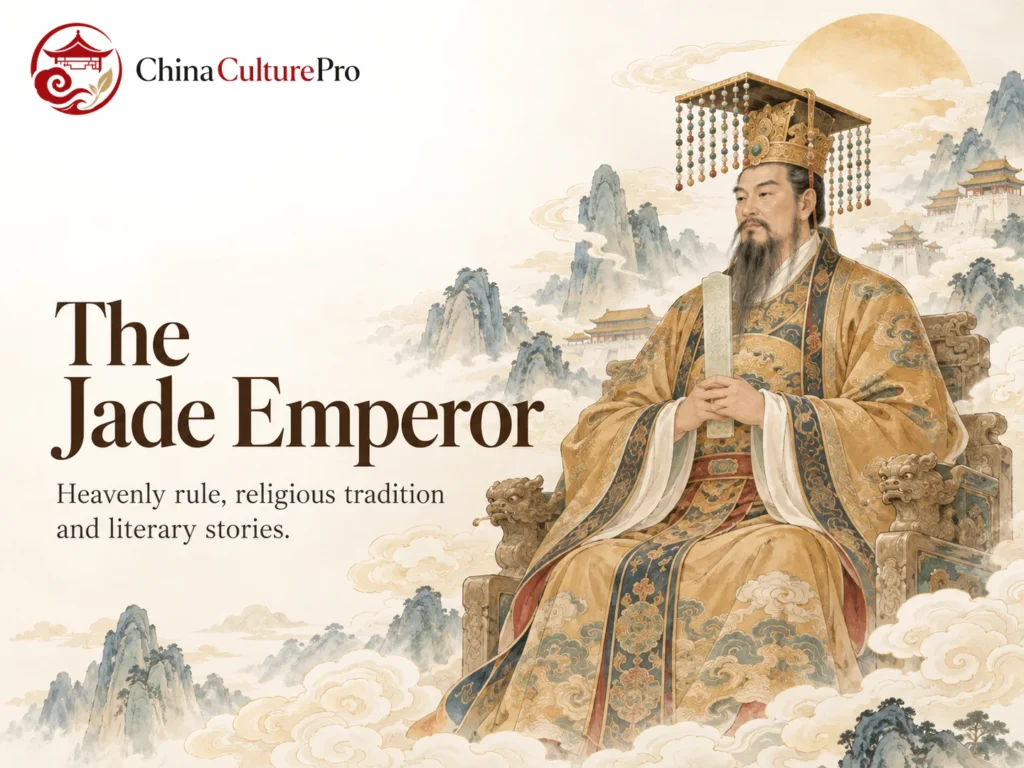

Quick Answer: Who Is the Jade Emperor?
The Jade Emperor, Yuhuang(玉皇,Yùhuáng), is a major deity associated with the government of Heaven in Chinese religion. He appears in Daoist worship, local religious traditions and popular storytelling, though these settings give him different emphases.
- Main role: A celestial sovereign who presides over divine affairs.
- Religious context: Prominent in Daoism and popular religion, without representing every Chinese person’s beliefs.
- Storytelling role: An imperial figure in tales about the heavenly court.
Calling him “the Chinese god” hides this variety. His position within a particular tradition matters more than a single ranking applied to all Chinese religion.

A celestial ruler receives reports, issues commands and holds court: this is the image many readers recognize. Yet a temple image and a scene from a fantasy novel ask to be read differently. This guide places the Jade Emperor within the wider world of Chinese gods and goddesses, distinguishing religious authority, sacred narrative and literary invention.
Names and the Imperial Image
Yuhuang Dadi(玉皇大帝,Yùhuáng Dàdì)is commonly translated as “Great Jade Emperor”; Yudi(玉帝,Yùdì)is another shortened name. Longer honorifics occur in religious texts, so different titles need not indicate separate beings.
The imperial language also has a visual counterpart. A seventeenth- to eighteenth-century hanging scroll cataloged by Princeton University Art Museum depicts the Jade Emperor in his celestial palace with attendants. The palace-and-attendants subject suggests the ruler’s courtly authority; the museum dates the artwork, not the deity’s life.[1] Read such an image through its setting, inscription and catalog identification; a richly dressed ruler alone is insufficient to identify a deity securely.
The Heavenly Court and Its Responsibilities
The heavenly bureaucracy offers one influential way of imagining divine order. In this model, the emperor presides over officials with different responsibilities, while local and household gods keep accounts of human conduct. The City God belongs to this administrative picture, linking a locality to a wider celestial government.[2]
Reports, audiences and official ranks explain heavenly authority through familiar institutions. They also explain why some temple halls resemble formal court settings. Nevertheless, this model has limits: scholars question the assumption that every important deity is best understood as an official. Devotion may also center on compassion, kinship, protection or a particular place. The administrative image illuminates part of Chinese folk religion; it does not supply a universal organizational chart.
Is the Jade Emperor the Highest Daoist Deity?
Ruling the heavenly court does not necessarily mean holding ultimate theological precedence. In a widely used Daoist arrangement, the Three Pure Ones(三清,Sānqīng)stand above the Jade Emperor. The Hong Kong Daoist Association describes him as a cosmic ruler acting under their authority.[3]
| Figure or group | Principal distinction | How to read the relationship |
|---|---|---|
| Jade Emperor | Celestial government and administrative sovereignty. | A ruler within the sacred order, rather than its sole definition. |
| Three Pure Ones | Highest divine precedence in the Daoist arrangement described here. | Their status concerns the foundations of that order, not a competing imperial office. |
This distinction helps with religious Daoism, but it should not be extended into a ranking of all Buddhist, Daoist and local figures. A worshipper’s most important deity may also differ from the one assigned the highest formal rank.
Historical Growth and the Sacred Life Story
The historical record concerns the development of a cult, while the sacred life story explains the deity through religious narrative. Song emperors granted elaborate titles that increased the Jade Emperor’s public prestige. Such records concern the historical promotion of worship, rather than a documented moment when a deity first came into existence.
A different kind of account appears in his sacred life story. The Daoist Culture Centre recounts a scripture in which a compassionate prince relinquishes royal power and pursues cultivation over immense spans before attaining his divine position.[4] This narrative explains religious ideals through generosity, renunciation and spiritual achievement. Its extraordinary chronology belongs to sacred storytelling, and different retellings need not agree on every detail. It is not evidence for a human ruler’s birth date, reign or verifiable age.
Birthday Observances and Regional Devotion
The ninth day of the first lunar month is widely observed as the Jade Emperor’s birthday. The Daoist Culture Centre also records the name Tiangong(天公,Tiāngōng), used in Fujian and Taiwan devotional settings. Neither the date nor the title should be converted into a claim that every household follows identical customs.
Singapore’s Thian Hock Keng provides a concrete example: its own account of a 2019 celebration mentions offerings and stage performances associated with the observance.[5] That report documents a particular community’s practice; it is not a schedule for every temple or a set of required actions for visitors. Follow a temple’s own guidance and the local expectations explained in Chinese temple etiquette.
The Jade Emperor in Journey to the West
In Journey to the West, the heavenly court becomes a dramatic setting for rebellion and negotiation. Chapter 7 has the Jade Emperor send for the Buddha when Sun Wukong(孙悟空,Sūn Wùkōng)cannot be subdued by the surrounding heavenly forces. The Buddha ultimately restrains the monkey beneath a mountain, and the emperor hosts a celebration afterward.[6]
The episode preserves the emperor’s office while another figure resolves the crisis. It should not be treated as a test establishing one religious tradition’s superiority. Nor does every scene familiar from television belong to the novel. Reading the Monkey King in context makes room for literary humor and conflict without turning fictional events into doctrine.
FAQs About the Jade Emperor
Is the Jade Emperor a creator god?
He is usually introduced through celestial rulership. Describing him simply as the sole creator of everything imposes a uniform theology that these traditions do not share.
Is the Jade Emperor the same as the Buddha?
No. They are distinct figures. Literature may place them in the same story, while their religious meanings come from different contexts.
When is the Jade Emperor’s birthday?
It is commonly observed on the ninth day of the first lunar month. Its Gregorian date changes each year, and local celebrations vary.
Sources
[1] Princeton University Art Museum. The Jade Emperor in His Celestial Palace with Attendants
[2] Columbia University, Asia for Educators. The Jade Emperor and the Heavenly Domain
[3] Hong Kong Daoist Association. Jade Emperor
[4] Fung Ying Seen Koon Daoist Culture Centre. The Great Jade Emperor
[5] Thian Hock Keng. Birthday of Jade Emperor
[6] Wu Cheng’en, Wikisource transcription. Journey to the West, Chapter 7