
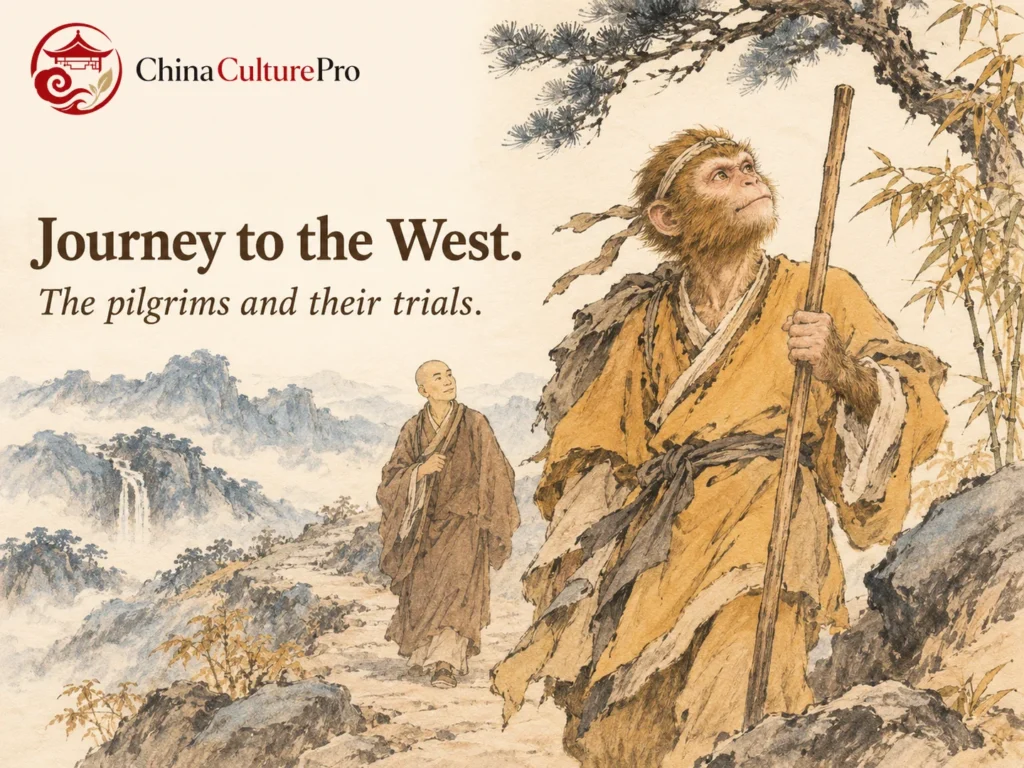

Quick Answer: What Is Journey to the West?
*Journey to the West*(西游记,Xīyóujì) is a Chinese novel about a pilgrimage to obtain Buddhist scriptures. The monk Xuanzang(玄奘,Xuánzàng) travels with disciples including Sun Wukong(孙悟空,Sūn Wùkōng), the Monkey King. Their encounters with demons, gods and rulers combine adventure with comedy and religious reflection.
The novel draws on the historical journey of a Tang monk and on stories told about him afterward. Its opening chapters give Monkey a history of his own before he joins the pilgrimage. For a first reading, follow how his talent for defying authority becomes both a help and a problem on the road.

The Monkey King is already a troublemaker before the monk sets out. That early rebellion matters because it gives the pilgrimage a question that runs through the book. How does a character who refuses to be controlled learn to travel with and protect others?
The Historical Journey and the Ming Novel
The historical Xuanzang traveled from China to India during the Tang and returned with Buddhist texts in the seventh century. His work included translating scriptures after his return. The story of his journey accumulated legendary material in storytelling and theatre. The novel turns the traveler into the center of a fantastic expedition, with supernatural companions and dangers. [1]
The familiar Ming novel has a hundred chapters and is traditionally attributed to Wu Cheng’en. Its story draws on earlier versions and traditions. The book places its fictional monk, often called Tripitaka in English, within a journey inspired by the real one. The novel belongs to the classical Chinese novel tradition and gives its pilgrims a world of supernatural trials. [2]
The Pilgrims and Their Roles
The companions have different strengths and failings. Their relationship changes depending on the obstacle they face. The dragon horse also accompanies them, carrying the monk on the journey. [2]
| Character | Place in the group | What to notice |
|---|---|---|
| Xuanzang, also called Tripitaka | The monk seeking the scriptures | His commitment keeps the journey going, even when he misreads a danger. |
| Sun Wukong, the Monkey King | A powerful protector and a former rebel | His transformations and quick judgment help the group, and his impatience can cause disputes. |
| Zhu Bajie(猪八戒,Zhū Bājiè), often called Pigsy | A disciple with a strong appetite and an eye for comfort | His complaints and temptations give the story much of its comedy. |
| Sha Wujing(沙悟净,Shā Wùjìng), often called Sandy | A disciple who helps keep the group together | He plays a steadier supporting part when the others quarrel. |
Names vary across translations. Follow each character’s place in the group if a familiar nickname disappears in a different edition.
From Heaven’s Rebellion to the Road West
The early chapters follow Monkey from his emergence from stone through his challenge to Heaven and confinement under Five Elements Mountain. The pilgrimage begins after the book has established his powers and problems. When he joins the monk, his resourcefulness has a purpose beyond his own status. The road brings repeated tests of judgment, loyalty and cooperation. [2]
In chapter 27, the White Bone Demon uses human disguises. Monkey recognizes the threat, but the monk sees the attacks as violence against people and sends him away. The danger comes from what each character believes as well as from the demon. Elsewhere, Guanyin helps set the pilgrimage in motion and sometimes helps the travelers. The quest draws them toward the scriptures while the episodes test how they travel together. [2]
What the Adventures Ask of the Pilgrims
The novel can be read as adventure, religious allegory and satire. Monkey’s skill can save the others, and his confidence can cause a new problem. The monk’s resolve gives the journey direction. His trust in appearances can also put the group at risk. Those tensions keep a religious quest full of practical and comic dilemmas. [3]
The prose and verse can also change the pace. A poem may set a scene or mark a shift in tone. Court scenes, divine offices and disputes among the companions invite different kinds of reading. Rather than assign each figure one fixed meaning, follow how their actions and roles change over several episodes. [3]
How to Choose an English Edition
A complete translation gives you the hundred-chapter structure and a fuller view of how prose and poetry work together. Anthony C. Yu’s revised translation spans four volumes and includes explanatory material. Choose it if you want the sequence of episodes and the details surrounding them. [3]
An abridgment gives a shorter route through selected episodes. Yu’s *The Monkey and the Monk* is one example. Arthur Waley’s *Monkey* is also an abridgment. [1] Compare the translator’s name and edition before using a chapter number or looking for a scene. An abridgment introduces the travelers through a selection of their adventures. [4]
FAQs About Journey to the West
Was Xuanzang a real person?
Yes. The historical Tang monk traveled to India and brought Buddhist texts back to China. The novel develops a fictional pilgrimage around him.
Is Monkey the same as the complete Journey to the West?
Arthur Waley’s *Monkey* is an abridged English translation. Complete editions cover the full chapter sequence.
Who wrote Journey to the West?
The Ming novel is traditionally attributed to Wu Cheng’en. It draws on earlier stories and performance traditions.
Sources
[1] Columbia University, Expanding East Asian Studies. Buddhism and Journey to the West
[2] Chinese Wikisource. Journey to the West, Chinese Text
[3] University of Chicago Press. The Journey to the West, Revised Edition, Volume 1
[4] University of Chicago Press. The Monkey and the Monk, an Abridgment