


Quick Answer: What Is Romance of the Three Kingdoms?
*Romance of the Three Kingdoms*(三国演义,Sānguó Yǎnyì) is a historical novel traditionally attributed to Luo Guanzhong(罗贯中,Luó Guànzhōng). It follows the collapse of Han rule and the rival powers that become Wei, Shu and Wu. Alliances, family bonds and political rivalries shape its long story.
The book uses historical people and events, but gives them dialogue, scenes and patterns of loyalty that belong to the novel. Start by identifying the leading people and their alliances. Then separate the action in a scene from what a historical account can establish.
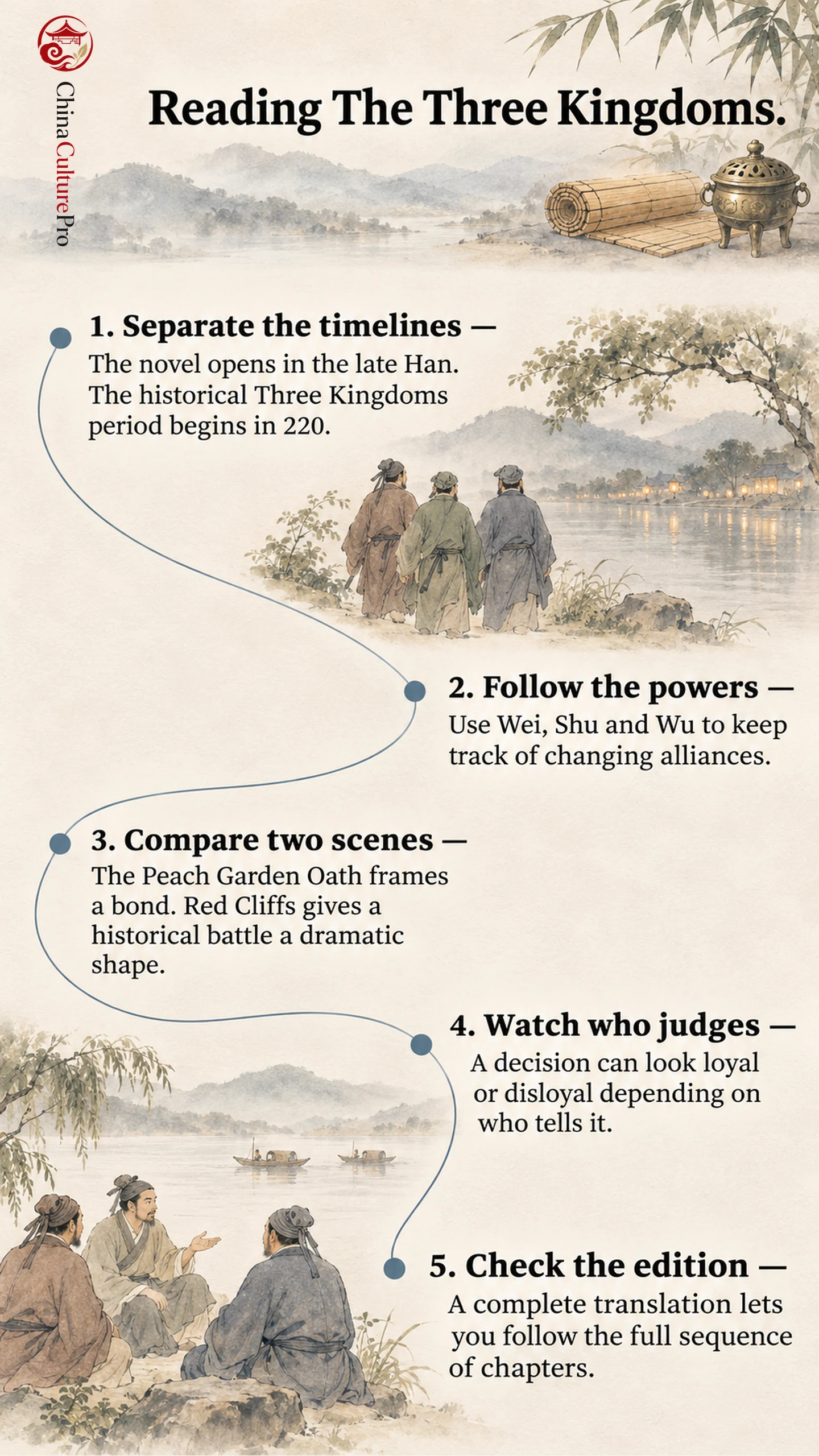
The novel begins before the three states exist as kingdoms. Its opening brings people together during a rebellion, then lets alliances form and break over generations. That wider time frame makes the title easier to understand.
Where the Novel Meets the Historical Period
The historical Three Kingdoms period is conventionally dated from 220, when the Han ended, to 280, when Western Jin reunited the realm. [1] The novel begins with the Yellow Turban uprising in the late Han and ends with Western Jin reunification. The literary story starts before 220. [2]
The familiar version has 120 chapters. It draws on historical writing and earlier narrative traditions, turning events into scenes and conversations. One useful comparison is between the novel’s treatment of a character and the shorter record of an event. The novel’s chapter titles give a reader a way to track the plot without treating every scene as a historical report. [2]
The Three Powers and Their Main Figures
Early in the story, the future rulers and commanders are still building their alliances. The names of the states help organize the later narrative. Use the groups to track relationships that change over the course of the story. [2]
| Power | Figures to follow | What to remember while reading |
|---|---|---|
| Wei | Cao Cao(曹操,Cáo Cāo) and his son Cao Pi | Cao Cao builds the power base. Cao Pi establishes Wei after the end of Han rule. |
| Shu, or Shu Han | Liu Bei(刘备,Liú Bèi), his allies and Zhuge Liang(诸葛亮,Zhūgě Liàng) | Liu Bei’s claim to Han continuity matters to the novel. Zhuge Liang becomes an important adviser and leader. |
| Wu | Sun Quan(孙权,Sūn Quán) and commanders such as Zhou Yu | Sun Quan’s lower Yangzi power can cooperate with or oppose other rivals as circumstances change. |
For names that recur, keep one note on the character’s connection to an alliance and another on what they are doing in the scene. A change of office or loyalty matters more than remembering every name at once.
From the Peach Garden to Red Cliffs
The first chapter brings Liu Bei, Guan Yu and Zhang Fei together in the Peach Garden Oath. The scene gives their bond a visible beginning and lets later acts of loyalty refer back to it. Read it as a scene that defines a relationship in the novel. The precise oath belongs to literary tradition. [2]
The Battle of Red Cliffs, fought around the end of 208, has a historical basis. Forces associated with Sun Quan and Liu Bei resisted Cao Cao on the Yangzi. The novel builds multiple chapters around the conflict, giving particular weight to plans, rival advisers and dramatic turns. The alliance’s resistance belongs to the historical account. The novel’s conversations and elaborated sequence give that conflict its particular literary form. [3]
How the Novel Shapes Loyalty and Strategy
A scene can make a decision look clever to one character and disloyal to another. The novel often draws readers toward Liu Bei’s side, and it also gives rivals plans and motives of their own. Follow who is making a judgment and what the narrator lets the reader see. That is more revealing than reducing each figure to a single virtue or fault. [2]
The characters also moved into other media. Guan Yu, Zhang Fei and Cao Cao are familiar examples in Peking opera face painting, and stories appear in oral performance. A stage scene or narrated episode can emphasize a different figure from the novel.
How to Read an English Edition
Moss Roberts’s complete English translation is published by the University of California Press. Use an edition’s description and contents to check whether it includes the full text. Notes and a map can help with places and offices that would be familiar to some of the novel’s earlier readers. [4]
Begin with the first chapter if you want to follow the relationships in order. For a scene from Red Cliffs, first identify the people and the alliance they are trying to maintain. Then see how the chapter gives the event dramatic shape. For historical comparison, look for Chen Shou’s *Records of the Three Kingdoms*(三国志,Sānguózhì), a third-century historical compilation organized around Wei, Shu and Wu. Its title resembles the novel’s, and it serves a different purpose. [5]
FAQs About Romance of the Three Kingdoms
Is Romance of the Three Kingdoms a true history?
It is a historical novel. It uses real periods, figures and conflicts while shaping them into scenes, dialogue and character arcs.
Who are the Three Kingdoms?
Wei, Shu Han and Wu are the three powers that give the period and novel their name.
Did the Peach Garden Oath really happen?
The novel dramatizes the bond among Liu Bei, Guan Yu and Zhang Fei in the oath. The scene should be read as literary tradition.
Sources
[1] Smithsonian National Museum of Asian Art. Period of Division
[2] Chinese Wikisource. Romance of the Three Kingdoms, Chinese Text
[3] Rafe de Crespigny. The Three Kingdoms and Western Jin, The Cambridge History of China
[4] University of California Press. Three Kingdoms, A Historical Novel, Complete and Unabridged
[5] Mark E. Byington. The Account of the Han in the Sanguozhi, Harvard Early Korea Project