


Quick Answer: Which Are China’s Four Great Classical Novels?
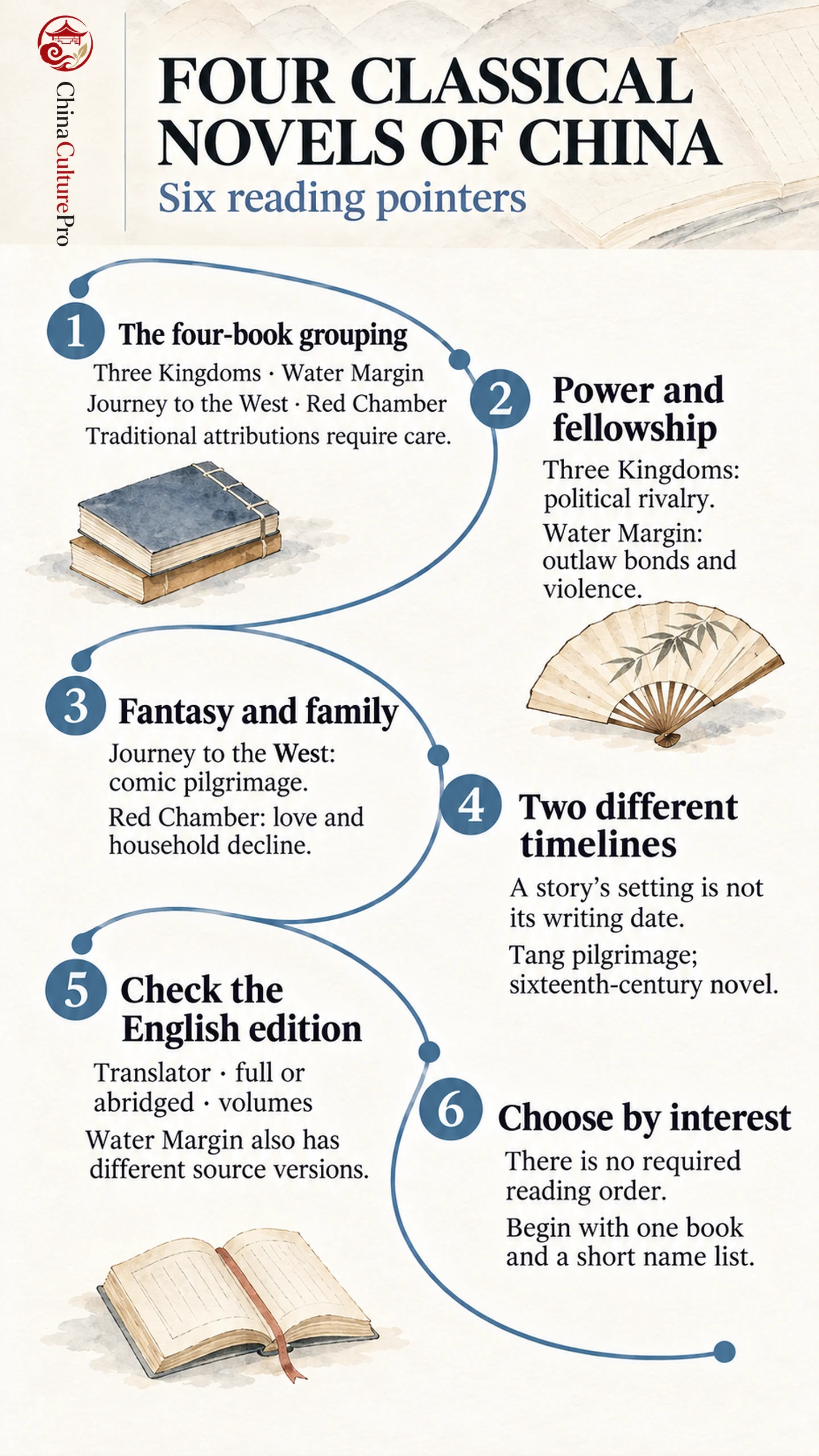
The Four Great Classical Novels (四大名著, sì dà míngzhù) are a familiar grouping of four major works of Chinese fiction, each offering a different kind of reading experience.[7]
- Romance of the Three Kingdoms (三国演义, Sānguó Yǎnyì): Rival states, military strategy and political loyalty.
- Water Margin (水浒传, Shuǐhǔ Zhuàn): Outlaw fellowship, injustice and the costs of violence.
- Journey to the West (西游记, Xīyóu Jì): A scripture-seeking pilgrimage filled with supernatural adventures.
- Dream of the Red Chamber (红楼梦, Hónglóu Mèng): Family decline, love and the pressures of an elite household.
Choose by the story you want to read. There is no required order, and an English book’s title alone does not tell you whether it contains the full novel.
A familiar name can hide an unfamiliar book. A game may introduce a strategist, a television series a rebellious monkey, or a film a tragic romance. The novels give those recognizable figures a larger world of competing obligations, narrators, poems and consequences. Within Chinese literature, these four works provide several entrances into long-form storytelling rather than a single style to master.
The Four Novels at a Glance
| Novel | Traditional author attribution | Main story setting |
|---|---|---|
| Romance of the Three Kingdoms | Luo Guanzhong | The late Eastern Han and subsequent struggle among rival states |
| Water Margin | Shi Nai’an, with Luo Guanzhong also associated with its textual tradition | The late Northern Song, centered on the outlaw community at Mount Liang |
| Journey to the West | Wu Cheng’en | A fantastic version of a Tang-era Buddhist pilgrimage |
| Dream of the Red Chamber | Cao Xueqin; the later completion has a separate textual history | The world of a wealthy household, with Qing social and material contexts |
These are conventional attributions, not equally secure modern authorship records. For Dream of the Red Chamber, distinguish the first 80 chapters associated with Cao Xueqin from the later 40 chapters in the familiar 120-chapter text; the authorship of that continuation is disputed.[1]
Four Stories, Four Kinds of Reading
Romance of the Three Kingdoms: Power and Allegiance
Romance of the Three Kingdoms follows the disintegration of imperial authority and the struggles through which rival powers emerge. Its pleasures include strategic reversals, negotiations, shifting alliances and competing ideas of legitimate rule. Military action matters, but a promise, appointment or failed judgment can change the political picture as decisively as a battle.[2]
Read it with a short character list and a map beside you. Ask what a decision reveals about a leader’s obligations, rather than treating every clever maneuver as timeless advice. For the distinction between the novel’s dramatic choices and the underlying period, the Three Kingdoms history provides a separate point of reference. Historical fiction can make a period vivid while reshaping its people and events.
Water Margin: Fellowship and Its Costs
Water Margin builds an outlaw community from people pushed into conflict with authority. Individual episodes gradually join the larger company associated with Mount Liang and its 108 heroes. Humor and feats of strength coexist with cruelty, coercion and destructive loyalties. Fellowship gives the characters a powerful bond, but it does not make every action admirable.[4]
This is a useful choice if you enjoy intersecting character stories and morally difficult action. Notice who gets recruited willingly, who is pressured, and whose suffering an episode treats lightly. The question of justice becomes more interesting when the community’s conduct is considered alongside the corrupt world it opposes. Expect violence; a reputation as a classic does not make an unabridged edition a children’s adventure.
Journey to the West: Pilgrimage and Comic Fantasy
Journey to the West transforms a Buddhist scripture quest into an expansive fantasy. A monk and supernatural companions face demons, temptations, misunderstandings and repeated tests of judgment. Comic quarrels sit beside religious ideas, satire and poetry. Its episodic adventures offer manageable stopping places even when the complete novel feels daunting.[3]
The opening and the later pilgrimage have different rhythms, so do not expect the traveling group to be assembled immediately. A guide to the pilgrims and other characters helps keep the cast clear. The historical monk Xuanzang belongs to a different kind of account: the novel’s monsters and magic are literary creations, not records of his travels.
Dream of the Red Chamber: Family and Inner Life
Dream of the Red Chamber, also translated as The Story of the Stone, follows the changing fortunes of the Jia family. Emotional attachments and young people’s hopes unfold within household hierarchy, marriage expectations, wealth and decline. Poetry, conversation and apparently small social interactions carry much of its force.[5]
Read this one if you want sustained attention to relationships and the gap between private feeling and public obligation. A family chart is more useful than trying to memorize every name on arrival. Notice changes in how characters speak to one another and what an exchange allows them to leave unsaid. Its fantasy framing also matters: reducing the novel to a love triangle loses part of its larger meditation on attachment.
Story Settings and Dates of Composition
Story time and writing time are different kinds of dates. These broad distinctions are more useful than assigning every novel one supposedly certain birthday.[1][2][3]
| Work | Relationship between setting and composition |
|---|---|
| Romance of the Three Kingdoms | Retells much earlier historical events; traditionally associated with late Yuan–early Ming authorship and developed through a larger storytelling tradition |
| Water Margin | Places its outlaws in the Song world; the novel circulated through later, differing textual versions |
| Journey to the West | Uses a Tang pilgrimage as the foundation for a sixteenth-century novel |
| Dream of the Red Chamber | An eighteenth-century Qing work whose later chapters raise distinct questions of completion and editing |
This separation changes interpretation. A battle scene can tell you about remembered history and the concerns of later storytelling at the same time. Likewise, a fictional household can illuminate social pressures without serving as a transparent record of every Qing family.
Choosing an English Translation
Check the translator, the words complete or abridged, and the number of volumes before choosing an edition. An abridgment can be a reasonable introduction; the problem is buying one while expecting the entire text.
- Romance of the Three Kingdoms: Moss Roberts translated a complete version and an abridged version. The 2020 edition titled Three Kingdoms: A Historical Novel is explicitly abridged. Match the edition description to your purpose rather than relying on the translator’s name alone.[2][6]
- Water Margin: John Dent-Young and Alex Dent-Young’s The Marshes of Mount Liang translates the 120-chapter version. Other English editions use other source versions, so the word complete needs to be read alongside the Chinese text being translated.[4]
- Journey to the West: Anthony C. Yu’s revised translation is a four-volume edition with updated notes and an introduction that addresses literary and religious contexts. It is a useful option when you want the poems and interpretive apparatus along with the narrative.[3]
- Dream of the Red Chamber: David Hawkes and John Minford’s translation is published as The Story of the Stone in five volumes. Check that you are selecting the beginning of the series, since a single volume is only part of the work.[8]
Sample a few pages if possible. The more useful choice is the edition whose prose, notes and physical format you can comfortably keep reading. Volume totals describe publishing arrangements, not a ranking of difficulty.
Where to Start and How to Keep Reading
For a first choice, use your existing interests: comic fantasy points toward Journey to the West; political narrative toward Romance of the Three Kingdoms; ensemble action toward Water Margin; and psychologically detailed family fiction toward Dream of the Red Chamber. These are starting suggestions, not a universal order of merit.
Begin with one novel. Keep a page of recurring names, read a few chapters at a sitting, and consult notes when a reference blocks understanding rather than interrupting every scene. If a screen adaptation brought you to the book, let it supply familiarity while remaining open to a different sequence, tone or emphasis.
For a shorter entry into the wider tradition, the beginner’s guide to Chinese classic books offers a wider next step if you would rather start with a shorter text before committing to one of these long novels.
FAQs About China’s Four Great Classical Novels
Is there a required order for reading the four novels?
No. Start with the subject and reading experience that interests you, then choose a clearly labeled edition. The four works do not form a sequential series.
Are all four novels based on true stories?
No. Their relationships to history differ. Romance of the Three Kingdoms reworks historical events, while Journey to the West turns a historical pilgrimage into fantasy. The other two also require their own literary and textual contexts.
Is The Story of the Stone the same as Dream of the Red Chamber?
Yes. These are English titles for the same novel. The Hawkes–Minford translation uses The Story of the Stone, so check the translator and volume number when comparing listings.
Does complete mean the same thing in every translation?
Not always. It can mean complete relative to a particular source version. This matters for Water Margin, while full sets and individual volumes also need to be distinguished.
Sources
[1] National Library Board Singapore. About the Four Great Classic Novels
[2] University of California Press. Three Kingdoms, A Historical Novel: Complete and Unabridged
[3] University of Chicago Press. The Journey to the West, Revised Edition, Volume 1
[4] The Chinese University of Hong Kong Press. The Gathering Company
[5] Penguin Random House. The Story of the Stone, Volume V
[6] University of California Press. Three Kingdoms: A Historical Novel
[7] Beijing Municipal Bureau of Culture and Tourism. Four Great Classic Novels of Chinese Literature
[8] Penguin Random House. Story of the Stone Series