


Quick Answer: What Is the Three Character Classic?
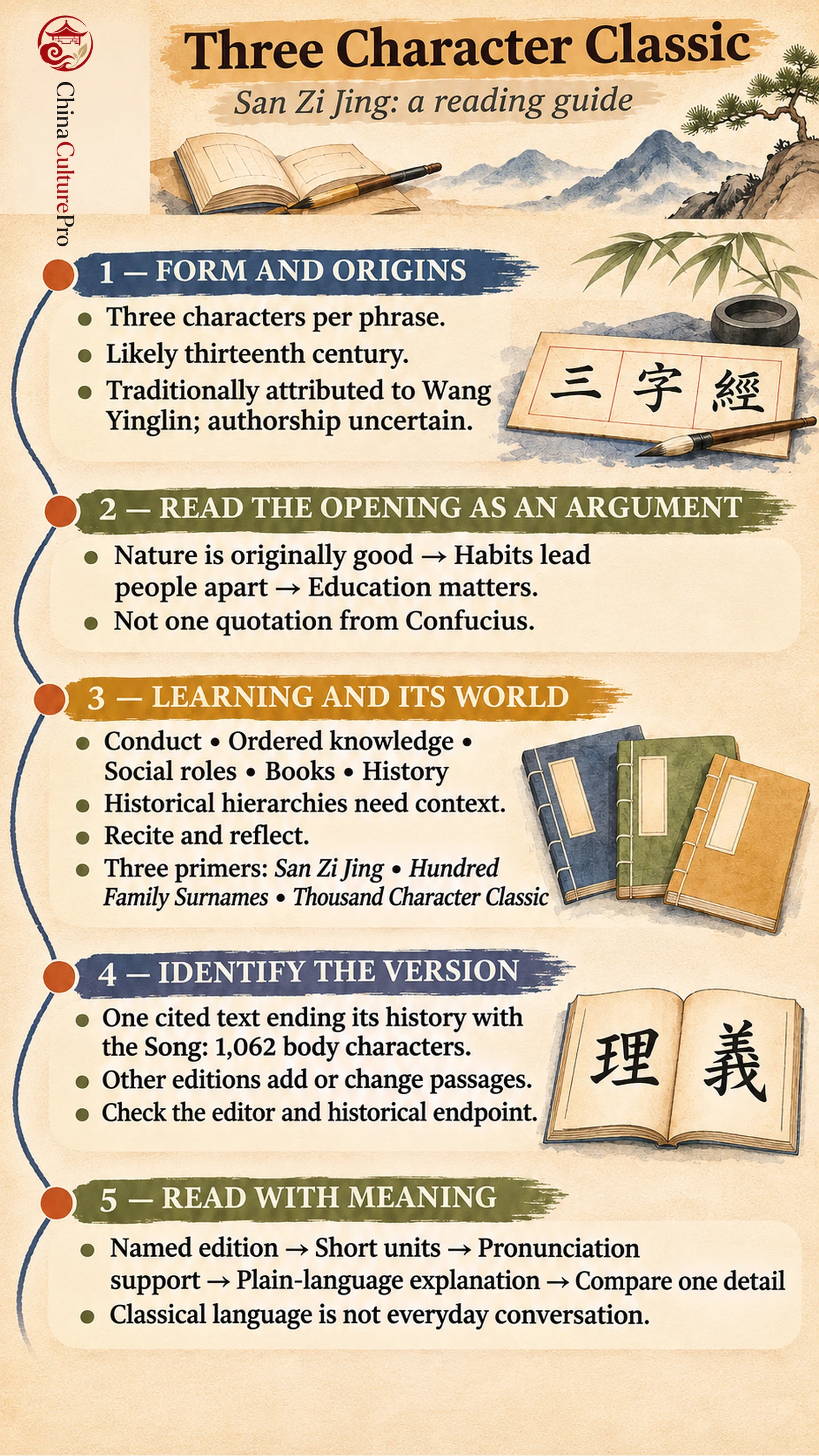
The Three Character Classic (三字经, Sān Zì Jīng) is a traditional Chinese primer written in three-character phrases. It combines an introduction to reading with moral instruction, classifications of the world, a curriculum of books and a compressed history of China.[1][2]
- Its form: Three characters make a phrase, not the whole book or necessarily a complete sentence.
- Its opening: Human nature, learned habits and the importance of education are linked together.
- Its origins: It is usually associated with the thirteenth century; traditional attribution does not settle its authorship.
- Its versions: Later editors added and changed passages, especially the historical sequence.
Read a named edition rather than assuming that every text called San Zi Jing has the same wording or length.
The Three Character Classic is memorable because its short units sound simple. Their meaning can be much denser: three characters may point toward a philosophical claim, a family story or a book that a student was expected to study later.
An English reader can start with the opening, then use the rest of the work as a window into traditional learning. The aim is to understand what the primer teaches, how it teaches and which edition you are reading. Its place in Chinese literature is that of an influential educational text, rather than a novel or collection of children’s adventures.
Origins, Authorship and the Meaning of the Title
The text is commonly attributed to Wang Yinglin (王应麟, Wáng Yìnglín, 1223–1296), a scholar of the Song dynasty (宋朝, Sòng Cháo). That is a traditional attribution, not an established signature on an unchanged original. The earliest composition is generally placed in the thirteenth century, and the original author remains uncertain.[1][2]
The Song period supplies a historical setting for that attribution. It cannot explain every line in a modern copy: later dynasties and events were incorporated as the text continued to circulate.
“Three character” describes the recurring phrase length. Several phrases can form a larger thought, so punctuation and explanation matter. The title is also translated as Trimetric Classic. Calling it a classic marks its standing as a traditional text; it does not mean that the primer itself is one of the ancient works it tells students to read.[2]
The Opening Lines: Nature, Habit and Education
The opening presents an argument in stages. It begins with goodness, turns to the differences produced by habits and then makes education consequential. These are concise moral and educational claims, not findings from modern developmental research.
The following Mandarin readings accompany the traditional-character text. The English glosses are brief explanations rather than an attempt to reproduce the three-character rhythm.[3]
| Original phrase | Mandarin reading | Brief meaning |
|---|---|---|
| 人之初 | Rén zhī chū | At the beginning of human life |
| 性本善 | Xìng běn shàn | Human nature is originally good |
| 性相近 | Xìng xiāng jìn | People are close to one another in nature |
| 習相遠 | Xí xiāng yuǎn | Acquired habits lead them apart |
| 苟不教 | Gǒu bù jiào | If there is no teaching |
| 性乃遷 | Xìng nǎi qiān | That nature can change |
| 教之道 | Jiào zhī dào | In the approach to teaching |
| 貴以專 | Guì yǐ zhuān | Concentrated, sustained attention is valued |
The goodness claim accords with the position of Mencius (孟子, Mèngzǐ). In his discussion of human nature, he compares its tendency toward goodness with water’s tendency to flow downward, while acknowledging that circumstances can force a different direction. The primer compresses a philosophical position; it does not mean that every action people take is good.[5] The fuller debate belongs to Mencius’s account of human nature.
The next pair has a different textual connection. The Analects (论语, Lúnyǔ), at 17.2, says that people are close by nature and become distant through habituation. Those words resemble the primer’s paired phrases, but the opening as a whole is not one quotation spoken by Confucius.[4] Reading the Analects separately makes that distinction clearer.
Taken together, the phrases ask readers to consider both a starting disposition and the effects of learning. Quoting only the first six characters leaves out the turn toward habits and teaching.
What the Text Teaches
The primer brings literacy and an ordered picture of the world together. Its ethics are rooted in Confucianism (儒家, Rújiā), but moral instruction is only one part of its content. The following areas recur in the cited text; they are a reading map, not a claim that every edition has five formally numbered chapters.[8]
| Area | What a reader encounters | What to notice |
|---|---|---|
| Learning and conduct | Duties of learners, parents and teachers; examples of dedication | Instruction is presented as a shared responsibility |
| Ordered knowledge | Numbers, seasons, directions, plants, animals and other sets | Classification helps arrange information for recall |
| Family and social roles | Kinship, age, rulers and subjects | Relationships are ordered through historical expectations |
| A curriculum of books | Named classical works and a sequence of further study | The primer points beyond itself |
| History and examples | Dynastic succession and exemplary learners | Compression leaves much unstated |
The family instruction includes filial piety (孝, xiào), or duties toward parents. Both filial traditions and Confucian ethics provide context, but understanding those traditions does not require endorsing every hierarchy in the primer.
For example, the cited text praises accomplished women while addressing boys as the expected learners. Its contrast reveals gender assumptions within the lesson. Read that framing as part of the document’s historical viewpoint, rather than turning it into a rule for children today.[6]
The dynastic section likewise offers a remembered sequence, not a complete account of political and social change. Use a Chinese dynasties timeline to orient names and periods, then investigate an individual claim in a fuller history.
Its Place in Traditional Education
Primers were used with private tutors and in small schools to introduce Literary Chinese. Memorization could bring character forms, pronunciations and subject matter together before a learner understood every allusion. This was preparation for further reading; it was not equivalent to a modern conversational-language course.[7]
San Zi Jing belonged to the familiar San Bai Qian (三百千, Sān Bǎi Qiān), a shorthand drawn from the titles of three elementary texts.[2]
| Primer | Main distinguishing feature |
|---|---|
| Three Character Classic | Three-character phrases joining instruction, knowledge and history |
| Hundred Family Surnames (百家姓, Bǎi Jiā Xìng) | A sequence of surnames used in elementary learning |
| Thousand Character Classic (千字文, Qiān Zì Wén) | A thousand-character composition arranged in four-character phrases |
The Hundred Family Surnames and Thousand Character Classic therefore share an educational setting with San Zi Jing while doing different textual work. The three titles do not describe interchangeable books.[7]
Recitation was important, but the primer also pairs reciting with thinking about the material. Sound and reflection need not be treated as opposites.[6] The wider story of Chinese education traditions includes changing institutions and access; the text’s popularity should not be mistaken for proof that every child received the same schooling. The imperial examinations belonged to a much longer path of study than this introductory primer alone.
Why Editions Differ
The linked text whose dynastic sequence ends with the Song contains 1,062 body characters, or 354 three-character phrases, when punctuation, headings and notes are excluded. That is a count of printed occurrences, not distinct characters. Later additions and substitutions mean that this total does not describe every edition.[6]
The historical endpoint is an especially visible clue. A later copy may extend the sequence through dynasties that had not existed when the early text was composed. Some early twentieth-century additions describe the fall of the Qing and the establishment of the republic.[1]
Small changes matter too. One edition ends the jade-polishing comparison with 不知理 (bù zhī lǐ), meaning not knowing principle; another has 不知義 (bù zhī yì), meaning not knowing what is right. The difference changes a word in the lesson, not merely a character’s simplified or traditional shape.[6][8]
Zhang Taiyan (章太炎, Zhāng Tàiyán) made deliberate revisions in a version with a preface dated 1928. An early example replaces a father teaching five sons with a different father teaching eight sons. His preface also discusses earlier additions and his own editorial changes. This is evidence of an actively revised teaching text, not a single frozen string of characters.[9]
When two copies disagree, first compare their editors, dates and historical endpoints. A script difference and a substantive revision require different explanations.
How to Read San Zi Jing Today
Treat the work as a short classical text with context, even if its rhythm feels approachable. Classical and modern Chinese differ in vocabulary and expression; short phrases can require substantial explanation.
Pinyin (拼音, pīnyīn), the Mandarin romanization system, helps with pronunciation; it does not by itself explain classical grammar or an allusion. A recording in another Chinese language variety may sound different while presenting the same written passage.
- Choose a named edition: Record the editor or translator, publication details and the text’s historical endpoint.
- Read a short unit: Start with two or four three-character phrases and identify how they connect.
- Use pronunciation support: Check tone-marked pinyin or a recording in the spoken variety you are studying.
- Explain before memorizing: Restate the passage in ordinary language and identify its examples or assumptions.
- Compare one detail: Check a variant wording, a cited classical passage or the treatment of a social role.
Contemporary interest has brought renewed discussion of the primer’s educational uses. That interest does not establish one best method or age for every learner.[10] When reading with a child, select a passage you can explain and discuss. If the immediate aim is enjoying a narrative, Chinese children’s stories may offer a more direct starting point; if a compressed example is puzzling, learning how literary allusions work can help unpack it.
FAQs About the Three Character Classic
Does “three character” mean the book has only three characters?
No. It refers to the recurring three-character phrase. Several phrases form a larger unit, and the complete work contains many such units.
Who wrote the Three Character Classic?
It is commonly attributed to the thirteenth-century scholar Wang Yinglin, but its original authorship remains uncertain. Later editors also expanded and revised the text, so an early attribution does not identify the maker of every line in a modern edition.
How many characters are in San Zi Jing?
The cited text whose history ends with the Song has 1,062 body characters, excluding punctuation and notes. Other versions differ, so identify the edition and distinguish character occurrences from distinct characters.[6]
Is San Zi Jing an easy modern Chinese textbook?
It is short and rhythmical, but it uses classical expression and compressed cultural references. A modern learner generally needs explanations as well as pronunciation support; it is not a substitute for a course in everyday conversation.
Sources
[1] University of Manchester Library. San zi jing: Chinese 23
[2] David K. Jordan, University of California San Diego. The Three-Character Classic
[3] Taipei Teaching Resource Center. San Zi Jing: opening passage
[4] Analects, Wikisource Chinese text. Book 17: Yang Huo
[5] Mengzi, Wikisource Chinese text. Gaozi I
[6] San Zi Jing, Wikisource Chinese text. San Zi Jing Shi Ju
[7] University of Manchester Library, Gregory Scott. Chinese Educational Texts of the Late Qing Dynasty
[8] San Zi Jing, Wikisource Chinese text. Xin Kan San Zi Jing
[9] Zhang Taiyan, Wikisource Chinese text. Chong Ding San Zi Jing
[10] Yi Sun, Guoqing Zhao and Xi Yang, Advances in Educational Research and Evaluation. Is the Three Character Classic Still Suitable for Contemporary Literacy and Enlightenment Education for Children?