


Quick Answer: What Is the Order of Chinese Dynasties?
A useful Chinese dynasty timeline combines an ordered list of ruling houses with periods when several states existed at once. The table below follows major starting dates rather than implying uninterrupted national succession.
- Sequence: Learn the familiar major dynasties, then restore the omitted intervals.
- Divided periods: Some labels describe several regimes rather than one ruling family.
- Parallel states: Overlapping dates often represent different territories under different courts.
- Dates: A founding proclamation, conquest and final abdication can produce different endpoints.
Early chronology includes uncertainty, and later dynastic boundaries did not match one permanent modern national outline.
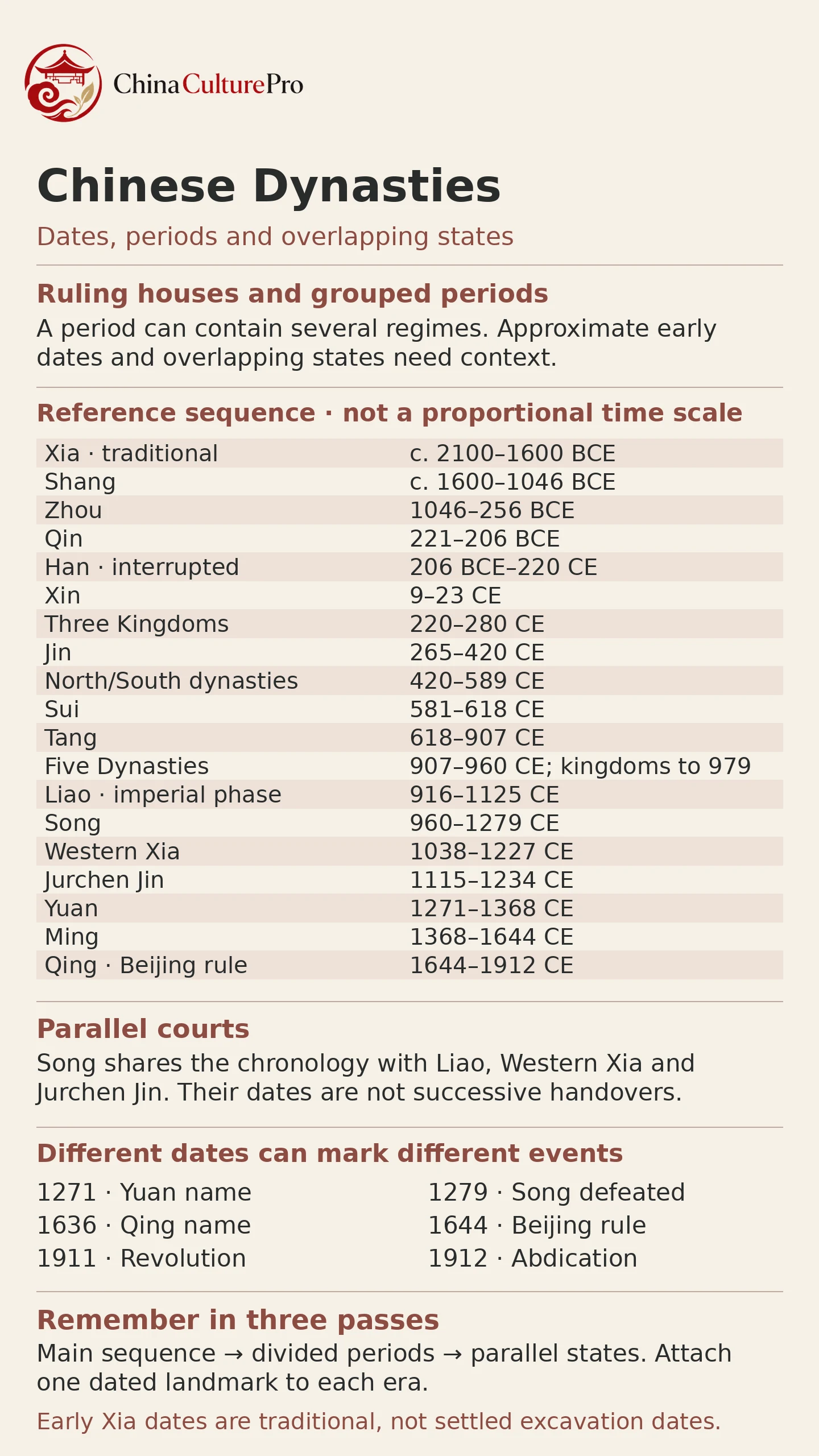
Dynasty names appear on museum labels, historical novels and accounts of Chinese art. They become much more useful when a reader can place them in time and recognize whether the label names one court or an entire divided period.
This is a reference to the major political sequence. The broader Chinese history guide follows social and cultural change across those boundaries.
What a Dynasty Timeline Actually Shows
A dynasty is a ruling house and the regime associated with it. A historical period can group several dynasties or states. A divided period still contains organized governments and cultural developments.
Successor rulers often justified their authority through the Mandate of Heaven (天命, tiānmìng): the idea that legitimate rule carried a moral responsibility that a failed ruling house could lose. This was a language of political legitimacy, not an objective test identifying the only government that existed at a given moment.[10]
The Mandate of Heaven guide explains that argument separately. Here, the practical rule is to read a dynasty label together with its dates and territorial context.
Chinese Dynasties and Major Periods in Order
Dates below use common teaching conventions. “c.” means approximately; BCE and CE correspond to BC and AD. The early traditional entry has a different evidential status from dynasties documented by contemporary inscriptions. The table includes major parallel regimes rather than every short-lived state.
| Dynasty or period | Dates | Landmark and context |
|---|---|---|
| Xia (夏, Xià) | c. 2100–1600 BCE, traditional | Traditional first dynasty; its identification with excavated sites remains debated.[3] |
| Shang (商, Shāng) | c. 1600–1046 BCE | Bronze ritual culture and royal inscriptions; late center at Anyang.[3] |
| Zhou (周, Zhōu) | 1046–256 BCE | Western and eastern courts; changing relationships between kings and regional states.[2] |
| Qin (秦, Qín) | 221–206 BCE | Imperial unification in 221 BCE; capital at Xianyang.[8] |
| Han (汉, Hàn) | 206 BCE–220 CE, interrupted | Long-lived imperial institutions; capitals at Chang’an and Luoyang.[1] |
| Xin (新, Xīn) | 9–23 CE | An intervening regime within the conventional Han span.[13] |
| Three Kingdoms (三国, Sānguó) | 220–280 CE | Several rival states; the period ends with the conquest of the remaining southern state.[1] |
| Jin (晋, Jìn) | 265–420 CE | A brief reunification followed by division and a south-based court.[1] |
| Northern and Southern Dynasties (南北朝, Nánběicháo) | 420–589 CE | A period grouping several northern and southern regimes.[1] |
| Sui (隋, Suí) | 581–618 CE | Reunification and large infrastructure projects, including canal construction.[2] |
| Tang (唐, Táng) | 618–907 CE | Chang’an and Luoyang; poetry, religious exchange and a powerful imperial court.[2] |
| Five Dynasties and Ten Kingdoms (五代十国, Wǔdài Shíguó) | 907–960 CE for the Five Dynasties; kingdoms continue to 979 | Short northern dynasties and overlapping regional kingdoms.[7] |
| Liao (辽, Liáo) | 916–1125 CE in the imperial convention | Khitan rule alongside other contemporary states.[4] |
| Song (宋, Sòng) | 960–1279 CE | Northern and southern courts; urban life, printing, painting and ceramics.[4] |
| Western Xia (西夏, Xī Xià) | 1038–1227 CE | Tangut-led state in the northwest; overlaps with Song and other regimes.[9] |
| Jurchen Jin (金, Jīn) | 1115–1234 CE | Jurchen rulers control northern China after the Song court retreats south.[4] |
| Yuan (元, Yuán) | 1271–1368 CE | Mongol dynasty proclaimed before the remaining Song court’s defeat in 1279.[5] |
| Ming (明, Míng) | 1368–1644 CE | Capitals at Nanjing and Beijing; court arts and far-reaching trade.[2] |
| Qing (清, Qīng) | 1644–1912 CE in the Beijing-based convention | Manchu dynasty; the imperial abdication follows the 1911 Revolution.[6] |
The table uses 1046 BCE as the Shang–Zhou transition convention. Older or differently framed references may use an approximate date around 1050 BCE. This is a reason to examine a source’s chronological convention, rather than silently blending its dates with another table.
The Main Overlaps and Interruptions
Han’s conventional span includes a break. Western Han (西汉, Xī Hàn) is normally dated 206 BCE–9 CE, while Eastern Han (东汉, Dōng Hàn) begins in 25 CE. The intervening Xin regime and the fighting around restoration should not disappear inside a label suggesting continuous government.[12]
The Three Kingdoms and Jin also overlap: Jin begins before it completes conquest of the remaining southern kingdom in 280. The Northern and Southern Dynasties are a grouping of states, not a single family called “Northern and Southern.” Sui likewise begins in 581, before the divided era conventionally ends in 589.[1]
Tang’s broad span includes the Wu Zhou (武周, Wǔ Zhōu) interruption of 690–705.[14] This later use of the Zhou name should not be confused with the ancient dynasty in the second millennium BCE.
For Song, the distinction is both chronological and geographical. Northern Song (北宋, Běi Sòng), 960–1127, rules from Kaifeng; Southern Song (南宋, Nán Sòng), 1127–1279, has its court at Hangzhou. Liao, Western Xia and Jurchen Jin belong beside Song in a timeline. They are not three dynasties that must be inserted between its start and finish.[4]
The two Jin names require particular care. The earlier dynasty is written 晋, pronounced Jìn; the Jurchen dynasty is 金, pronounced Jīn. An English label without dates or characters can conceal that difference.
Why Historical Timelines Use Different Dates
Several kinds of historical boundary coexist. Check what event the date marks before deciding two references contradict one another.
- Traditional reconstruction: Xia’s dates and its proposed relationship to the Erlitou archaeological culture remain debated. An excavated urban culture is not automatically a securely identified royal genealogy.[3]
- Imperial proclamation: The Yuan dynasty name is proclaimed in 1271; the conquest of the Southern Song is completed in 1279. The first date identifies the dynasty, while the second marks a later territorial result.[5]
- Earlier state versus imperial phase: The Liao entry uses the 916 imperial convention; references beginning in 907 follow an earlier stage of Khitan state formation. State development and a ruler’s imperial claim are different milestones.[4][15]
- Different parts of a divided era: The Five Dynasties end with the beginning of Song in 960, but regional kingdoms associated with the wider era persist until 979. Neither boundary makes those states sequential national rulers.[7]
- Name versus capital: The Qing name dates to 1636; the commonly used 1644 starting point marks the establishment of its Beijing-based rule. Its conquest was a process rather than a change everywhere on one day.[11]
- Revolution versus abdication: The revolution begins in 1911, while the Qing imperial abdication takes place on 12 February 1912. This table uses 1912 for that formal endpoint.[6]
For early material, the distinction between history and traditional legend is especially useful. For later transitions, ask whether a source dates a proclamation, a capital’s fall or the ending of a remaining court.
A Practical Way to Remember the Sequence
Use three passes rather than memorizing a short list as the complete political record:
- Learn the main spine: Memorize Xia, Shang, Zhou, Qin, Han, Sui, Tang, Song, Yuan, Ming and Qing as a preliminary sequence.
- Restore the divided periods: Insert the Three Kingdoms, Jin and Northern and Southern Dynasties after Han, and the Five Dynasties and Ten Kingdoms after Tang.
- Add the parallel states: Place Liao, Western Xia and Jurchen Jin alongside Song, then attach a dated landmark to each era.
For practice, find 1127 in the table and identify both the Song court’s transition and the contemporary Jurchen state. Then try 1271 and 1279: one is a proclamation and the other a conquest. These checks turn a remembered sequence into a usable chronology.
When dating an object, combine its dynasty label with the narrower date on its record. A broad court span does not establish the production year of every artifact associated with it, and a later copy can preserve the style of an earlier period.
FAQs About Chinese Dynasties
What was China’s first dynasty?
Xia is first in the traditional sequence. Shang is the earliest dynasty securely supported by its own surviving written evidence and archaeological remains. Qin is the first unified imperial dynasty; “first dynasty” and “first empire” answer different questions.[1][3]
Which Chinese dynasty lasted longest?
Zhou has the longest conventional span among the major dynasties listed here: 1046–256 BCE, about 790 years. Its kings’ effective authority changed greatly across that span; the duration should not be read as 790 years of uniform centralized control.
How many Chinese dynasties were there?
There is no single useful total without a counting rule. A short teaching list, a list including concurrent northern and southern regimes, and a catalog of every claimant count different things. The table gives a major-period reference rather than claiming an exhaustive total.
When did dynastic rule end?
The Qing emperor’s abdication in February 1912 marks the conventional end of the imperial dynastic era and the republican transition. The continued residence of the former court in the Forbidden City did not mean that Qing government still ruled China.[6]
Sources
[1] University of Washington Press. Observing the Unseen: Simplified Chronology of Chinese Dynasties
[2] Columbia University, Asia for Educators. China: Timeline of Historical Periods
[3] Asian Art Museum. An Introduction to Ancient China
[4] Metropolitan Museum of Art. China, 1000–1400 CE: Chronology
[5] Metropolitan Museum of Art. Yuan Dynasty, 1271–1368
[6] Palace Museum. The 1911 Revolution and the Qing Abdication
[7] Cambridge History of China. The Southern Kingdoms between the Tang and the Song, 907–979, chapter overview
[8] Xixian New Area Administrative Committee. Qin Xianyang City Archaeological Site
[9] Library of Congress. The Economy of Western Xia: A Study of Eleventh- to Thirteenth-Century Tangut Records, catalog
[10] Asian Art Museum. An Introduction to the Zhou Dynasty
[11] Palace Museum. The Shunzhi Emperor and Qing Founding Context
[12] Metropolitan Museum of Art. Han Dynasty, 206 BCE–220 CE
[13] Smithsonian National Museum of American History. Huo Ch’uan Coin of the Xin Dynasty, 9–23 CE
[14] Archontology. Zhou: Emperor, 690–705
[15] University of Washington Press. Slapping the Table in Amazement: Chronology of Chinese Dynasties